




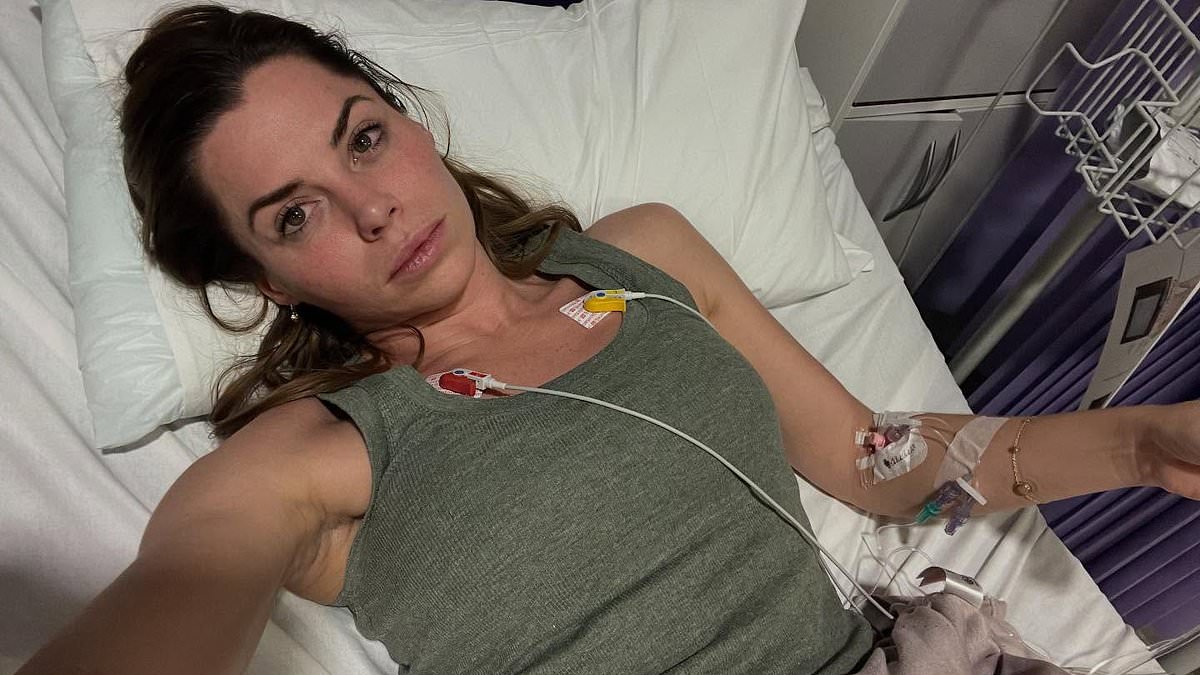

Former FHM star and Miss Great Britain Louise Glover has announced she is awaiting ‘high risk surgery’ to remove a life threatening tumour.
The 42-year-old explained how she has been in hospital in Oxford for more than a month ahead of the operation which is now taking place Friday, February 6.
In an update Louise confirmed the surgery would begin at 8am and take four hours, saying she was ‘staying positive’ as she looked forward to her birthday on Sunday.
Sharing a clip to Instagram, Louise said she’d been keeping her illness a secret as she struggled to come to terms with it, and also battled agonising symptoms that have left her at constant risk of suffering a heart attack or stroke.
According to the NHS adrenal glands make a number of important hormones, which are released into the bloodstream to control blood pressure and metabolism.
The rare tumour, known as a Pheochromocytoma, can then cause them to release too much, which often results in heart palpitations and high blood pressure.
Former FHM star and Miss Great Britain Louise Glover has announced she in hospital awaiting ‘high risk surgery’ to remove a life threatening tumour
The 42-year-old explained how she has been in hospital in Oxford for more than a month ahead of the operation which is now taking place Friday, February 6 (pictured 2025)
In an update Louise confirmed the surgery would begin at 8am and take four hours, saying she was ‘staying positive’ as she looked forward to her birthday on Sunday
Louise said: ‘It’s called Pheochromocytoma, it is one in a million rare. So basically, I’m stuck in fight or flight and I’ve been stuck in it for 18 months’.
‘The symptoms have been there for 19 months, the heart palpitations, the sweating banging headaches, its brought me to her knees’.
She went on to explain how she also vomiting and collapsing before eventually doctors discovered the cause and would now be removing the tumour as well as her adrenal gland.
Louise captioned a post last week ‘34 days in hospital with a rare active tumour called Pheochromocytoma — diagnosed in only 1 in a million people each year’.
‘The tumour is growing in one of the most dangerous places in the body: my adrenal gland, where it’s been over-secreting adrenaline and other hormones daily for the last 18 months.
‘This has caused: dangerously high heart rate & blood pressure, high risk of stroke & heart attack , brought on Osteoporosis & type 2 diabetes. I’m now awaiting high-risk surgery at Oxford hospital with specialties to remove the tumour and adrenal gland, hopefully in the next few weeks’.
She went on: ‘Until then, specialists are working to stabilise my heart rate and blood pressure, as surgery can trigger unpredictable adrenal surges. This journey has been life-changing — and I’m sharing it to raise awareness, honesty, and strength.
Before going on to ask fans for their support due her being unable to work which had left her at risk of losing her houseboat.
According to the NHS adrenal glands make a number of important hormones, which are released into the bloodstream to control blood pressure and metabolism (pictured 2023)
She has also battled agonising symptoms that have left her at constant risk of suffering a heart attack or stroke
Sharing a clip from her hospital bed to Instagram, Louise said she’d been keeping her illness a secret as she struggled to come to terms with it
Louise captioned a post last week ’34 days in hospital with a rare active tumour called Pheochromocytoma — diagnosed in only 1 in a million people each year’
Louise finished as a finalist in Miss Great Britain in 2006 before moving on to modelling work.
As well as FHM Louise appeared in Bizarre, Maxim, Loaded, and tabloids such as the News of the World, The Sun.
Pheochromocytoma is rare, suffered by about 100 patients a year, and is diagnosed when a non-cancerous tumour grows in one of the two adrenal glands in the body.
It is often difficult to diagnose because it triggers a broad range of differing symptoms, which can be associated with a range of other conditions — including menopause.
Typical symptoms include headaches, sweating and heart palpitations — but studies show only 17 percent of patients have these. Other signs include anxiety, high blood pressure, abdominal pain, nausea and weaknesses.
The condition can also cause heart problems because it can cause the adrenal glands to manufacture excessive amounts of adrenaline — stimulating the heart to beat faster.
It is normally diagnosed using scans of the adrenal glands, with any masses that are found removed during surgery.
If it is not treat, there is a risk it can cause permanent damage to the heart muscle — leading to complications such as an arrhythmia, or irregular heart beat, and heart disease. In serious cases, the condition can also cause heart failure.
Read the full article here