



From the power of the Catholic Church, including brutality against children and women, to a woman in Northern Ireland bringing her son to a punishment shooting by a paramilitary group, and Irish writer Edna O’Brien recounting her controversial life, Irish documentary director Sinéad O’Shea doesn’t shy away from topics that are likely to cause debate. Her new doc, All About the Money, which world premieres on Sunday in the World Cinema Documentary Competition of the Sundance Film Festival, is no different.
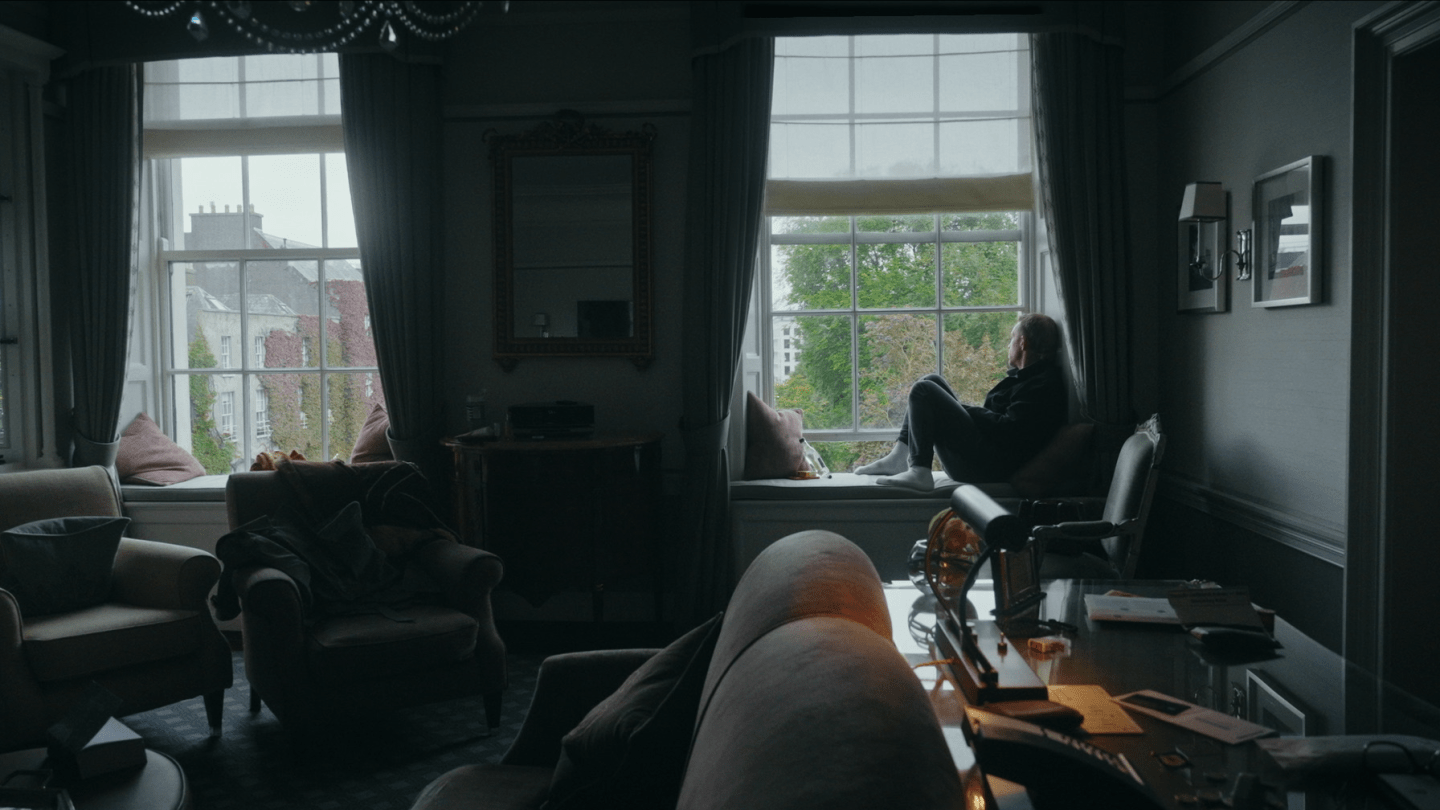
Exploring the themes of money and revolution, the doc follows the journey of “activist” and “revolutionary” James Cox Chambers, who goes by Fergie Chambers, the great-grandson of James M. Cox, the ex-governor of Ohio and Democratic presidential nominee in 1920. That makes Chambers a member of the family, whose holdings include Cox Enterprises. Also part of the story is his Palestine and anti-Israel activism, which has drawn criticism, along with the political comeback of Donald Trump.
Sundance describes All About the Money as “a documentary for our times of concentrated wealth and power” and “a fascinating study of the power money has to make and destroy, and what access to astronomical wealth does to a person and those around him.” The doc follows Chambers as he — the son of one of America’s wealthiest families — creates a Communist revolutionary base in rural Massachusetts with the goal of disrupting the capitalist system before his journey takes him elsewhere.
Claire McCabe, Harry Vaughn, Katie Holly, and Sigrid Dyekjær produced All About the Money with O’Shea, who wrote and directed the doc. SOS Productions and Real Lava are co-producers.
O’Shea talked to THR about the genesis of All About the Money, what she learned about the power of money, and how she sees her role as a documentarian.
The director found out about the man at the core of the film in an unusual way. “A friend of mine was living, briefly, in that project of his,” she recalls. “She’d moved there during COVID. I’m a journalist and a filmmaker, and I just thought that sounds strange and very intriguing. When I found out who was financing it, I googled him. And I just thought the combination of things was so extraordinary. This guy, who’s coming from a family who are so much the establishment within the United States, was so opposed to that. And he wasn’t just saying it, he was really following through with his actions.”
O’Shea wrote to him, and he agreed to be filmed. “I wrote, would you like me to come and film? And he just said yes to me,” she tells THR. Did he ever see any of her past films? “I sent him a link to my first film, which is called A Mother Brings Her Son to Be Shot, which I actually thought might give him some scope to compare, because again I knew it was going to be shot over a period of time, and I was trying to document change and talk about an alternate political system. But I don’t know if he ever watched it, because he never mentioned it.”
Chambers tends to not hold back in sharing his thoughts, which certainly helps with a documentary. “One of the things that was so appealing about this project was just how candid and frank he is,” the director highlights. “He kind of revels in pulling away the curtain.”
Case in point is a clip from All About the Money, which THR exclusively premiered recently, in which O’Shea asks Chambers if he ever worries about running out of money. “He is operating on a different sphere or plane,” she says. “Ironically, Fergie isn’t a very materialistic person. He spends a lot of money, but I would not [call him] a materialistic person at all. I think there are lots of people with much less money who are more conspicuous consumers. So it was amazing for me to hear that he was so certain, so dismissive about [not running out of] money.” Watch the scene from All About the Money here.
The members of the base that Chambers bankrolled in rural Massachusetts were “so kind and helpful and cooperative and enthusiastic,” O’Shea says. “One of them I remember saying to me, ‘I don’t know what took so long for someone to decide to make a documentary here’. I felt that there was a pride in the work they were trying to do there.”
The Massachusetts setting was “so beautiful, and I hope that comes across in the film,” the filmmaker notes. “The landscape is idyllic, and it does evoke the early United States that the settlers came to. For me, it really evoked The New World by Terrence Malick, with all this lushness and forest.”
Chambers may be a member of the 0.01 percent, as the opening moments of the film reveal, and the doc shows him in the U.S., then moving to Tunisia where he buys a soccer club after his pro-Palestine activism led to arrests following what critics called an ill-conceived protest of an Israeli defense contractor, and Ireland. However, the director emphasizes the universal themes of his story. “I always felt that there was something in this story that represented something much bigger than the story itself,” she says. “The project was focused on capital, on economics, and it was focused on revolution and change. These are concepts that would have just seemed almost laughable a few years ago as subjects to be taken seriously and to be discussed, whereas now it seems not unreasonable to be thinking about these things.”
After all, economic inequality has loomed large in both the news cycle and public consciousness. “There’s a very important statistic at the very start of this film about the wealth gap in the United States,” O’Shea points out. “It’s probably going to be out of date in a year and is probably going to have expanded even further. The statistic is that 1% of the population owns as much wealth as 90% of the population combined. The rich cannot help but get richer, [and] that gap is getting more and more difficult to bridge.”
In her approach to Chambers and his activism, O’Shea says she felt that “the most important thing was to be as truthful and as journalistic as possible, and to report as faithfully as I could what I was seeing.” But her approach is not that of traditional observational documentary. “I do believe that a director interrupts whatever is happening, the camera interrupts whatever is happening before our eyes,” she says. “So I wanted to acknowledge my presence and that I was there, disrupting and asking questions. But I also felt that in totality the film had to represent what I had seen, what the camera had seen, and it was just very important to keep any agenda away from it.”
And she went with the flow of world news. “I had to give some context politically at points. Of course, I didn’t anticipate that October 7 was going to happen,” she notes. “But on the other hand, of course, I was very aware of what was happening in the U.S. regarding the elections, and that it was clear that Donald Trump was going to come back, that people were extremely dissatisfied, and that so many people felt they were worse off that they really sought some kind of alternative.”
Another idea for the title of the film was Eye of the Needle, but that “just seemed a bit obscure,” O’Shea recalls in discussing how she landed on All About the Money. Eye of the Needle is a reference to the Bible, where a rich man is told that he has no more chance of getting into heaven than a camel has of passing through the eye of a needle.
As such, the alternative title idea reflects the central conundrum that the film explores, just as the final title of the doc does. “It’s a very rich idea [to consider] how one can be good,” the filmmaker says. “How do you be in this world? How does Fergie be with all these resources? There are all these resources, but what does he do? How does he be a good person?”
Chambers wasn’t enthusiastic when he saw All About the Money, and there is a special twist at the end of the film, which we will not spoil here.
“I can maybe see his perspective,” O’Shea tells THR about his negative reaction. “He just feels there’s not enough politics in the film. … He is someone who cares very deeply about his political beliefs, and he doesn’t hold them casually. He is very frank in this film, and he shares a lot. So, I admire him for that.”
That is actually something she gives people a lot of credit for in her work as a documentary filmmaker. “I just always feel that about everyone that I work with in any documentary,” O’Shea says. “I just think they’re brave and they’re generous, and it impresses me that they have the resources within themselves to share.”
Read the full article here