



You can hardly blame the young leads of Star Trek: Starfleet Academy for being chaotic. They’re essentially first-year college students, most of them adjusting to life away from their home planets for the first time and figuring out who they want to become. Confused and inconsistent is exactly what they’re supposed to be at this stage.
You can, on the other hand, certainly blame the Paramount+ show itself for being messy. Created by Gaia Violo, the series is a hybrid of sci-fi spectacle and teen drama that’s admirable in its ambitions but shaky in its execution, at least in the first six hours (of 10) sent to critics. But much like Starfleet’s brightest cadets, it’s too full of charm and promise to dismiss outright. You just hope to see it live up to its full potential someday.
Star Trek: Starfleet Academy
The Bottom Line
A cast worth following to the ends of the galaxy.
Airdate: Thursday, Jan. 15 (Paramount+)
Cast: Holly Hunter, Sandro Rosta, Karim Diané, Kerrice Brooks, Bella Shepard, George Hawkins, Zoë Steiner, Gina Yashere, Tig Notaro, Robert Picardo, Oded Fehr
Creator: Gaia Violo
Starfleet Academy unfolds sometime in the 32nd century, roughly concurrent with the later seasons of Paramount+’s Star Trek: Discovery but centuries after most of the rest of the Star Trek canon. As the show gets underway, the titular school is preparing to reopen its doors under the leadership of chancellor Nahla Ake (Holly Hunter), having shut down a century earlier amid a galaxy-wide catastrophe known as the Burn.
If the previous paragraph made perfect sense to you, you’re probably a Star Trek fan and will surely be pleased to see some familiar faces here, including Tig Notaro’s Jett Reno, Oded Fehr’s Charles Vance and Robert Ricardo’s Doctor, as well as references to events of several other Star Trek properties. If all of that sounded like gibberish, come on in anyway. Starfleet Academy requires no previous buy-in to the franchise — just a high tolerance for lore dumps and alien names you can’t spell.
Nahla has her issues with Starfleet, having quit the force 15 years earlier after working on a criminal case that separated a desperate mother (guest star Tatiana Maslany) from her son. Now the boy is 21, and despite the lengthy rap sheet and rebellious attitude he’s acquired from a life on the run, Nahla offers Caleb (Sandro Rosta) a spot at the school. In him, she sees an opportunity to right her own past wrong; in her work, she sees a chance to chart a more compassionate path for the galaxy as a whole.
By far the best things the show has going for it — the thing that makes you eager to forgive any other shortcomings along the way — are its characters, who tumble into the Alex Kurtzman-directed premiere already fully formed.
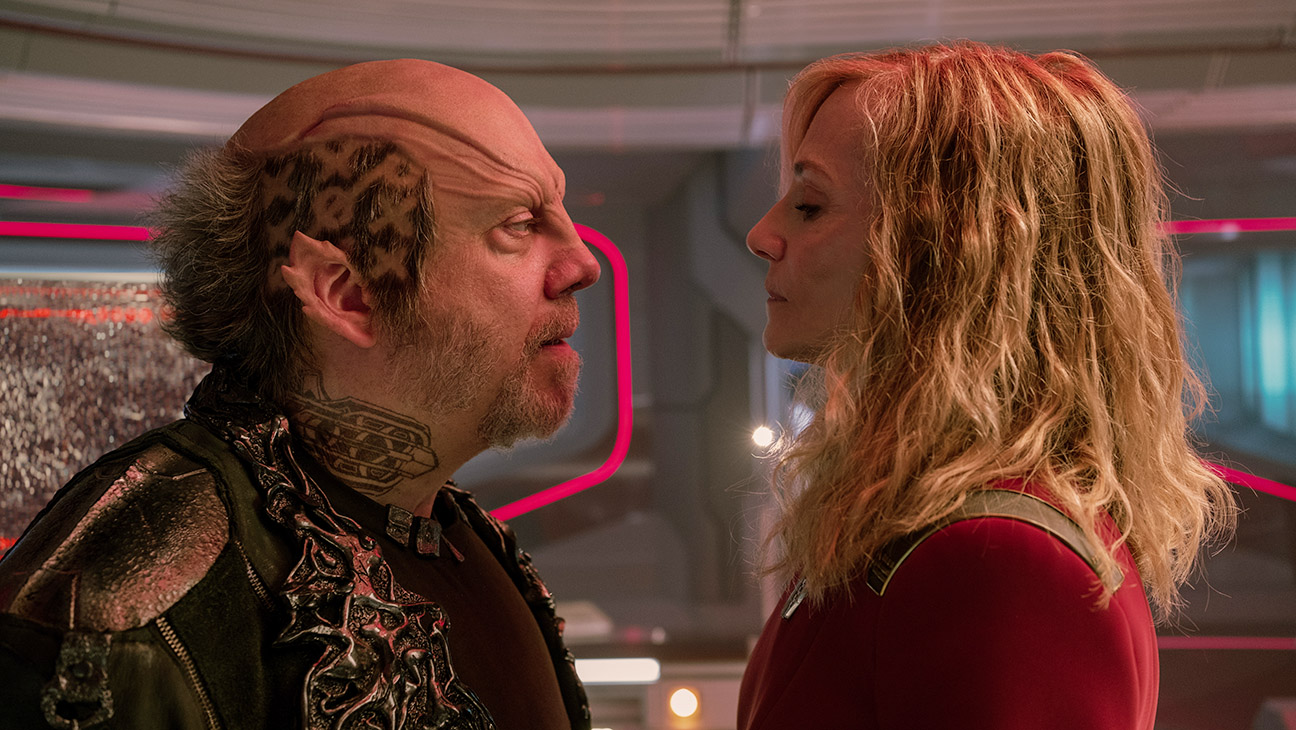
Hunter is a total delight as the half-Lanthanite Nahla, whose tiny stature, playful humor and disregard for propriety (this is a woman who keeps inventing new ways to slouch into chairs) belie her quiet strength as a Starfleet officer. Picardo, as the perpetually cranky holographic Doctor, and Gina Yashere, as ferocious half-Klingon cadet master Lura Thok, are almost as entertaining — though no one is having more fun than special guest star Paul Giamatti as Nus Braka, a Klingon-Tellarite pirate who delivers every line like he’s putting on a one-man show and punctuates every other sentence with a clack of his silver-tipped fingers for good measure.
Of the kids, Karim Diané makes an immediately touching impression as Jay-Den, a painfully shy Klingon with a very un-Klingon interest in medicine, as does Kerrice Brooks as Sam, a bubbly hologram who’s new to the “organic” world and therefore reacts to every single experience like a baby tasting ice cream for the first time. While most of the younger set evoke familiar tropes — Genesis (Bella Shepard) is the overachieving daughter of a prominent family, Darem (George Hawkins) the rich bully with mean parents, Tarima (Zoë Sadal) the sheltered princess — all are embodied by actors lovable enough to make those archetypes fresh and fun again. Collectively, they make for a cast I was excited to see interact, especially since the sparks between them — whether as instant besties, enemies or star-crossed lovers — fly so fast and furious.
But Starfleet Academy unfolds less like a serialized ensemble drama than a string of connected standalone stories, each focused on a different main character. The advantage is that it allows the series to go deep into Jay-Den’s poignant backstory as a refugee (in the single most moving episode thus far) or to delve into Sam’s uniquely digital point of view via cute overlaid graphics, without getting tripped up by lengthy detours to, say, Caleb’s search for his mom or Genesis’ struggle with daddy issues.
The disadvantage is that it means most of the characters are sidelined most of the time, and their relationships made to develop largely offscreen — to the extent that it’s not always clear if they’re actually close, or if they’re just the only six students to whom anything interesting ever happens aboard the U.S.S. Athena. It’s sweet to see the gang take Sam out partying for the first time, but it’d be sweeter if we saw more of Sam interacting with her pals already and didn’t have to take her word for it that she loves them more than anything in the universe.
Starfleet Academy finds variously funny and profound ways into the “teachable moments” that Nahla and her colleagues are always on the lookout for, turning a prank war into a demonstration of the subversive power of empathy and a high-stakes crisis into a lesson in cross-cultural understanding. If it seems every moral ultimately turns out to be some variation on “Be yourself,” it tracks with the coming-of-age process of young adulthood.
But the specifics of those life lessons can get weighed down by sci-fi jargon and bursts of confusing action amid dark green screen sets. (When the lights aren’t going off for enemy attacks or glorified games of laser tag, Starfleet Academy prefers to backlight every cast member in a perpetual magic-hour halo.) While the dialogue is never so dense that I felt completely lost, I found myself checking out every time the characters spent too much time explaining complicated scientific concepts or deep-cut Trek lore.
Fortunately, the show has, in its talented young cast, a built-in north star. “These kids are inheriting a broken world they did not create but have to clean up,” reflects Vance, and his words resonate particularly at a time when our own future looks awfully dark and uncertain. In these students’ intelligence and courage and kindness, he and Nahla see hope of a better and brighter tomorrow. In their warmth and brightness and magnetism, Starfleet Academy has a crew worth following to the ends of the universe.
Read the full article here