


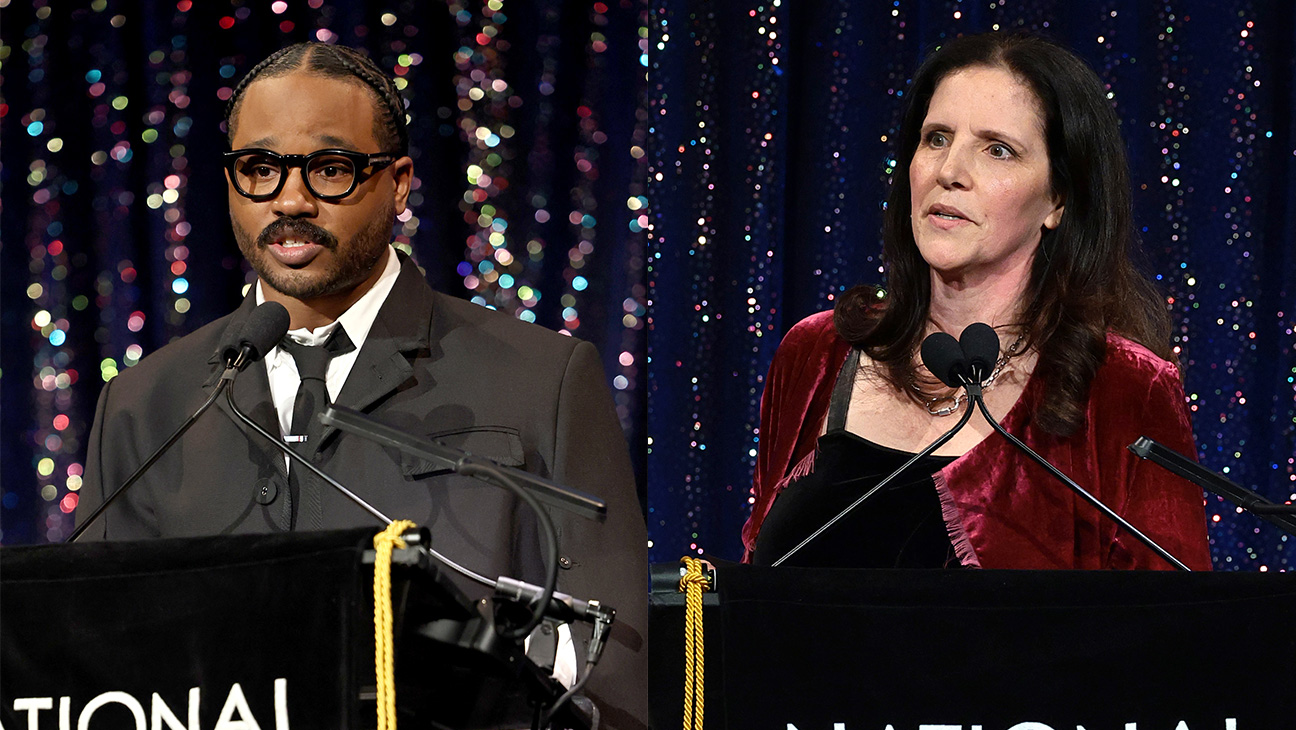

While the 2026 Golden Globes was light on political commentary, apart from some barbed remarks in host Nikki Glaser’s monologue, just days later, at the National Board of Review awards gala in New York, winners used their time onstage to speak about the killing of Renee Good by an ICE agent in Minneapolis, Iran’s deadly crackdown on protesters and even Nicolás Maduro being removed from power in Venezuela.
Sinners writer-director Ryan Coogler, being honored for best original screenplay, was arguably the highest profile winner to directly address Good’s death. Good was fatally shot by an ICE agent in Minneapolis last week as she was moving her car in an incident that a number of political figures and commentators have characterized as murder. Trump administration officials have said the officer was acting in self-defense and accused Good of “domestic terrorism.” Good’s death has led to protests in Minnesota and beyond.
Coogler, who had been previously honored by the National Board of Review for his 2013 directorial debut Fruitvale Station, alluded to that film as he began his speech, indicating he was distracted by the news.
“I was young and naive, and I thought the movie was going to change the world and make it so you didn’t see people executed by civil servants on camera anymore. I was proven wrong again and again. And it’s tough to be here and not think about Minnesota,” he said, recalling people he knew from the state. “My heart is broken. I can’t be here and not think about Renee.”
Coogler went on to deliver an emotional speech in which he recalled making the film for his late Uncle James, who he said he wasn’t with when he died and was instead doing post-production on a film, and how he was inspired to start writing by his college professor Rosemary Graham, who attended the ceremony with him.
Filmmakers Laura Poitras and Mark Obenhaus, on hand to accept the best documentary award for their Seymour Hersh film Cover-Up, also spoke about Good’s death, with Obenhaus wearing an “ICE Out” pin like the ones donned by a handful of stars at the Globes.
Poitras also addressed the “schizophrenic” nature of this awards season as these gala ceremonies are taking place against the backdrop of tragic, contentious news in the U.S. and overseas.
“I think it’s kind of schizophrenic, but I think we have to use the platform to talk about the reason we made the film, which is that the essential right of press freedom in this country, we can’t take it for granted, because it’s not a given that we will have it, and these rights are being stripped away,” Poitras told The Hollywood Reporter ahead of Tuesday night’s event. “When we see what happened to Renee Good, being killed in cold blood for a protected right of protest is terrifying. So why am I here tonight? Is to say that to you and to say that to cameras and use the platform wisely.”
And she shared that she was “surprised” that the Globes didn’t feature more people talking about these serious incidents.
“I was surprised that there wasn’t more noting of what a really terrifying moment we’re in, given both the regime change that’s happened and the killing of a protester in broad daylight.” Poitras told THR. “I think we should be talking about those things.”
Obenhaus added that their film has “met its moment” in a way that they hadn’t anticipated when they started working on it.
“The message of the film is about what’s going on right now and the suppression of journalism,” he said. “It’s always been the case but not to the degree that there’s this much suppression of free expression.”
Poitras added, “One thing that I feel is important to say and it’s something that Sy [Hersh] has said throughout his career. We do have a right. Press freedom is an enshrined right in this country. So when you see journalists that don’t speak maybe as freely as they think or when you see something like 60 Minutes withdrawing a news program because of government pressure, that is the press hurting the press.”
Onstage she added, “Journalism is not repeating government narratives. We all know that the CIA is capable of regime change, kidnapping, stealing resources. That’s really not news, and it should not be presented as that. It’s illegal, and it should be presented in the long historical context in which these actions are happening.”
And Iranian filmmaker Jafar Panahi, on hand to accept the best international film award for It Was Just an Accident, spoke strongly about the violent crackdown on protesters in his native country.
“The Islamic Republic has caused a bloodbath to delay its collapse,” Panahi said through a translator. “Bodies are piling up on bodies, and those who have survived are searching for signs of their loved ones through mountains of corpses. Today, the real scene is not on screens, but on the streets of Iran. This is no longer a metaphor. This is not a story. This is not a film. This is a reality written with bullets day after day.”
“In accepting this award, I consider it my duty to call on artists and members of the global film community to speak out and not remain silent,” he continued. “Use any voice and any platform you have. Call your governments, call on your governments to confront this human catastrophe rather than turn a blind eye. Do not let blood dry in the darkness of amnesia.”
Multiple recipients expressed their support for Panahi from the stage, with Train Dreams writer-director Clint Bentley seemingly departing from his best adapted screenplay speech midway through, saying “I had a fucking thing I was going to say.”
“When the world is kind of burning down and it can feel very frivolous at times,” he added. “I just want to say thank you most of all to Mr. Panahi for reminding us for what we can do with the medium and what it can be and why it can be worth doing.”
The National Board of Review winners, announced in early December, like most awards ceremonies so far this season, were dominated by One Battle After Another, which won best picture, director (Paul Thomas Anderson), actor (Leonardo DiCaprio), supporting actor (Benicio del Toro) and breakthrough performance (Chase Infiniti).
Other winners included Rose Byrne (best actress for If I Had Legs I’d Kick You) and Inga Ibsdotter Lilleaas (best supporting actress for Sentimental Value). The ceremony, hosted by Willie Geist, took place at New York’s Cipriani 42nd St.
Read the full article here