





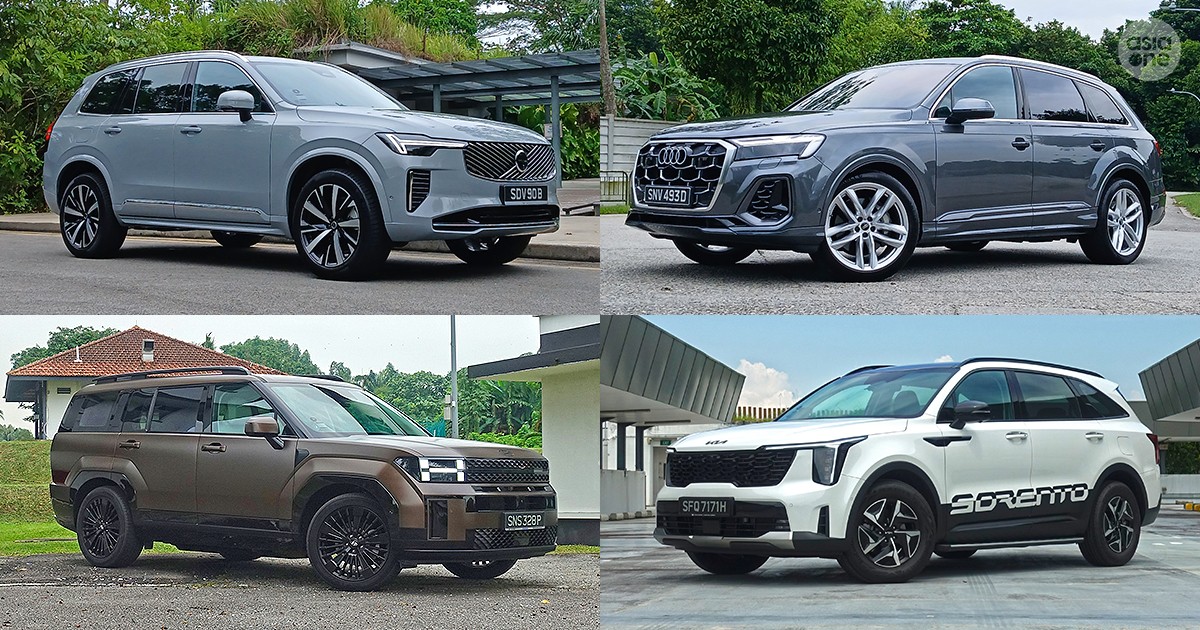


If you want a car that can ferry members of your extended family, but don’t want to go for a traditional MPV, then a seven-seater SUV might be what you’re looking for.
The appeal of seven-seater SUVs lies mainly in the fact that they are large enough to accommodate more people than a regular SUV, but don’t have the dowdy image that most MPVs convey.
Some seven-seater SUVs also have all-wheel-drive capability, making them ideal choices for active families who like to go off the beaten track for their lifestyle pursuits.
But even in an urban environment like Singapore, seven-seater SUVs are useful for those with big families who need something practical and spacious.
Volvo XC90
What is it? Volvo’s XC90 is an all-time favourite that has received a substantial refresh.
Why is it worth considering? Those who are in the know would acknowledge that the Volvo XC90 is one of the finest choices around for those who want a seven-seater SUV that ticks all the boxes.
The current generation model has been around for more than a decade, but such has been its appeal that Volvo has deemed it wise to only give it major updates instead of coming up with an all-new model.
In Singapore, you can currently have the XC90 with either a regular petrol engine, or a plug-in hybrid powertrain.
Volvo XC90 B5 Ultra
- Power: 250hp
- Torque: 360Nm
Volvo XC90 T8 Plus
- Battery size: 18.8kWh
- Electric range: 64km
- Combined power: 455hp
- Combined torque: 709Nm
The one featured here is the regular B5 Ultra petrol model, and it does an excellent job in this application. There’s adequate power to move what is admittedly a large car, and the delivery is silky smooth as it gets you up to speed without much fuss.
Equally smooth is the XC90’s ride quality, with the car’s suspension featuring something called Frequency Selective Damping (FSD), which can adjust the damping force of the shock absorbers in real time to handle any road condition.
The result is a car that’s extremely comfortable under most circumstances, and it makes the XC90 a thoroughly pleasant drive.
Visually, the updated XC90 can be recognised through its new front grille and headlight design that gives it a distinctive face, but otherwise it’s the same classic shape that has made it a firm favourite for many over the years.
It’s the same story inside too, with the only significant change being the new 11.2-inch infotainment screen with an updated Google-based Android Automotive operating system software.
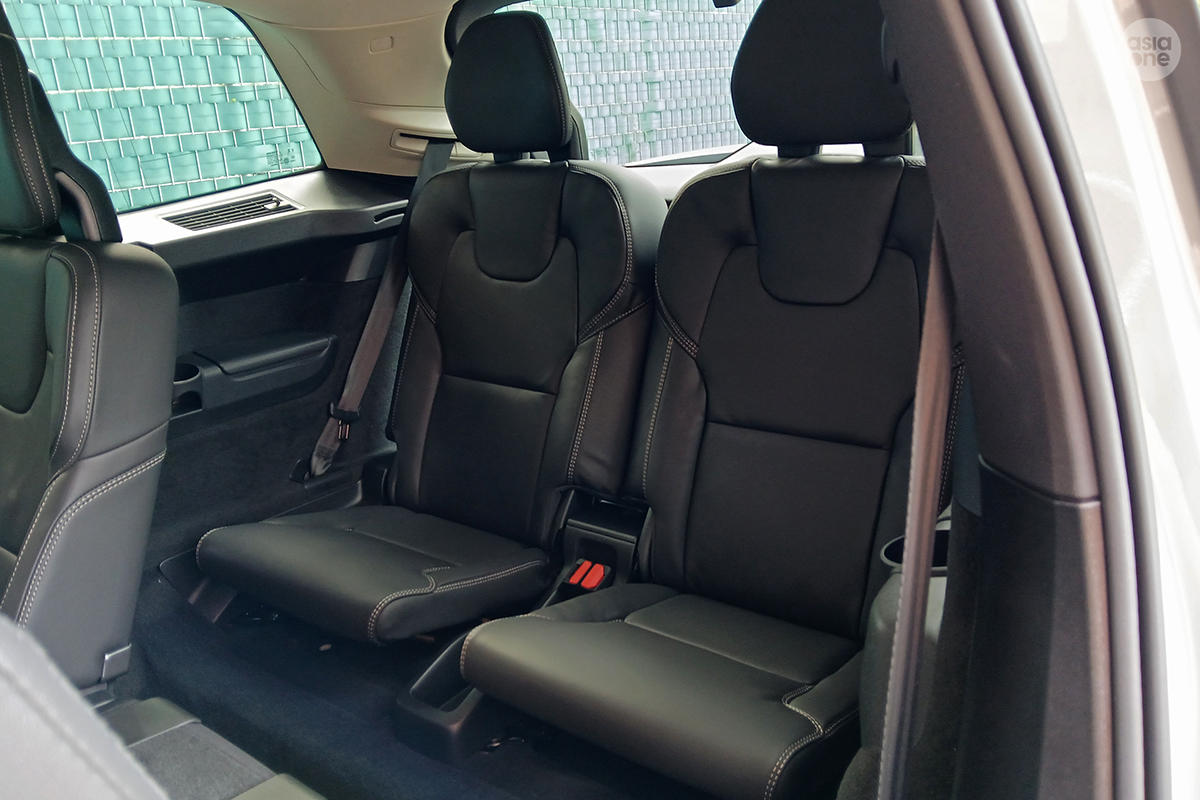

The third row of seats are comfortable enough to fit two average-sized adults, and access is incredibly straightforward. There’s also a built-in child booster seat in the centre of the second row of seats, which makes life so much easier for parents.
It’s thoughtful little touches like these that make the XC90 such a family favourite. While the petrol-powered XC90 B9 Ultra’s price tag of $439,000 with COE (as of December 2025) can be a bit expensive, its excellent well-rounded capabilities make it a seriously worthy consideration as a family SUV.
Audi Q7

What is it? Audi’s mildly updated Q7 SUV lets you drive your family around in luxurious comfort.
Why is it worth considering? Like the Volvo XC90, the Audi Q7 has been around for a while, and it has received a mid-life update to keep it refreshed and relevant.
The Q7 is a pretty sizeable car, measuring in at over 5 metres long, and in Singapore you can have it in three flavours: two regular petrol variants and the high-performance SQ7 model.
Audi Q7 2.0
- Power: 265hp
- Torque: 370Nm
Audi Q7 3.0 S Line
- Power: 340hp
- Torque: 500Nm
Audi SQ7 4.0
- Power: 507hp
- Torque: 770Nm
The car tested here is the mid-range 3.0 S Line model, and the engine feels just about right for a car like this. Being rather heavy at around 2.1 tonnes, there is a slight lag upon initial acceleration. But that is quickly dispensed with once the torque kicks in and the engine helps pull the car along as you make up speed rather briskly.
For such a big car, the Q7 is surprisingly easy to drive. Its demeanour is somewhat relaxed, with its light steering and excellent ride quality thanks to its adaptive air suspension that helps smooth out road imperfections.
On the outside, the facelifted Q7 gets a new front grille and matrix LED headlights, giving it a rather imposing fascia. Other than that, there’s little else to differentiate it visually from the pre-facelift model.
Likewise, the interior remains mostly unchanged. The Audi MMI infotainment software has been mildly updated, but that’s really about it. The double screen setup, with a secondary touchscreen below for the climate control settings, is carried over, and is surprisingly easy to operate compared with some of Audi’s newer setups.

Given the Q7’s size, it’s no surprise to find that the third row of seats can easily accommodate full-sized adults comfortably. Access is a bit tricky though, with the second row requiring the use of two levers to fold away.
While the Q7 is certainly not cheap, with prices starting at $474,999 with COE (as of December 2025) for the 2.0 variant, it is an excellent option if you want a seven-seater SUV that can ferry your family around in relative luxury.
The 3.0 S Line featured here is going for $498,999 with COE, and probably strikes the best middle ground in terms of performance and usability. For those who want even more power though, you can consider the SQ7, which will set you back $543,999 with COE, but offers astonishing pace and speed.
Hyundai Santa Fe

What is it? Hyundai’s chunky Santa Fe ups the premium factor with its impressive design and features.
Why is it worth considering? The latest generation Hyundai Santa Fe certainly looks eye-catching, with its boxy design that evoke images of off-road bashing Land Rovers.
There’s only one drivetrain option for the Santa Fe in Singapore, a 1.6-litre turbocharged petrol hybrid, but there are three trim options: a base model, and the higher spec Calligraphy, available with either six or seven seats.
Hyundai Santa Fe 1.6 Turbo Hybrid
- Power: 215hp
- Torque: 367Nm
The engine seems to fare pretty okay in moving the Santa Fe along, although it’s hard to ignore the fact that the car weight of nearly two tonnes. As such, it rather prefers you take it easy, and it rewards you with its smooth and composed power delivery if you don’t push it too hard.
Given the car’s nature, it’s no surprise that the Santa Fe comes across as a bit of a softie in its driving manners. The suspension soaks up bumps pretty well, but the ride does tend to wallow at speed. It can feel like a boat rocking at sea sometimes, a sensation that may not be palatable to everyone.
The Calligraphy variant feature here comes with a whole host of luxuries that you might not even find in more expensive cars. Highlights include heated rear seats, an ultraviolet sterilisation compartment above the glovebox, and remote smart parking assist, which is rather handy for such a large car.

Space in the third row is decent, although a bit tight for adults. The second row can be adjusted though for more legroom, and access is relatively easy, with the seats folding away at the touch of a button.
Pricing starts at $273,999 with COE (as of December 2025) for the non-Calligraphy variant, but it’s probably worth forking out the extra $20,000 for the Calligraphy model, given all the extras you’ll receive.
Paying over 300 grand for a Hyundai might seem like a bit of a high price, but given what you’ll get, the Santa Fe definitely offers excellent value.
[[nid:715063]]
Kia Sorento

What is it? Kia’s family-friendly Sorento gets a mid-life facelift with a punchy hybrid powertrain.
Why is it worth considering? The Kia Sorento is effectively a close sibling of the Hyundai Santa Fe, but it retains plenty of its own character to make it an alternative choice worth seriously considering.
It shares the same 1.6-litre turbocharged hybrid powerplant as the Santa Fe, and is available in two variants: a base model, and the better-equipped Tech Pack model.
Kia Sorento 1.6 SX
- Power: 212hp
- Torque: 366Nm
Surprisingly, unlike the Santa Fe, the Sorento seems to exhibit a more energetic attitude when you put the pedal down. The car accelerates with a lot of verve and liveliness, perhaps aided by the fact that the Sorento is slightly less heavy than the Santa Fe.
Visually, the main changes to the facelifted Sorento pertains to the front, where it has a new grille and vertically-stacked headlights that are meant to mimic the large EV9 electric SUV.
The interior too has been updated, and gets the modern Kia setup of the large dual 12.3-inch screens for the driver instrument display and infotainment system. There’s also the digital switches that can be toggled between climate control and infotainment settings, which is pretty neat and easy to use.

As a seven-seater SUV though, the Sorento’s relatively smaller dimensions means that space in the third row is fairly tight, and that area is probably best reserved for small children only. Access is rather easy though, with the second-row seats folding away at a touch of a button.
The Tech Pack model featured here comes with a number of extras over the standard Sorento, including a panoramic sunroof, a head-up display, ambient mood lighting, and a 12-speaker Bose sound system.
Pricing starts at $253,999 with COE (as of December 2025) for the regular Sorento, while the Tech Pack will cost you an extra 10 grand. For what you’re getting though, the Sorento does represent excellent value for a well-equipped seven-seater SUV that’s nice to drive.
[[nid:714096]]
Skoda Kodiaq

What is it? The Skoda Kodiaq offers great value for those looking for a seven-seater SUV at a sensible price.
Why is it worth considering? It’s hard to believe that the most affordable seven-seater SUV on the market right now is a relatively large offering from a European brand, but that only goes to underline Skoda’s positing as a brand that offers excellent value for its products.
Its latest Kodiaq is available here in two trims, the Selection and Sportline, both using the same 1.5-litre drivetrain. It is the former that takes the title of the lowest priced seven-seater SUV you can buy new in Singapore.
Skoda Kodiaq 1.5 TSI
- Power: 150hp
- Torque: 250Nm
The engine is not exactly what you would call powerful, although it is decent enough for you to make meaningful progress. You’ll just have to manage your expectations and take it easy, for this is a car that won’t really help you get anywhere quickly.
Like many of the large SUVs out there, the Kodiaq majors on comfort, with its well-sorted ride that takes care of bumpy roads with excellent composure and poise. The engine can be a bit loud when pushed, but otherwise the Kodiaq is a model of refinement.
The interior has a fairly simple and straightforward setup, with the large 12.9-inch infotainment touchscreen complemented by physical switches in the form of rotary dials that you can use to adjust the air con temperature of music volume.

Space in the third row can be a little tight for adults, but it’s not too squeezy to the point of being unacceptable. In any case, the second-row seats can be adjusted to offer more legroom.
Access is relatively straightforward too, with the second row folding away at the pull of a lever.
As mentioned earlier, the Kodiaq Selection is the most affordable seven-seater SUV you can buy new in Singapore right now, at $238,400 with COE (as of December 2025).
The Sportline trim featured here though costs 15 grand more at $253,400 with COE, and for that money you get extras like a panoramic sunroof, a 360-degree camera, park assist, and a premium 12-speaker sound system, among others.
It certainly does represent excellent value, and if you’re looking for a seven-seater SUV for a reasonable price, there are not many better options out there than the Skoda Kodiaq.
[[nid:714820]]
ben.chia@asiaone.com
No part of this article can be reproduced without permission from AsiaOne.
Read the full article here