





If you’ve turned to ChatGPT or other artificial intelligence (AI) chatbots to discuss personal matters or just to make conversation, you’re not the only one.
Over one in 10 Singapore residents use AI chatbots for companionship, according to a study conducted by the Institute of Policy Studies (IPS).
Titled Fraternity and the Social Fabric in the Digital Age, it polled 3,713 Singaporeans and permanent residents aged 21 and above from October to November 2025.
Its findings were released by IPS social lab head Mathew Mathews during an online panel discussion on Tuesday (Jan 20).
The study investigates friendships and digitally mediated interactions in Singapore, and also explores how AI chatbots can provide emotional support and companionship.
The study found that 64 per cent of respondents use AI chatbots, with younger and higher-educated Singaporeans being more likely to do so.
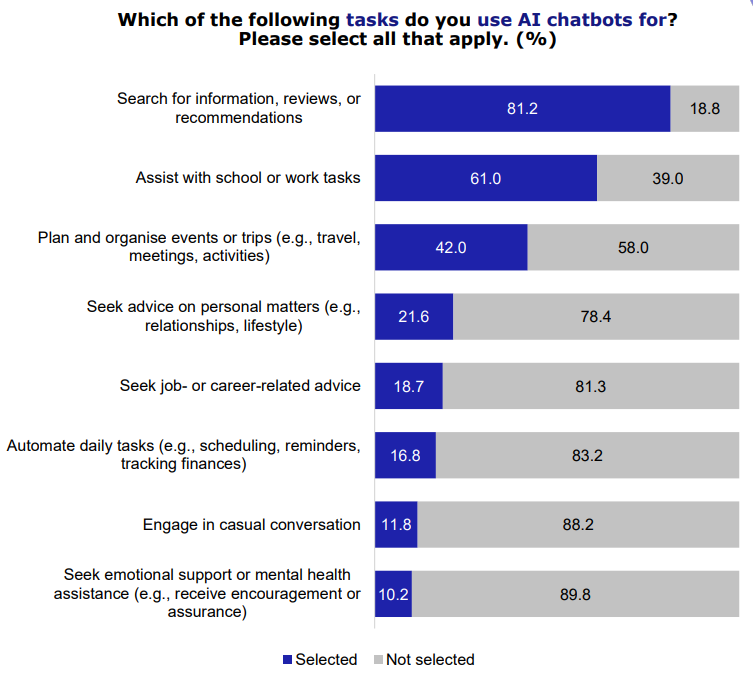
Most respondents indicated that they primarily use AI chatbots to search for information (81.2 per cent) or to help with work or school (61 per cent).
A notable proportion of them, however, also said that they use AI chatbots to seek advice on personal matters (21.6 per cent), engage in casual conversation (11.8 per cent), and seek emotional support or mental health help (10.2 per cent).
Women are more likely to seek emotional support or mental health assistance from AI chatbots, with 13.8 per cent of female respondents saying that they have done so, and just seven per cent of their male counterparts indicating the same.
Younger respondents are more likely to go to AI chatbots for emotional support or mental health help as well.
A total of 15.9 per cent of respondents aged 21 to 35 said they have done so, while just 6.1 per cent of those aged 51 and above indicated the same.
Younger people are also more likely to trust AI chatbots, with 74.7 per cent of those aged 21 to 35 saying they at least somewhat do so, compared to 70.5 per cent of those aged 36 to 50 and 53.1 per cent of those aged 51 and above.
However, the study also found that overall, most respondents (92.8 per cent) remain cautious about AI chatbots.
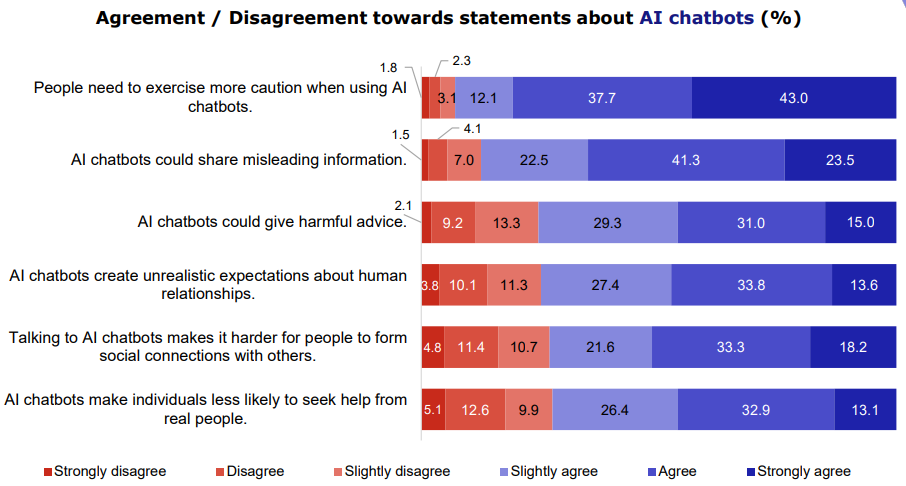
Additionally, 87.3 per cent of respondents agreed that chatbots can share misleading information.
Over seven in 10 felt AI chatbots create unrealistic expectations about relationships, make it harder to form connections, and reduce the likelihood of seeking help from real people.
They also do not view these chatbots as a satisfying substitute for real-life interactions, as about three-quarters of respondents disagreed with the statement that it is possible to form “friendship-like” connections with AI chatbots.
Speaking about the study’s findings during the online panel on Tuesday, associate professor in computational communication at the National University of Singapore, Kokil Jaidka, said AI chatbots offer interaction without obligation.
This means that people cannot create shared experiences or mutual dependencies, which help bridge social development, she explained.
AI chatbots “give people false confidence even about knowledge, not just about relationships”, Prof Kokil said.
She also pointed out that in addition to women being more likely to disclose personal details to chatbots, there is a gap in how they perceive the responses from chatbots and how it affects their own self-preception.
“I think there needs to be more done to understand that we are inadvertently creating digital divides, even amongst people who have the most access [to the internet],” Prof Kokil said.
[[nid:725458]]
Read the full article here