






The Red Hangar (Hangar rojo), the fiction feature debut of Chilean director, producer and screenwriter Juan Pablo Sallato, may be set in 1970s Chile as a military coup unfolds, but the themes and human challenges it explores feel very timely.
It tells the story of Captain Jorge Silva, a former head of Air Force Intelligence, who receives an order that will change his life forever. He is tasked with transforming the Air Force Academy where he trains young cadets into a center for detention and torture. The reason is the coup by a group of miltary officers, led by General Augusto Pinochet, that overthrew the socialist President Salvador Allende.
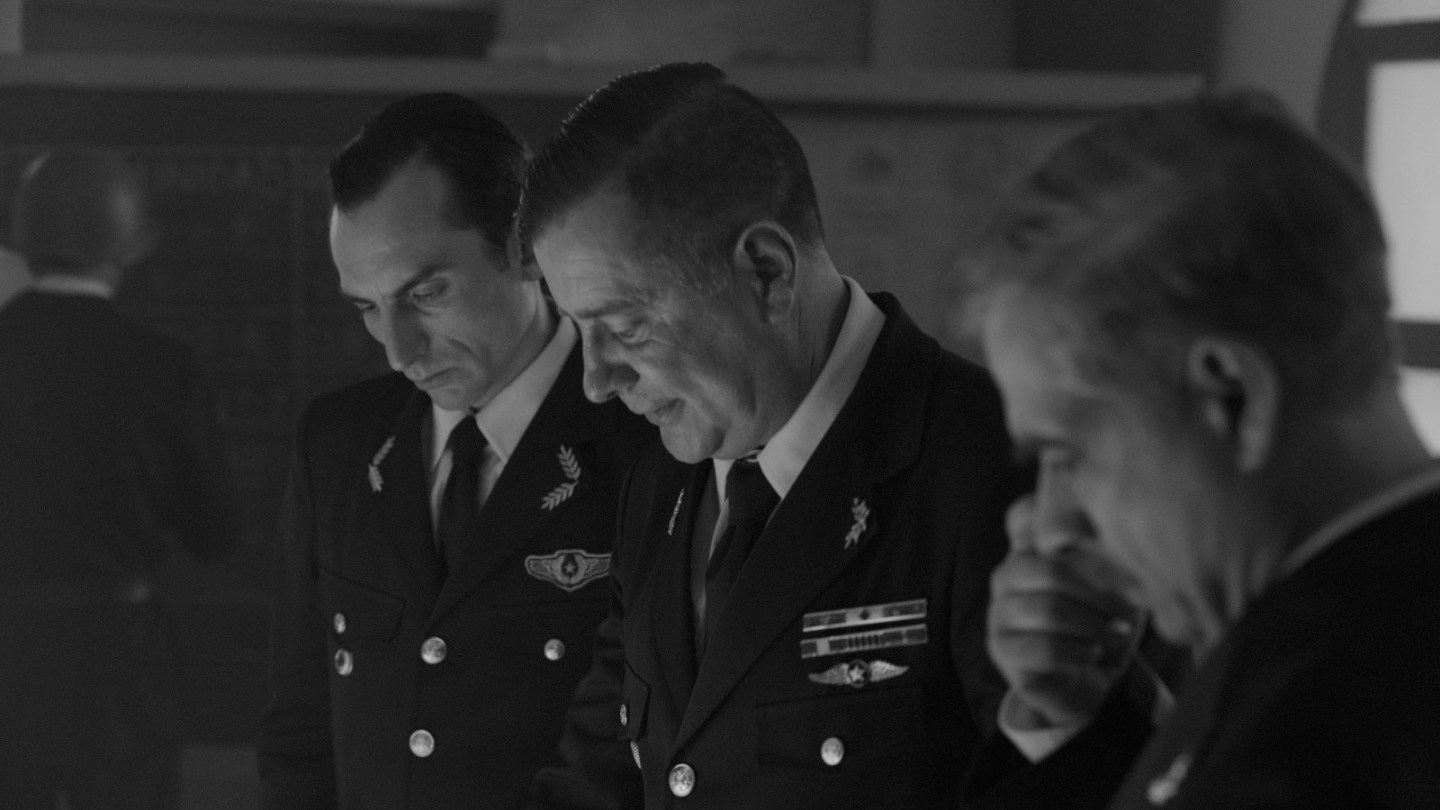
The Red Hangar world premiered in the Perspectives section of emerging voices in the Berlin International Film Festival. Inspired by true events and shot in black and white, the movie has been described as the first Latin American thriller to explore the inner workings of the military during the dictatorships of the 1970s.
Sallato previously directed the documentary Red Eyes and the series Addicted to the Horn, Freed, and The Culture of Sex. He directed The Red Hangar based on a screenplay by Luis Emilio Guzmán. The film stars Nicolás Zárate (Prison in the Andes, Inside the Mind of a Psychopath), Boris Quercia, Marcial Tagle, Catalina Stuardo, and Aron Hernández.
Produced by Villano and co-produced by Brava Cine, Rain Dogs, Caravan, Berta Film and TVN. World sales are being handled by Premium Films/MPM Premium.
Silva faces all sorts of dilemmas in the film. “Convinced that the horror will be short-lived, Silva tries to stay on the sidelines,” reads a synopsis for The Red Hangar. “But the arrival of Colonel Jahn – an old rival who is returning with unchecked power and unfinished business – forces Silva to confront not only his past but also his deepest beliefs. As trucks begin to fill the hangar with prisoners and the exercise of power grows increasingly ruthless, Silva finds himself trapped at an impossible crossroads: disobedience could cost him his life, but then so could obedience, too.”
THR asked Sallato about the creation of The Red Hangar, the political and morally ambiguous issues it touches on, the timeliness of the film, and what he is working on next.
Thank you for the powerful film and taking me inside these difficult moral choices. I am curious: Is Jorge Silva’s story widely known in Chile, and is the film based on an autobiography, book or something like that?
Thank you very much for your words. Jorge Silva’s story is not widely known in Chile; it circulates mostly within a small circle of people who have studied that period. The most emblematic case connected to him is that of General Alberto Bachelet, father of former Chilean president Michelle Bachelet, who died after being tortured by the dictatorship. It was Captain Silva who was with him in his final moments at the Public Jail.
The film is inspired by the autobiographical chronicle Disparen a la bandada by Fernando Villagrán, who is one of the two students whose lives Silva saves in the story. Villagrán conducted research on Chilean Air Force officers and non-commissioned officers who were tortured by their own comrades for refusing to participate in the coup.
Through Fernando — who was actively involved in the production — we were able to meet Jorge Silva. Hearing him recount, in the first person, the exact moment when the coup unfolded was decisive. But what struck us most was the position from which he spoke: not from the high ranks of power, but from a middle ground where orders arrive fragmented, and obedience seems inevitable. That moral ambiguity and that perspective made us understand that this was the heart of the film.
Why did you decide on a black-and-white film?
There were several signs that led me to black and white. The first appeared during my reading of the book. In one passage, Fernando Villagrán writes that when he woke up on Sept. 11, 1973, and learned of the military coup, everything suddenly seemed to him in black and white. That image felt deeply cinematic to me. A seed was planted there — the intuition that this story should be portrayed through that visual imagination. Interestingly, when I later mentioned the line to Fernando, he didn’t even remember writing it, but it was there.
The second reason was stylistic. My background is closely linked to art school, and many of my references come not only from cinema but from painting and its history. I always imagined the film in an expressionist mode, where the image carries a strong emotional weight. In that sense, black and white — the chiaroscuro, the contrast, the gradation of grays — became a visual metaphor for the moral dilemmas at the center of the story.
It also creates a certain temporal distance. It places us in an era that collective memory often associates with monochrome images, while at the same time giving the film its own identity and language.
You mentioned the very difficult moral decisions in focus in the film. Why did you want to explore such human dilemmas?
What drew me to the story was that gesture of humanity in the midst of barbarism. The atrocities of Latin American dictatorships are widely known, but I felt it was important to approach the conflict from a different angle.
The perspective of a military officer forced to choose between obeying orders and listening to his conscience is rarely explored. It is an uncomfortable but necessary dilemma, because such decisions do not belong only to the past — they continue to happen today, in different contexts.
Telling the story of someone who, under immense pressure, decides to do what he believes is right is not about idealizing him. It is about asking how far our own responsibility extends. I hope the film activates that question in the viewer: What would each of us do in a similar situation?
The film is set in a specific place and time. But as you hinted at a minute ago, the film seems scarily timely. Do you also feel the dilemmas and themes it touches on feel very current?
Yes, absolutely. Premiering the film at the Berlinale — especially in the city of Berlin — has been deeply meaningful. It is a city that constantly confronts its past in order to understand its present. In a way, that is also what the film tries to do.
I believe it is urgent today to reconsider our moral and ethical boundaries. In many parts of the world, we are witnessing the erosion of human rights and international agreements with alarming normalization. Inevitably, this brings to mind some of the darkest moments of the 20th century.
The film does not offer easy answers, but it insists on keeping the question alive: What do we do when the context turns hostile? How far does individual responsibility go? I would like to think that even in extremely adverse circumstances, there is always the possibility of acting differently.
What was the hardest thing for the production to make the film feel like we really are in the 1970s?
The biggest challenge was finding the right locations. The film required an Air Force training school and an air base that still preserved a genuine 1970s aesthetic.
In Chile, the only place that truly met those conditions was the El Bosque Air Base and its training school — the very place where the real events occurred. We approached them, but we received a refusal, without much explanation.
That forced us to rethink everything. We decided that if we could find the appropriate locations in Mendoza, Argentina, we would move the entire production there. And that is what happened. The National University of Cuyo and the Cóndor Air Base allowed us to recreate the world of the film with strong visual coherence.
It was a leap into the unknown. We traveled with a reduced team and integrated into a local Argentine crew who, together with the cast, created a powerful synergy. In just 18 shooting days, we completed the film.
In the end, that obstacle became a strength. The co-production between Chile, Argentina and Italy not only solved a practical problem, but reaffirmed our belief that collaborative filmmaking is one of the most vital ways to sustain independent cinema.
How did you find and decide on the title, The Red Hangar?
The title comes directly from the book. “The Red Hangar” was the actual detention space inside the base, and from the beginning, I found it deeply evocative.
On one level, it refers to a concrete, physical space. But it also carries strong symbolic weight. “Red” inevitably suggests violence and blood, but also the political charge of the time. A hangar is meant to protect aircraft, to shelter machines. Turning it into a place of detention speaks to how quickly an institution can change its function. That transformation is, ultimately, the core of the film.
This is your first fiction feature film. Do you plan to do more fiction work, or will you go back to documentaries or series? Any new projects?
Yes, absolutely. With our production company Villano — which I founded almost two decades ago with Juan Ignacio Sabatini — we are constantly developing both documentary and fiction projects.
Personally, I am working again with Nicolás Zárate, the lead actor of The Red Hangar, on a film adaptation of a play by the iconic Chilean theater company Ictus. The project is titled Los niños están grandes (The Children Have Grown), written by Emilia Noguera, and it unfolds over a single night, as three siblings reunite after the death of their parents.
As a producer, we are also in an advanced stage of development on Simulacro, a fiction feature directed by Juan Ignacio Sabatini and written by Luis Emilio Guzmán — the same screenwriter of The Red Hangar — based on the true story of Chilean goalkeeper Roberto Rojas, who in 1989 cut his own face in an attempt to help Chile qualify for the 1990 World Cup.
Read the full article here