




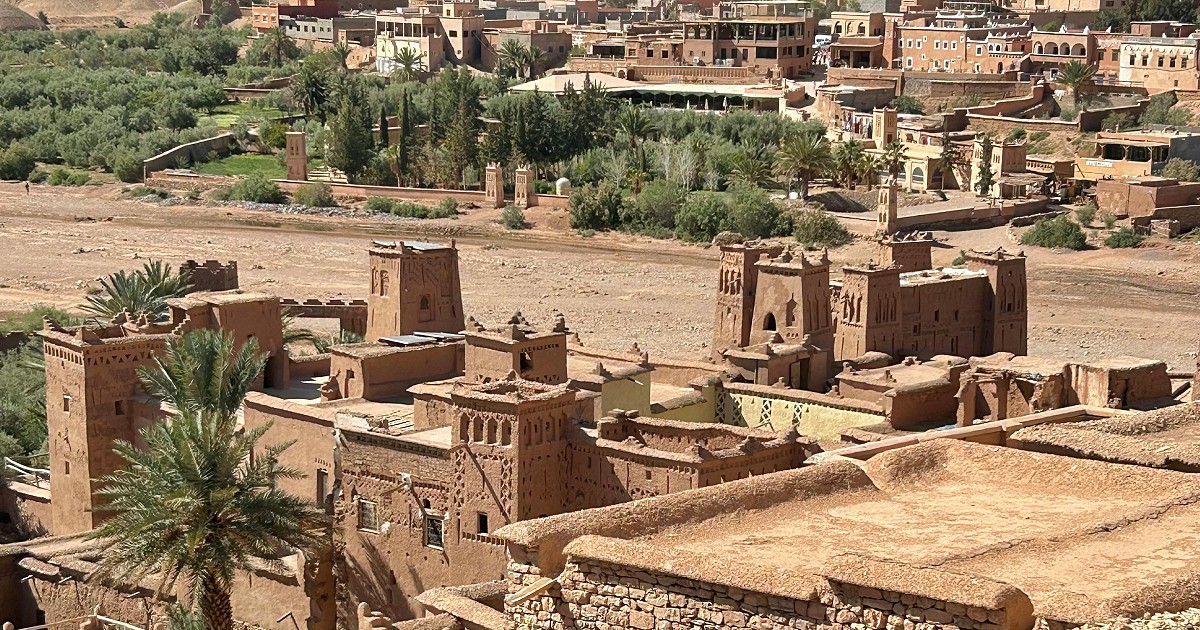


If life has been moving too fast, Northern Morocco invites you to slow down this summer and embrace the art of slow travel.
Step into the part of the country where ancient medinas, Rif mountain trails, golden coastlines, and artsy small towns sit side by side, far from the crowds, and entirely at your own pace.
Follow along as we picture a summer getaway designed to invigorate your senses, one unhurried day at a time.
Tangier: Where the Mediterranean meets the Atlantic
Perched at the tip of Africa where the Mediterranean and Atlantic converge, Tangier has long been a city of storytellers, artists, and culinary adventurers.
Culinary immersion
Start your Tangier chapter in the kitchen.
The city’s hands-on cooking experiences let you step inside a classic art-deco apartment between the port and the Grand Socco, where you’ll learn to prepare traditional tagine, hand-roll couscous, and master Morocco’s beloved tea ceremony.
Morning and afternoon sessions guide you through the fragrant world of Moroccan spices, from chicken tagine with preserved lemon to fresh-from-the-Mediterranean seafood dishes.
Cafes and seaside life
Let Tangier’s cafe scene show you the ultimate slow day. Settle into a terrace seat overlooking the Strait of Gibraltar and watch the ferries drift between two continents.
Wander through the Grand Socco and Petit Socco, the two markets that make the city’s reputation, where traders display lemons, olives, figs, and local produce in lively medina alleys.
The city’s main beach stretches fine white sand right through the centre, close to the most elegant hotels that are perfect for a lazy afternoon.
When you’re ready to explore further, follow the Atlantic coast to the Hercules Caves at Cape Spartel, where the sea has carved through a limestone formation to frame the ocean and the African coastline beyond.
[[nid:735386]]
Tetouan: Step into living history
Just an hour southeast of Tangier, Tetouan feels like a precious secret in the form of a city, rewarded to those who take their time. Known as the “White Dove of the Mediterranean”, this is where Andalusian heritage lives and breathes in every alley.
A Unesco-Listed Medina
Inscribed as a UNESCO World Heritage Site, Tetouan’s medina is one of the most complete and untouched in all of Morocco.
Walking through its seven gates into the old quarter, you feel the weight of history in every wall, the untold stories of Andalusian refugees who rebuilt their lives here after the Spanish Reconquista, leaving their mark in the city’s Hispano-Moorish architecture.
Stroll alleys lined with green and white houses reminiscent of Seville or Granada.
There’s no rush here, just the quiet rhythm of daily life unfolding around you.
Artisan workshops
In the souks, an unhurried pace turns an ordinary stroll into a series of small revelations.
In one corner, you will come across craftsmen presenting zellige, exquisite, enamelled ceramic masterpieces that have made the city famous. In another, artisans carve and paint wood panels in intricate geometric patterns.
Watch the Jebliates embroiderers in Guersa El Kebira selling their handwoven mendils (traditional handwoven Moroccan cloths) or colourful pieces of fabric in red, blue, and white while coppersmiths shape frames, lamps, and knockers from brass and silver.
Taste the hinterland
Tetouan’s local gastronomy is nourished by a whole hinterland where olive and fig trees grow in abundance.
In the souks, look for Jben, a creamy white cheese wrapped in palm leaves, prepared by women in rural cooperatives and brought fresh to the city each morning.
Tamuda Bay: Mediterranean luxury with a Moroccan soul
Just a short drive from Tetouan, Tamuda Bay unfolds along the golden Mediterranean coastline, offering a refined pause from the region’s cultural intensity.
Comfort meets the coast
Prestigious luxury establishments have settled along this bay, offering thalassotherapy spas, private beach access, and a unique elegance that adds an indulgent layer to slow travel.
Marinas dot the shore, where you can board a yacht or sailboat for a quiet afternoon on the Mediterranean.
For families, there’s a water park and gentle stretches of beach perfect for younger travellers.
For couples, beachfront restaurants serve fresh seafood with views of the bay, a simple pleasure that connects Tamuda’s luxury setting to the region’s fishing traditions and Mediterranean table.
Where the sea meets the mountains
What sets Tamuda Bay apart from generic resort strips is its hinterland.
Behind the beach, the landscape rises into hilly terrain covered with forests, olive groves, and the same fertile countryside that feeds Tetouan’s souks.
Spend the morning on the beach and the afternoon exploring the forested hills behind it for an authentically Moroccan day.
[[nid:735361]]
Chefchaouen: Where the blues combat your blues
Chefchaouen, the blue-painted city nestled high in the Rif Mountains, has captured the imagination of photographers worldwide and is part of every globetrotter’s bucket list.
A city painted in calm
Every wall, doorway, and staircase here is washed in varying hues of deep cobalt blue, creating a dreamlike atmosphere that almost demands you to be mindful and present in the moment.
The medina’s narrow winding alleys invite aimless wandering, impromptu photoshoots, and moments of inspiration at every turn.
At the heart of the old quarter sits the Kasbah, its lush gardens offering a haven of freshness and shade.
The museum inside houses old weapons, photographs, and textiles that trace the city’s story.
Stay in a boutique riad
Chefchaouen is best experienced from small boutique riads that are often family-run.
Start your day to the melody of birdsong over blue rooftops, take your breakfast on a sunlit terrace, and let the day unfold without an agenda.
Akchour: Connect with nature
Venture deeper into the Rif to reach Akchour, a favourite destination for hikers and nature lovers hidden within the Talassemtane National Park.
Waterfalls and light hiking
Spread across nearly 59,000 hectares of cedar, fir, and pine forests, Talassemtane was created to protect the region’s natural heritage.
This summer, follow the trails leading to Akchour’s waterfalls and let nature’s soundtrack of rustling leaves, cascading water, and birdsong ease you into a beloved escape shared by families and hikers for years.
The highlight is God’s Bridge, or Pont de Dieu, a natural rock arch soaring approximately 25 metres above the river, carved by centuries of flowing water.
Take your time to breathe in the view and let your senses awaken to the moment.
An eco-nature retreat
For the full digital disconnection, stay at an eco-lodge nestled among the trees, where the rhythm of nature replaces the pull of notifications.
Simple, peaceful, and surrounded by pristine green, it’s the purest expression of slow travel in the region.
[[nid:734779]]
Asilah: The hidden coastal gem
Northern Morocco’s best-kept secret is Asilah, an Atlantic coastal town south of Tangier.
For those seeking a genuine alternative to crowded beach destinations, this is it.
Art on every wall
Asilah’s whitewashed medina doubles as an open-air gallery.
Every year since 1978, the walls are freshly painted white just before the annual Cultural Festival, creating a blank canvas for local and international artists who transform the medina into a living exhibition of murals, geometric designs, and contemporary art.
Each summer, the festival draws artists, musicians, and poets from around the world, adding a global aura to the town’s intimate character.
Outside festival season, the murals remain, silent storytellers on whitewashed walls, waiting to be discovered.
A seaside town that breathes easy
Asilah holds on to a sense of serenity that many coastal towns have gradually lost.
Promenade the ramparts overlooking the Atlantic.
Watch the hue of the tide turn from turquoise to rose-gold as the sun dips toward the horizon. Sit in a seafront cafe and watch local fishermen bring in the day’s catch.
Beyond the medina walls, the nearby beaches of Briech, Rmilat, and Sidi Mghayet offer a quieter alternative to Morocco’s more crowded coastal rhythms.
For many travellers, Asilah will feel like the fresh discovery of the trip — somewhere to wander, look, pause, and end the journey on a gentler note.
[[nid:735536]]
This article was first published in Wego.
Read the full article here