





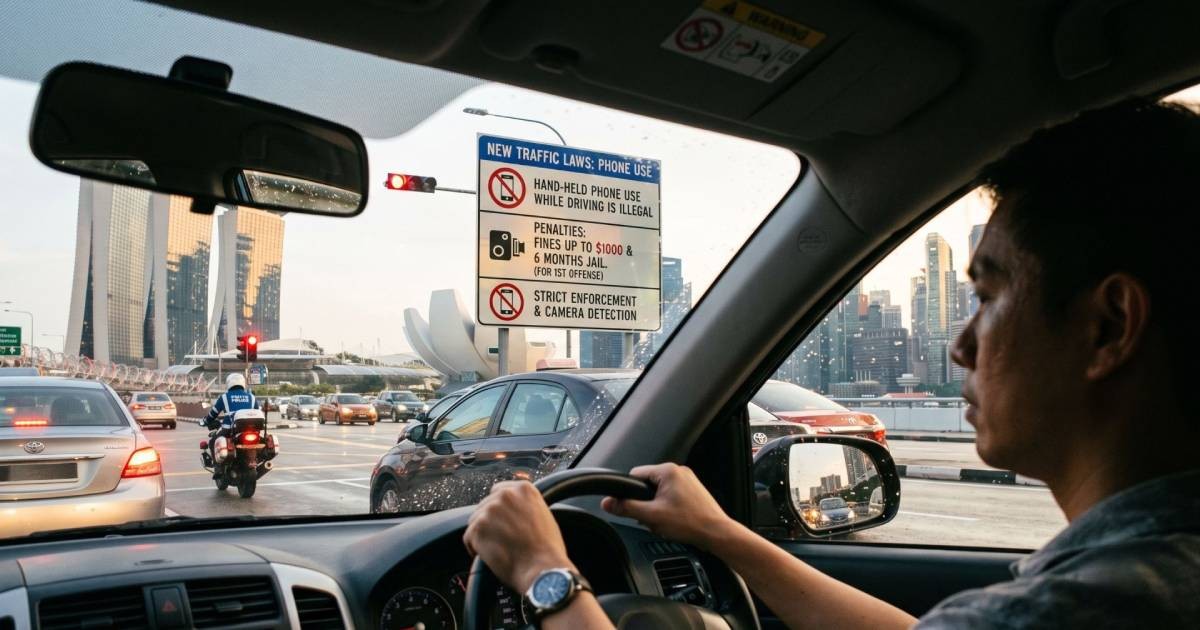


You are driving home after a long day, stuck in the evening rush, when your favourite song ends. Instinctively, you reach for your phone to skip the track or hand it to your passenger to change the playlist.
It seems harmless.
But under Singapore’s proposed Road Traffic (Miscellaneous Amendments) Bill 2025, that simple action could land you with a hefty fine, demerit points, or even a jail sentence.
On July 7, the Ministry of Home Affairs (MHA) introduced the Bill to Parliament, proposing some of the biggest changes to Singapore’s road traffic laws in recent years.
Among the most significant amendments is a stricter rule on mobile phone use while driving.
Previously, authorities had to prove that a driver was actively using their phone. Under the new Bill, simply holding a mobile phone while the vehicle is moving is enough to constitute an offence.
Here’s everything Singapore drivers need to know.
What is changing under the Road Traffic (Miscellaneous Amendments) Bill 2025?
Holding your phone while driving may become an offence
Under the current law, Traffic Police must prove that a driver was actively using a mobile phone while driving.
This usually requires officers to observe the offence and determine whether the driver was texting, making a call, browsing the internet, or using another application.
The proposed Bill removes this requirement.
Once the new rules take effect, drivers may be committing an offence simply by holding their mobile phone while the vehicle is moving.
Authorities will no longer need to prove what the driver was doing on the phone.
Whether you are checking a notification, changing a song, replying to a message, or simply holding the phone in your hand, you could face enforcement action if your vehicle is in motion.
The Ministry of Home Affairs explained that holding a phone while driving is dangerous because it reduces the likelihood that the driver is fully focused on the road.
Are mounted phones still allowed?
Drivers can continue using hands-free navigation
The proposed amendments do not completely ban the use of mobile phones inside vehicles.
Drivers can still use navigation apps such as Google Maps or Waze if their phones are securely mounted on a dashboard or windscreen holder.
Drivers are also encouraged to use:
- Voice commands
- Hands-free calling
- Bluetooth controls
- Vehicle infotainment systems
The key difference is that the driver must not physically hold the phone while the vehicle is moving.
Can you hold your phone at a red light?
Stationary vehicles are treated differently
Drivers may still hold their phones when their vehicles are completely stationary, such as when waiting at a red traffic light.
However, once the light turns green and the vehicle begins moving, the driver must immediately stop holding the device.
For example, a driver waiting at a junction who checks a message while stationary may not be committing an offence.
However, continuing to hold the phone after accelerating away could result in enforcement action.
How will Traffic Police catch drivers?
AI cameras and public videos could be used as evidence
Enforcement under the new Bill is expected to become more technology-driven.
The Traffic Police will be able to rely on different forms of evidence, including:
- Traffic enforcement cameras
- AI-powered video analytics
- CCTV recordings
- Dashcam footage
- Photos and videos submitted by members of the public
This means motorists do not necessarily need to be stopped by a police officer to face penalties.
A driver holding a phone could potentially be reported through footage captured by another motorist’s dashcam, a pedestrian’s video recording, or an automated camera system.
The Traffic Police are also preparing to introduce newer cameras equipped with advanced video analytics technology that can detect drivers holding mobile phones while driving.
Why is Singapore tightening mobile phone enforcement?
Rising traffic fatalities and offences trigger stronger action
The changes come as Singapore faces increasing concerns over road safety.
Between 2021 and 2025, traffic fatalities increased by approximately 24 per cent, while traffic violations rose by around 38 per cent.
In 2025 alone, Singapore recorded:
- 149 road deaths, the highest number in a decade
- 9,955 road injuries, compared with 9,342 in 2024
- Around 4,200 mobile phone-related traffic offences, up from approximately 3,000 cases in 2024
The increase in phone-related offences highlights the growing concern that distracted driving is becoming a major road safety issue.
The Ministry of Home Affairs stated that stronger enforcement and tougher penalties are necessary to reduce dangerous driving behaviour.
What are the penalties under the new bill?
Mobile phone offences
Although the maximum penalties for mobile phone offences remain largely unchanged, the biggest difference is that enforcement becomes easier because authorities no longer need to prove active phone usage.
| Offence | Penalty |
| First mobile phone offence while driving | Up to six months’ imprisonment, $1,000 fine, typically 12 demerit points, and a composition fine of $400–S$500 |
| Repeat mobile phone offence | Up to 12 months’ imprisonment and $2,000 fine |
| New enforcement standard | Simply holding a mobile phone while the vehicle is moving may be sufficient for an offence |
Tougher penalties for serious driving offences
These changes reflect Singapore’s tougher approach towards motorists whose actions put other road users at serious risk.
| Offence | Previous maximum penalty | New maximum penalty |
| Dangerous driving causing grievous hurt (First offence) | Five years’ imprisonment | Seven years’ imprisonment |
| Dangerous driving causing grievous hurt (Repeat offence) | 10 years’ imprisonment | 13 years’ imprisonment |
| Purposeful endangerment using a vehicle | Existing penalties | Up to 15 years’ imprisonment, caning where applicable, fines, and lifetime driving ban |
How drivers can stay safe under the new rules
Small habits could prevent big penalties
Many motorists reach for their phones without thinking.
Changing a song.
Checking a notification.
Looking at a message.
Adjusting navigation.
However, under the proposed changes, these small actions could have serious consequences.
Drivers should develop safer habits by:
- Setting up navigation before starting a journey
- Mounting their phones securely
- Using voice commands whenever possible
- Avoiding unnecessary phone interactions while driving
- Keeping both hands on the steering wheel
The safest phone is the one you do not need to touch while driving.
Frequently Asked Questions (FAQs)
Can I pass my phone to my passenger while driving?
No. Holding a phone while the vehicle is moving could still be considered an offence, even if you are only passing it to another person.
Can Traffic Police use dashcam footage against drivers?
Yes. Dashcam footage, CCTV recordings, traffic camera images, and videos submitted by members of the public may be used as evidence when investigating traffic offences.
Will AI cameras detect drivers holding phones?
Yes. Traffic Police plan to introduce cameras with video analytics capabilities that can identify motorists holding mobile phones while driving.
When will the new law take effect?
The Bill has been tabled in Parliament but is not yet in force. The amendments will only become effective after the Bill is passed and the Government announces the official implementation date.
Singapore drivers need to adapt
The Road Traffic (Miscellaneous Amendments) Bill 2025 represents a major shift in how Singapore approaches distracted driving.
The message is simple: when your vehicle is moving, your focus should be on the road.
With stricter laws, smarter enforcement technology, and tougher penalties, motorists should start changing their habits now.
Mount your phone before driving, rely on hands-free features, and avoid unnecessary distractions.
A few seconds of convenience are not worth risking your licence, your finances, or the safety of yourself and others.
[[nid:737019]]
This article was first published in Motorist.
Read the full article here