



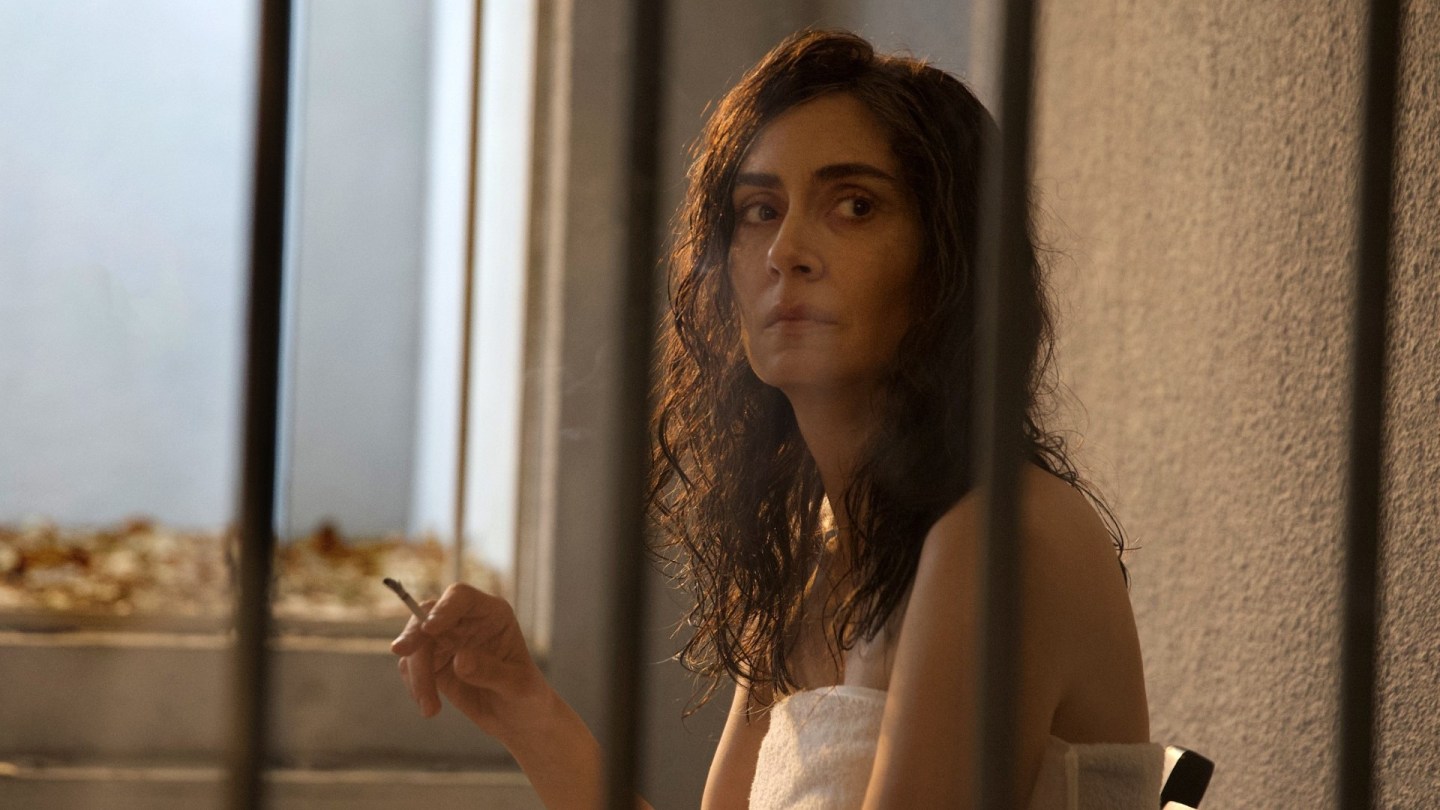


Roya is an Iranian teacher imprisoned in Tehran’s Evin Prison for her political beliefs. And she faces a choice: make a forced televised confession or remain confined to her three-square-meter cell.
That is the central dilemma in Roya, the second fiction feature from writer-director Mahnaz Mohammadi, who has not been permitted to make films since her 2019 fiction debut Son-Mother. So, she had to make Roya, starring Turkish actress Melisa Sözen (Winter Sleep, The Bureau), underground without official permission. The movie will world premiere in the Panorama program of the Berlin International Film Festival on Saturday, Feb. 14.
Mohammadi knows the situation Roya is in all too well. The Iranian filmmaker, whose first film was the 2003 documentary Women Without Shadows, and women’s rights activist “has faced repeated persecution for her films and activism, including multiple arrests and a seven-year prison sentence on charges of ‘endangering national security’ and ‘propaganda against the regime’,” notes the Berlin festival’s website. “She spent several months in Evin prison. Although the sentence was later overturned, she continues to live under surveillance and severe restrictions.”
The cast of Roya also features Maryam Palizban, Hamidreza Djavdan, Mohammad Ali Hosseinalipour, Bacho Meburishvili, and Gholamhassan Taseiri. Ashkan Ashkani was the cinematographer, with editing handled by Esmaeel Monsef.
Totem Films is handling world sales on the movie produced by Farzad Pak at Hamburg-based PakFilm in co-production with Europe Media Nest (Czech Republic) Amour Fou (Luxembourg) and NDR, ARD Degeto Film, BR and SWR. It also was made with the support of MOIN Filmförderung Hamburg Schleswig-Holstein, Medienboard Berlin-Brandenburg and Film Fund Luxembourg.
The visceral Roya “reveals how solitary confinement reshapes both perception and identity and makes the possibility of resistance increasingly fragile,” Berlinale programmers note.
“The raw material comes from my lived experience, … but [it is also so] many people’s experience,” Mohammadi tells THR about what flowed into Roya and its story. “It’s not just mine.”
Why did she cast Turkish actress Sözen in the lead role? “When I came back from prison, for almost two years, I was not going out. I was just inviting some of my friends to my place,” she shares with THR. One day, a photographer friend mentioned the film Winter Sleep. “Maybe you will like it,” she recalls him saying. “I know the Turkish language, and I love watching films in their original language.” And Sözen stood out for her. “There was a moment with Melisa in that film where she is just in silence and gave me this feeling that I started crying,” the director says. “I felt, ‘Oh, my god, I understand her.’ When I was writing the script for Roya, I was in Turkey, and suddenly, Melisa came to mind again.” The creative team contacted the star, who joined the project and got fully into the role. “She’s amazing,” the director emphasizes.
Cinema is dear to Mohammadi’s heart and part of her resistance. After all, silence causes fear, and narration can take on that silence, she tells THR.
Memory, suppression and trauma are among the themes that Roya explores, and the film’s aesthetics reflect that. “To narrate this film, I couldn’t follow the classic narration in cinema. And I learned that for this story, I had to follow the concept and structure of unconsciousness,” the filmmaker explains. “Unconsciousness has its own language. It’s not linear. It’s mixed together. Is overlapping. Everything is fragmented, and you have to find an interpretation for this nightmare.”
Just like the character Roya, people facing suppression may experience confusion about what is real and true and how much to trust their brains and memory. “Sometimes, suppression comes from the regime,” Mohammadi says. “Sometimes suppression comes from the family, the husband, wife, anybody. And what’s happening to the person when they are suppressing things like that is that they don’t have any certainty about anything.”
She herself had to stay away from loved ones to make Roya. “I wanted to make this film, and not just this film. There are also documentaries, one of them for Channel Four in the U.K.,” she highlights. “So, I couldn’t be in public. I hid myself just to make it. And I didn’t hug any of my family for so long. I became the loneliest person just to make it, like a soldier.”
Asked about her hope for a better future, Mohammadi tells THR: “I think everybody has their own definition of hope. And I think through my life experience, I learned that hope is not just a destination, but a way of living. And cinema is part of my practicing [that].”
Read the full article here