



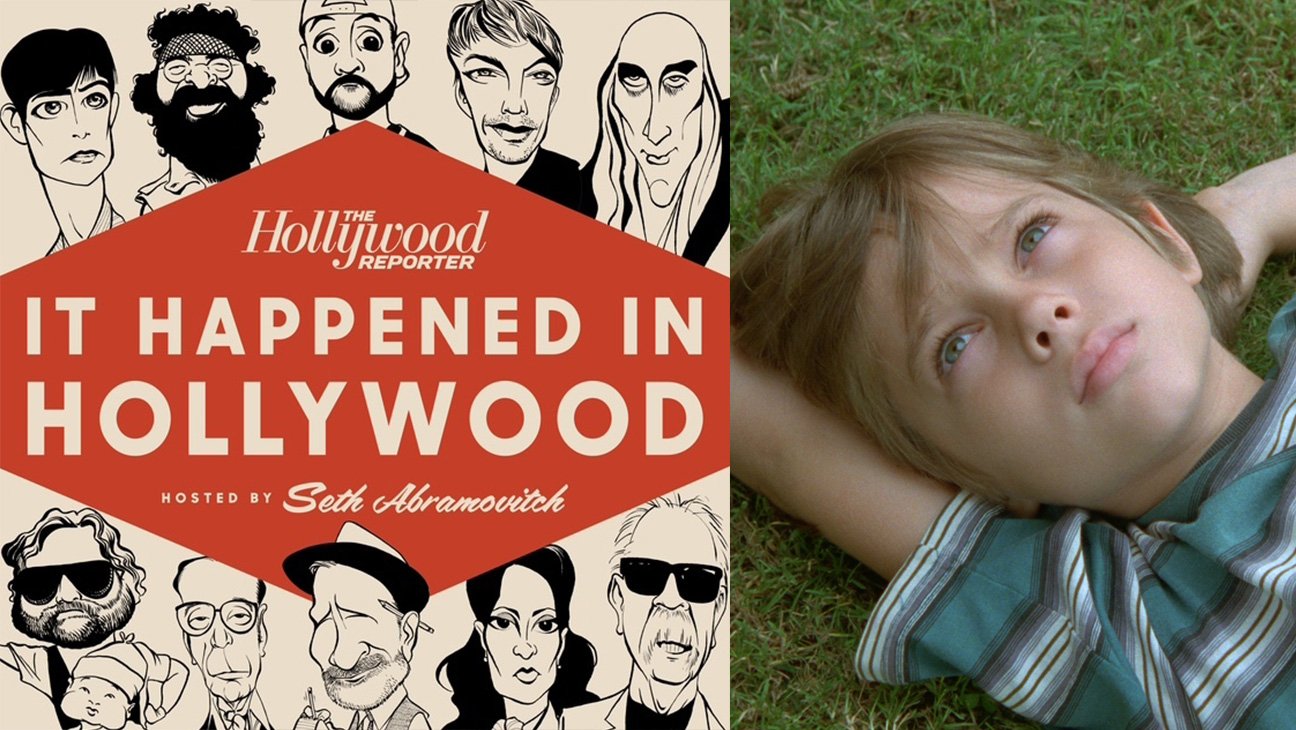


Twelve years ago this month, Richard Linklater released a movie unlike any other. Boyhood, filmed in secret over 12 years with the same cast, followed a Texas kid named Mason Jr. (Ellar Coltrane) from first grade to his first day of college — no makeup tricks, no digital de-aging, just time itself doing the work. Made for $200,000 a year on a handshake deal with IFC, it premiered as a surprise addition at Sundance in 2014, earned universal acclaim, won Patricia Arquette an Oscar, and is routinely cited among the greatest films of the century.
Now, on the film’s 12th anniversary — a span chosen to mirror the 12 years of production — Boyhood returns to theaters July 31 via IFC, following a cast reunion and Q&A in Linklater’s hometown of Austin.
For the season nine finale of The Hollywood Reporter‘s It Happened in Hollywood podcast, the director — fresh off 2025’s twin charmers Blue Moon and Nouvelle Vague and midway through his 20-year adaptation of Stephen Sondheim’s Merrily We Roll Along — discussed watching Boyhood for the first time since 2014, the flash of inspiration that solved a 25-year-old creative problem, and how Ethan Hawke pushed him to rewrite the film’s most devastating scene.
Listen to the full conversation on It Happened in Hollywood, and read the highlights below.
You, Ethan Hawke and Patricia Arquette recently rewatched Boyhood for the first time since 2014. What did you make of what you created?
God, it was fascinating. A couple years ago, IFC was interested in doing a 10-year anniversary. I said, “Everybody always does 10s and 20s. Let’s do 12.” Mainly I was just delaying it two years — but if there were ever a film that deserved a not-round number, it’s this one. I hadn’t watched it, Patricia hadn’t seen it, or Ethan, in 12 years. So there was something cool about the 12 years we spent making it now being the 12 years we haven’t seen it or thought about it much. It was kind of the most unique experience of my life of watching a thing I did.
By the time you finish your movie, you’ve seen it so much, you’ve pored over it for so long, you really just want to be done with it. And I had a unique experience even in the way I remembered it. Say I cut something in the last two years that I had seen for seven years — in my film memory, it was still in the movie. I’d be anticipating, “Oh, here’s that line I never liked that much,” and we’d get to the scene and it’d be gone. I was more wrong about it than other films I’ve made, just because I experienced it in so many different phases.
It struck me that the film’s got its own little time-release formula. If you haven’t seen it in 12 years, it’s largely a different movie. Someone who was 18 watching it for the first time will have a very different experience at 30. I saw things I thought were funny — it was more dramatic than I remembered. More intense. A lot more cautionary things, a lot more advice. I saw threads that I wasn’t conscious of, maybe.
Your daughter Lorelei plays Mason’s sister, Samantha. She’s so funny in it. So much of your personal DNA is baked into the story.
Watching her grow up on film again was profound. When do you get to revisit your own kid — not in a home movie, but in this fictional world that was actually tapping into little quirks of her at certain ages? It was wild.
Take me back to the beginning. What inspired the idea?
Going back about 25 years — I had been a parent for a while at that point. Lorelei was eight or nine when I got this idea. I wanted to make a film about childhood. I hadn’t done that, and being a parent, you can’t help but revisit your own childhood. Everybody thinks they have their 400 Blows in them somewhere, but I never could land on one moment of childhood. The origin of Boyhood was me being frustrated with what I felt was the limited canvas of making a film about a kid. Most of the great childhood movies are really about a specific moment, a specific summer, a specific three days. I was interested in the growing up part — all of it. I was thinking more like a novelist. I wanted to bite off a much bigger chunk of development, and you can’t really do that on film unless you skip a lot of years and cast someone else. You can’t ask a seven-year-old, “OK, now you’re 10, now you’re 13.”
So I was feeling that restriction intensely, and just at the moment I was giving up that I could do this cinematically, I was sitting down to write what I felt would be this kind of experimental novel about growing up. And as my fingers hit the keyboard — I’m not kidding — this film popped into my head fully formed: What if everyone just aged throughout the movie, and by the end of this one feature film, everybody would be older? Why can’t you do that? I hadn’t seen that in a narrative. First through 12th grade was always the grid — the grid we’re all on educationally. It was one of those aha flash moments, but looking back, I was solving a narrative problem, probably not unlike a physicist who wakes up with a formula in their head. The idea was the fun part. The hard part was figuring out how to actually do it in the real world.
You went to Ethan, who you were close with. How did you get everyone else to commit to a 12-year undertaking?
Ethan and Patricia came on in similar fashion. I was in New York; I sat down with Ethan and told him the idea. I’ll never forget the look on his face. It was about five seconds of “Huh?” — and then, “Cool.” Same with Patricia. I called her up and said, “What are you doing 12 years from now? You’re going to be an actor looking for a role. I’m going to be a filmmaker trying to get my next film made. Statistically speaking, most likely.” And we started talking about our moms and she came aboard. She’s like, “Yeah, let’s do it.” Artists responded, put it like that. It was just a logistical challenge.
Even financially, that wasn’t a problem, because IFC pretty early on came aboard. Jonathan Sehring at IFC, who I’d made two films with at that point, took the leap with us. I was like, “Give us $200,000 a year. We’re going to shoot on film. At the end, you’ll have a film by me with Ethan and Patricia.” He’s just like, “That could be really cool.” They were producing a lot of films in the early century, and by the last four or five years he’s like, “You’re our only production. We’re in production on one film. Better be good.” But Jonathan was there to the end, and they ended up distributing it. We got our $200,000 a year. Never got a raise. It got more expensive to make films, but we just got our $200,000 a year. A lot had to go right, put it like that. We were tempting fate, obviously, but we all believed. It was a wonderful, wonderful life experience.
How did you find Ellar Coltrane, who plays Mason Jr.?
Casting the kids was a whole different thing. When you’re talking to adults, they’re making an adult decision. When I first met Ellar, he was six. I decided early on I didn’t want to just pull some kid off the street — I wanted a kid who had a lot of family support behind their acting, because you’re asking a kid to make such a mature decision it’s almost not fair. He had a headshot and résumé. He’d been in one indie thing, one TV thing. His dad’s a musician, his mom’s a dancer — an artistic couple with deep roots in central Texas. What if he moved away? Logistically, we couldn’t afford flying people in. So you’re kind of casting the parents and the family too.
I met a lot of kids — huge casting sessions. There were these little jockey kids, and I could have gone that way. But Ellar was more ethereal. To me, he represented a future artist. He had elevated tastes in storytelling and music and culture. His favorite band at six was Rage Against the Machine. And Lorelei, she’s a medievalist — she does Britney Spears in the first episode, but she had to really learn that. She was listening to medieval harpsichord music. Those kids were not much help about being contemporaneous to their generation. They were sort of outliers, but very great souls. And Ellar, sure enough, grew up to be this sensitive poet guy. He’s a poet living in New Mexico now. The film was going to go where he went, to a large degree. It was kind of a mix of autobiography for me, but then also developmentally for him.
How much was scripted and how much was improvised along the way?
It was all scripted. But at the end of every year, I would tell everybody what’s going on. The architecture was pretty fixed, but I had a year to write the next script, which is an incredible gift. I would spend that year thinking, OK, third grade — what went on that year in my life? And what’s going on in the culture? I wanted the film to feel like a memory, and it’s become that now. What would you remember of a childhood? You’d probably remember the Harry Potter midnight book releases. The Iraq War hovers over the whole thing, obviously, and the post-9/11 America the film was born into is there. Looking back, I almost forgot how many devices there are — there’s a lot of TV and a lot of images from the world.
I’d forgotten how dark it gets, with the abusive, alcoholic stepfather. That’s the most dramatic swing the film takes, and yet it feels rooted in plausibility — you see the way these kids are terrified.
Yeah, but you get through it if you’re lucky, and then life goes on. Looking at it again, alcohol kind of hovers over the whole movie — even his own choices. When you see him drinking in high school, it’s like, oh, here we go. Madness kind of hovers around. Adulthood seemed volatile. There are some real potholes to step in in life, a lot of bad paths. Everyone’s giving him advice and it’s not always good, and there are a lot of bad examples of behavior. But even when he’s hanging out with those older guys throwing blades around, talking such shit, being typical horrible teenage boys — I like to think Mason Jr. is looking at that going, “OK, I’m here, I’m dealing, but I’m choosing not to be like that.” A lot of who we are is who we choose not to be. I even remember that feeling of not knowing what I wanted, but knowing what I didn’t want. Maybe that’s how we curate our lives.
It’s also really observant about American masculinity and its pressures.
The way that society kind of boosts you up, reinforcing masculinity and maleness — well, what is it? Is it sexual? Is it power? Is it aggression? What form does it take and what does it mean? That’s a real thing. I was raised by a single mom with two older sisters, so there were a lot of men in my life who thought it was their job to help make a man out of me. Truth is, I had a very stable, wonderful dad — I just saw him on weekends, but they didn’t know him. They thought I was this kid who needed a little male reinforcement, and my mom promoted that too. Some guy would take me on a motorcycle ride, and I’m like, “What am I doing? I don’t need this.”
Let’s talk about the birthday scene where Ethan’s Mason Sr. gives his son the “Black Album” — a mixtape of the Beatles’ solo work — after having sold the GTO he’d promised him. It’s not worth any money, but it has so much thought in it.
That was something Ethan actually was doing. Ethan and I have always pushed each other — “That means something. Everything means something. Let’s build a scene around this, because it is thoughtful.” And that idea that it’s a combination of unique talents that makes the Beatles what they are. There’s no one Beatle. It’s the team. It’s what makes them a true band. You can go on about that forever. The dad’s clearly a lover of music.
I thought you were going to bring up his birthday with his East Texas grandparents — this happened to me. I call it the redneck bar mitzvah year. It wasn’t a birthday, it was Christmas: I got my own Bible, the red letter edition, and my grandfather gave me a shotgun. I look back on that and it’s kind of funny, but it’s kind of affectionate, because it came from both their hearts — my step-grandparents, sweet people who accepted us lovingly into their family. That meant a lot to both of them. We can laugh at it, and I do, but there’s something kind of sweet about it too.
The darkroom scene, where the photography teacher tells Mason he has talent but needs discipline, hits me to the core. That’s a good male role model.
He’s just old enough to hear it then — he wouldn’t have been two years before. We all had that: the sincere adult pulling you aside, the English teacher saying, “Hey, you’re a good writer, but…” At the time, he’s a little pissed at him. He’s punishing him — “You’re going to film the football game. I know you don’t want to, but I’m going to instill a little professionalism in you.” Twelve years ago, I thought of it as another adult in your face telling you what to do. Now I was more moved by it. Those stand out. Those are important. You’ve got to be ready to hear it, though.
The world tends to let you know what you’re good at. If you can’t sing, no one’s handing you a mic. If you’re not a good athlete, you don’t get picked first. But in the arts it’s a little vague, especially photography or writing — everybody can kind of do it, but who can do it well? It’s easy to be unsure of your own talent. So those little shots in the arm from someone who actually knows what they’re talking about — “Actually, you’re pretty good; all these other knuckleheads aren’t” — that’s a powerful thing, and you hope they use it judiciously. Part of that scene is something I might’ve heard about my own talent, and part of it is definitely me talking to young people. I tell anybody who wants to do anything: it’s going to take twice as long as you think, and you’re going to have to work twice as hard as you think. But it’ll be great. It’ll be fun. It’ll be your life.
Something you do better than anyone is dialogue. It has a plainness to it, and yet I’m always engaged. How do you approach it?
The writer in me really emphasizes the structure and the ideas — I’m a big believer in the architecture. But as far as the exact wording, I’m kind of loose. I’ll have a script, but then the actors and I workshop it. That’s where I’m very ear-based. I want to hear the actors say it. I’m searching for some kind of realistic perfection in dialogue — that it feels at ease and yet is telling the story and communicating everything. I don’t really believe in improvisation as most people think of it, where actors are just catching it live, because there’s too much redundancy in that. It can only work in emotional moments; it can’t help you tell your story as well as you need to. The dialogue dial-in goes hand in hand with the performance. It’s only when it starts coming out of the actor’s mouth that I perk up and go, “Huh — am I believing this? What could make it better, more funny?” That’s the moment of truth for me.
Let’s talk about the most iconic dialogue in the film: Patricia’s speech as Mason leaves for college, ending with “I just thought there would be more.” What do you remember about writing it?
That evolved. It’s one of the final threads of the entire movie, so there’s some pressure on that moment. In my own life, when I left for college, it was just my mom and me. She was sitting at a table smoking her cigarette and she didn’t say too much — “OK, bye.” So I was playing it as a quiet moment between them. The summer before, we were in Greece, and Ethan Hawke was asking me about it — a scene he’s not even in, but he’s such a partner. He started pushing me: “Well, what’d you make the movie for? You might want to articulate that more.” And I was like, “Yeah, maybe it does deserve more.” I’m giving him credit for that. Once that gate was open, it became an opportunity to purge, to say quite a bit.
My producer Kathleen’s daughter had gone off to college the year before. She called her from the airport after dropping her off, still crying, and said, “Just so you know, this is the worst day of my life.” I said, “You told your kid that? It’s supposed to be a great day.” She goes, “Yeah, I told her.” I’m like, “Wow. Mothers can just lay it out.” And Ethan Hawke’s mom had said something similar to him: “Here’s my life, and what’s next is my funeral.” And I like the way Mason says, “Aren’t you jumping ahead a few decades?” It’s a little funny and really sad and very true. Patricia had so much to say about all that. That was the evolution of a scene over a one-year period — from a quiet moment to a very big moment.
Her character holds it together through the worst moments, but when she breaks, it’s very moving. I think that’s why she won the Oscar.
She handles it so well. At some point, Patricia’s instincts are so right on, you just go with them. She’s always right. Such a great collaborator, such a great actor — she’s just so real in herself. Even vanity — she was like, “I’m getting older. No makeup this year. I want to look like shit in this scene. It’s Saturday morning.” How many actors approach it like that? She’s deserved all good things.
You never made a secret of what you were doing, yet Boyhood seemed to arrive fully formed. Everyone was blown away that this happened under their noses.
Even in year one, someone got hold of it — it was on IMDb, there was a little article, and I was like, “Ah, I wanted to work in secret.” But we flew under the radar. We weren’t sending out press releases — what good is that? I’d talk about it if anyone asked, but no one knew about it much. You had to be pretty close in to know. That was the fun thing. By the last year, I think Ethan was doing press for a movie he didn’t like that much, so he started talking about Boyhood. I’m like, “Ethan! He blabbed.”
That fall it leaked onto film radars. There was one of those “25 most anticipated films of 2014” lists, and I was going through it thinking, “What’s coming out this year?” It hadn’t crossed my mind that we would even be on it. I got to the No. 1 most anticipated film, and suddenly it was Boyhood. I was like, “What the fuck?” No one had seen it at that point. That’s some crazy pressure. And then Sundance didn’t announce it — it wasn’t on the schedule. It just got announced two or three days before the screening. So even that lacked anticipation. That was probably a pretty good way to do it. It was a discovery. I still run into people — “I was there at the Eccles for the premiere of Boyhood.” That started a year-long trek. I was touched by how much people connected with it. You never know.
Tell me about the music — starting with the first shot, young Mason lying on the grass, which became the poster, set to Coldplay’s “Yellow.”
How many movies have the first image of the movie as the poster? Not many. I was always looking for music that fit a time and a place, and that was like, oh, early century — Coldplay, they were big. It’s bookended at the end with Family of the Year’s “Hero.” They’re kind of on the nose in a way, but kind of beautiful in their own way. Unlike most movies, where I know every song I want, I was trying to capture what kids were listening to, and I was out of the demographic. In the last couple of years, I’d get people about the age of Ellar and Lorelei into my editing room, write down all the songs of that year, and have them talk about the ones everybody was listening to. A few songs came out of that. And I remember Arcade Fire’s The Suburbs was a big album around then — that kind of infused the last part of the movie. I was happy to get two songs from that.
What is Ellar up to now? Is he happy he did this?
I’d seen him about six months before the reunion — he lives in New Mexico now. He’s a poet, and he acts a little bit, but he didn’t have that driven personality of an actor. Maybe to his credit. He’s a pretty chill guy, so thoughtful. I think he’s happy he did it, but on him and Lorelei — it had been this fun 12-year project, and once it hit the public, it was kind of like, wow. They experienced something few ever have: people felt they really knew him. I remember being at screenings with Ellar where he’s being hugged by grandparents as if he’s their grandson. He doesn’t know them, but they feel close to him. That’s a weird way to suddenly have the world respond to you. It takes a lot of mental rigmarole to put it in a healthy place.
The film sits at 100 percent on Rotten Tomatoes and is considered one of the greatest of the century. Watching it back, do you think about its future?
I was kind of relieved watching it. I was like, OK, that film’s going to be relevant far, far into the future, just because of what it’s about. Nothing changes. It hitched its wagon to these relationships that are eternal — parents, siblings, you to yourself. That is so damn universal. If you can resonate in that area, you’re being truthful in some way, and that helps with your continued relevance, maybe.
It’s hard to talk about this movie — I stuttered around a little, because I haven’t had to talk about it in 12 years. I have an updated view of it now, and I’m having to incorporate new ideas of how I feel about it. I would’ve thought my opinions at this age would be kind of fixed. Oh no, they are not. They fluctuate. Time never quits working on us.
Read the full article here