





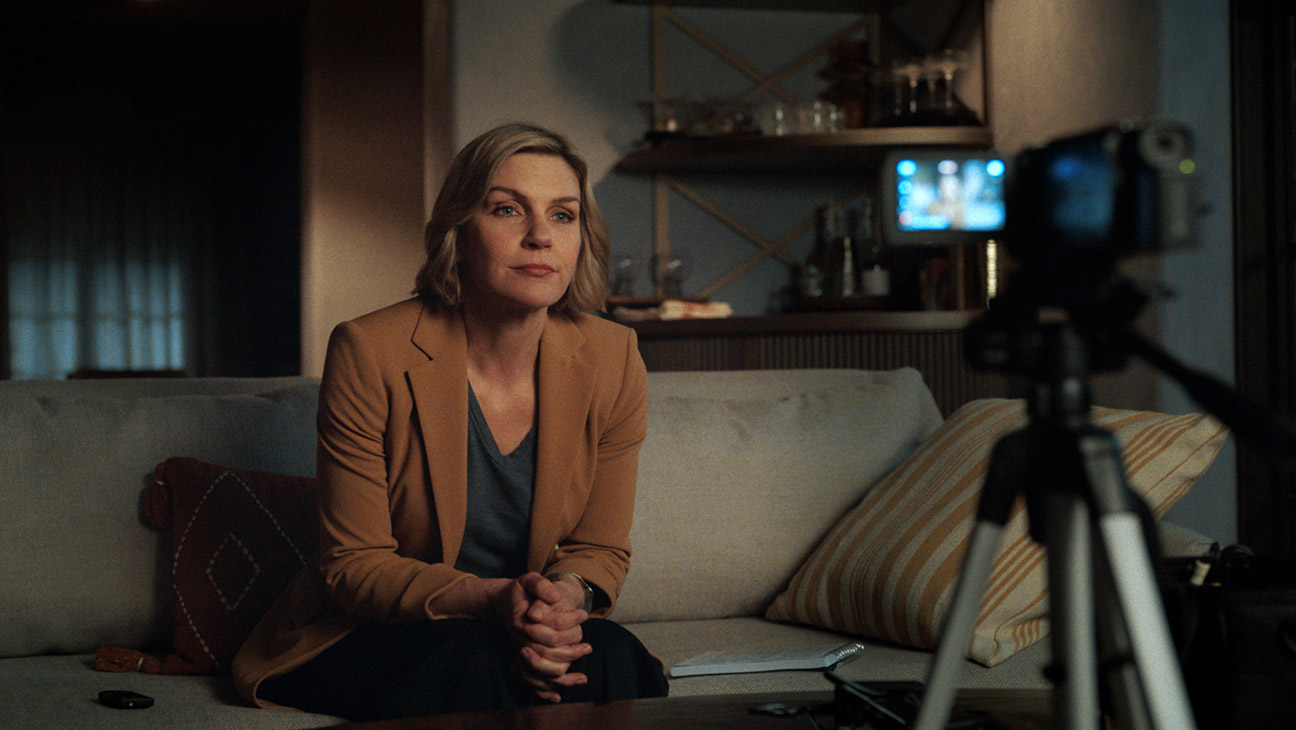


Rhea Seehorn knew she was in for a big workload on Pluribus: She’s in nearly every scene, and sometimes the only person in a scene. She also got to see what that was like up close on her previous series, Better Call Saul, when Bob Odenkirk carried a similar amount of scenes.
“[Pluribus creator] Vince Gilligan and Peter Gould on Better Call Saul, and their murderers row of writers that are all incredible, they do such deep character investigation and portraiture, and it evolves, so you are going to dig deep,” Seehorn told The Hollywood Reporter Monday on the heels of her first ever Golden Globe nomination, for lead actress in a TV drama, for her work on the Apple TV series. “I saw Bob do that firsthand.”
In Pluribus, Seehorn plays Carol Sturka, one of only a dozen or so people on Earth unaffected by “the Joining,” an extraterrestrial virus that links the thoughts, feelings and memories of every other person on the planet. The series follows Carol as she looks to save humanity “from happiness,” as the show’s tagline puts it, or as she sees it, from losing forever the individuality that makes us human.
“I was surprised by the amount of psychological portraiture of a woman who’s dealing with isolation. I didn’t know that element of the story [before starting],” she said. “When I started seeing those, at first I got a little terrified — ‘OK, how am I going to pull this off?’ But I love those scenes as much as any other scene.”
Pluribus has sparked a lot of discussion among viewers about what it’s really about — with pandemic isolation, artificial intelligence among the biggest points of discourse. Gilligan has said he wants the audience to draw its own conclusions from the material, and Seehorn told THR that she’s thrilled people want to delve into it.
“It’s been very gratifying that people really want to talk about the show, and they want to talk to each other, and they’re making it a show they need to watch with others and discuss things,” she said. “I spoke to someone that thought the entire thing is a metaphor for grief and depression. … Vince wasn’t trying to tell anybody what to think or to preach a certain topic. He started writing this before the pandemic lockdowns — another person [I spoke to] thought that’s what it’s about. Well, sort of. It’s about everything. Another person thought it was only about AI, but AI wasn’t the debate topic [that it is now] when Vince started writing this 10 years ago.”
Seehorn also said she’s looking forward to attending the Golden Globes — except for one thing.
“I’m so excited that I get to do this for a living, that I get to do really incredible work for a living, and I love all the people I work with. And then I’m getting invited to the prom for it as well? I’m not jaded at all about it,” she said. “My only thing, if I’m honest with you, is the red carpet part, I fall apart on. [Laughs] I’m no good at still photos. I feel OK about my physical being in the world in motion. As soon as I’m told to be very still, and I feel like my whole job is to try to look as pretty as possible, it crumbles. I sweat, and then I worry that I have pit stains, and then I freak out, then I do the photos and I go back to having fun.”
The Golden Globes are produced by Dick Clark Productions, which is owned by Penske Media Corporation, The Hollywood Reporter’s parent company, in a subsidiary joint venture between Penske Media and Eldridge.
Read the full article here