




Faisal Baltyuor is a busy man. One of Saudi Arabia‘s most prominent film producers since the country lifted its ban on public cinemas in 2018, Baltyuor has produced domestic hits such as the wrestling comedy Sattar and the drama From the Ashes, as well as Hijra, the country’s submission for the 2026 Academy Awards. He is also a leading film distributor in the MENA region through his company CineWaves Films. That’s not all, he is also involved on the exhibition side, and established Cinehouse, Saudi Arabia’s first art house cinema.
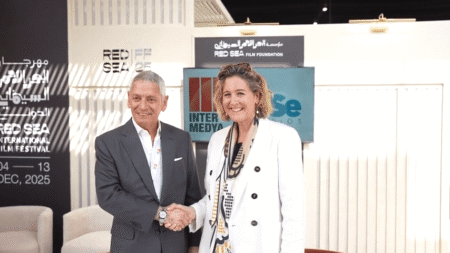
But wait, there’s more. In June, Baltyuor, undoubtedly the most connected man in the Saudi entertainment industry, was named CEO of the Red Sea Film Foundation, the sprawling non-profit cultural organization that hosts the annual Red Sea International Film Festival (RSIFF) in Jeddah, and also the fast-growing film market Red Sea Souk, as well as supporting filmmakers and backing projects through the Red Sea Fund, and developing creative talent through the Red Sea Labs.
As Baltyuor himself says, he is a “man who wears many hats” and his appointment to the top job at the Red Sea Film Foundation comes at a crucial time for the still nascent, but generously funded, Saudi film and TV industry that is seemingly speedrunning its way to establishing a sustainable entertainment ecosystem.
In the days leading up to the fifth edition of RSIFF, The Hollywood Reporter spoke to Baltyuor, where he opened up about his long journey to becoming CEO of the Red Sea Film Foundation, the rapid development of the entertainment industry in Saudi Arabia, and what the festival means to local filmmakers.
Let’s start with your, relatively, new job as the CEO of the Red Sea Film Foundation. First of all, how does your background help with leading the foundation?
The Red Sea Film Foundation is touching almost the whole ecosystem in Saudi Arabia. I’ve been with Red Sea since the beginning, as a producer, as a jury member, as part of the fund, as a participant in the Souk [market], and as sponsor as well of the festival. I’ve seen the Red Sea Film Festival through multiple directions, interacting with the team, interacting with guests, being a filmmaker who has had his film as opening film or closing film. Going through all of that experience,honestly, gives a good background of the efforts that Red Sea is adding on the ground to the filmmaker. [At the end of the day], I’m a filmmaker, I’m a producer, I’m a distributor, and it’s adding a lot.
Given all the hats you’re wearing, are you quite hands on with Red Sea, or are you more of a strategist?
No, actually I’m a full-time, hands-on with the Red Sea, definitely. The best thing with the producing, with the distributing, I don’t do things myself. I have a great team that they are handling everything, so I don’t get into that. I’m hands on with the details of Red Sea. I moved completely to Jeddah. I have to take it seriously. This is very important to the region, very important for the industry overall.
This is a quick aside, but for the outsider who might not be familiar, would you say that Jeddah is the culture capital, the film and TV city, of Saudi Arabia?
Jeddah was [the culture city] since even before the opening of cinemas in Saudi Arabia [in 2018]. That is because of Jeddah’s multiculturalism, we have [many different people] here in Jeddah. Because of its strategic location, it’s where everyone from countries all over the world come to if they’re going to go to Makka, their first stop will [most likely be] Jeddah first. Jeddah’s history has been rich with art, with film, with cinema, with culture.
We did some research about Ahwash Cinemas [informal backyard open-air cinemas that were popular in Jeddah before the Saudi ban on cinemas in the 1980s]. There was a lot of cinemas around us here in the Cultural Square where the festival is located, in the historical part of Jeddah. There were cinemas here since the 50s, 60s and 70s, not just one or two, more than 20 during that period. There were cinemas that even specialized. There were some focused on classic films from Egypt, some of them had Bollywood films, some of them had Hollywood films. There are people who are still living with us today who still remember watching movies in Ahwash Cinemas in Jeddah. So the city was, and still is, rich with culture and art. That’s why the audience here are always more vibrant.
You have input into the entire entertainment value chain in Saudi Arabia, that covers production, distribution, archival, funding, theatrical as well as the festival and policy, perhaps, so you likely have the most unique viewpoint of the industry here. Given that, are there major gaps in that value chain that you see? If so, how do you hope to fill those gaps?
Yes, there are some gaps, which is why we have strategies that are coming together to fill them. If we [don’t plug] the gaps, we won’t have good results. It was recognized years before [that we needed] to be building an audience, [but also] building below the line with crews having more training on set as well as training for the talents. That’s why we are attracting a lot of international productions as well 1765253158. When it comes to the funding now, there are actually multiple, serious funding entities in Saudi Arabia, including the Red Sea Film Fund that had its own successes, not just in Saudi, but in the region. There’s the Saudi Film Commission, of course, Film AlUla, the Cultural Development Fund, there’s King Abdul Aziz Cultural Center, all of that and beyond, all avenues of support and funding. And there have been a lot of good results for the funded films that got into the festival here, or were hits at the box office.
The best thing that [has happened] to the ecosystem is things like Red Sea Souk, that brings together all of those entities that I mentioned, plus the private sector, plus international expertise, bringing them together for panel discussions, meetings, collaborations. All of that is quickly fixing and finding solutions on how to fill the [remaining] gaps. I remember a few years back at Red Sea, we were discussing the challenge of below the line, and now we have so many below the line specific programs, either on set or educational with collaboration with the best universities. The development [of the industry] will take years, but within 1.5 years, 2 years, you see a lot of creative progress and the results are beyond expectations. Why? Because the capacity is good. There is a good synergy that is happening, and the volume is good enough to have a good result.
To move the discussion to Red Sea Film Festival itself. Obviously there are the headline aspects, the glitz and glamour, the stars, the red carpets, etc. but for you, as someone who works behind the scenes and is also a policy strategy person, what’s the ROI of the Red Sea Film Festival? That is, what do you want from it on a Saudi level, for local filmmakers?
The best thing with the festival is that it started with a clear vision on how to become a key player in developing the ecosystem of the film industry in Saudi Arabia. That’s why it’s not just about the red carpet. The shiny thing is important, it is nice, it is something that we have, and we are good at it, too. However, Red Sea [Film Foundation] is not just a Red Sea Film Festival. The film foundation has a lot of initiatives that start even before the festival. There are the labs that develop the talents from having an idea to a solid script during not just one or two weeks, but six or seven months in collaboration with the best entities in the world like TorinoFilmLab, USC, Film Independent, and others, to develop that script, in specific programs. After that, the winners get some funds from the labs themselves. This is just one of the programs of the labs, and there are so many others. Then [the filmmakers] also have an opportunity to get funds from the [Red Sea] development fund, the production fund, the post-production fund.
The Souk is like merging the talent with the industry, with the industry makers. I’m so happy about the Souk, because if you go there, you see the volume of talents just running from one meeting to another. We have seen a lot of success, progress for films that started as an idea in that Souk, then ended up in 2 years competing in A-list film festivals or achieving great milestones, for example, the [black comedy drama] Mandoob (Night Courier), was released last year in Saudi Arabia, was a big hit and was selected in Toronto — that was an idea that started in Souk. So you see the progress and you see the results in such a short time. Of course there is a long term vision. We need to sustain this. We need to keep doing it with a bigger volume, but in a strategic way.
The foundation funds a lot of films across the Arab and African world, that is quite a large region. Is there a specific Red Sea film? Are there particular voices you want to champion or stories that you want to promote?
When I think about this, I always think about it as what my industry needs… If you see the [movies I produced], you will see that I funded mostly art house films and mostly commercial films. So Sattar was my first project, and everyone was surprised, they said ‘oh, Faisal, we thought you only care about the independent or art house films?’ I said, of course I do, but I care about the industry. Three years back, I said to people we need more mainstream commercial films because this is what will sustain the industry. This is what will build the capacity of the audience, because the audience they go to the commercial cinemas. There is some audience for the art house movies, it’s healthy for the industry to balance between that and [commercial].
I know people will say, ‘oh, you should be [promoting] more art house movies, you are a festival.’ But I don’t think about it from a personal level. [It’s what] will make this industry sustainable, what will make it an industry that most of the business people in Saudi Arabia will invest in. When I sit with a lot of business people they understand the difference, and they are OK to go and fund some independent films, but the main thing is that they like to make sure that there is a return on their investment with box office movies.
With all the infrastructure spending and ecosystem building in the film and TV industry, on a macro level, is this strategy also linked to the Saudi Vision 2030 plan?
I’m not 100 percent sure about the specific policy things. But as a producer, I’m having all the support from all the government entities. They are supportive and very open to producing more content, and to give us the freedom of producing more content. Give us good facilitation, they developing more studios now. We have so many other studios either in AlUla, Neom or Riyadh now.
My last question is about you, personally. You started off in the film industry in Australia, and when you were there could you ever have imagined how Saudi Arabia’s film industry would develop the way it has?
This is something that I always have a flashback about. When I was in Australia, [after college] I went to see the production side, so when I went to these places, [I would think] I wish we had something like this in Saudi. When I went to Sydney Film Festival, [I would think], I wish we had a festival like this in Saudi. All of that, the production side, the celebration and festival side, the funds, it was a wish [for my own country]… It was something that I wanted to happen. That’s maybe what drove me when I came back.
So it’s been a dream come true?
It’s a dream that I’m living. I’m not being biased, but this is the reality, honestly. We are celebrating five years of one of the biggest festivals. We have a flourishing box office. This year was a great year for Saudi films, with a lot of achievement and box office records. We also had [Saudi films screen] at the A-list film festivals. That’s why I’m saying it’s a dream that came true.
Read the full article here