





[This story contains spoilers from People We Meet on Vacation.]
Emily Henry is so well known for her best-selling emotionally resonant love stories that the author has been called the queen of rom-coms. At least four of her novels (Beach Read, Book Lovers, Funny Story and Happy Place) are in development to become films. And Friday, the first onscreen adaptation of one of her books, People We Meet on Vacation, began streaming on Netflix.
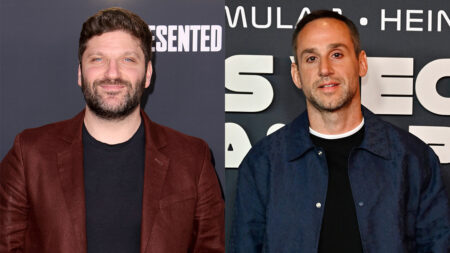
Writers Yulin Kuang, Amos Vernon and Nunzio Randazzo were tasked with adapting Henry’s work for the screen and felt the anticipation around the movie from early in the process.
“They loom large in culture,” Vernon tells The Hollywood Reporter about Henry’s books.
Kuang recalls, “It was daunting to see the number of comments on the [film] announcement. I was on Instagram and thinking, ‘Oh, people are paying attention.’ You get hit with this tidal wave of how much people care, and it’s impossible not to feel it.”
Randazzo adds, “It’s definitely intimidating because we don’t want to betray the book and the fans. People are very interested in getting this story right. They want Alex and Poppy depicted on screen the way they imagined them in the book. We were really trying not to just copy the book but to capture the book’s romance feelings.”
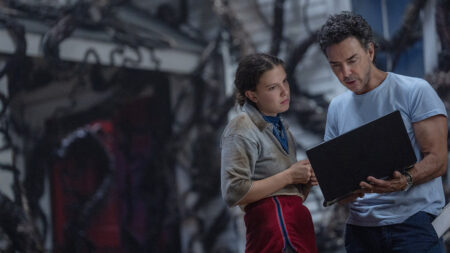
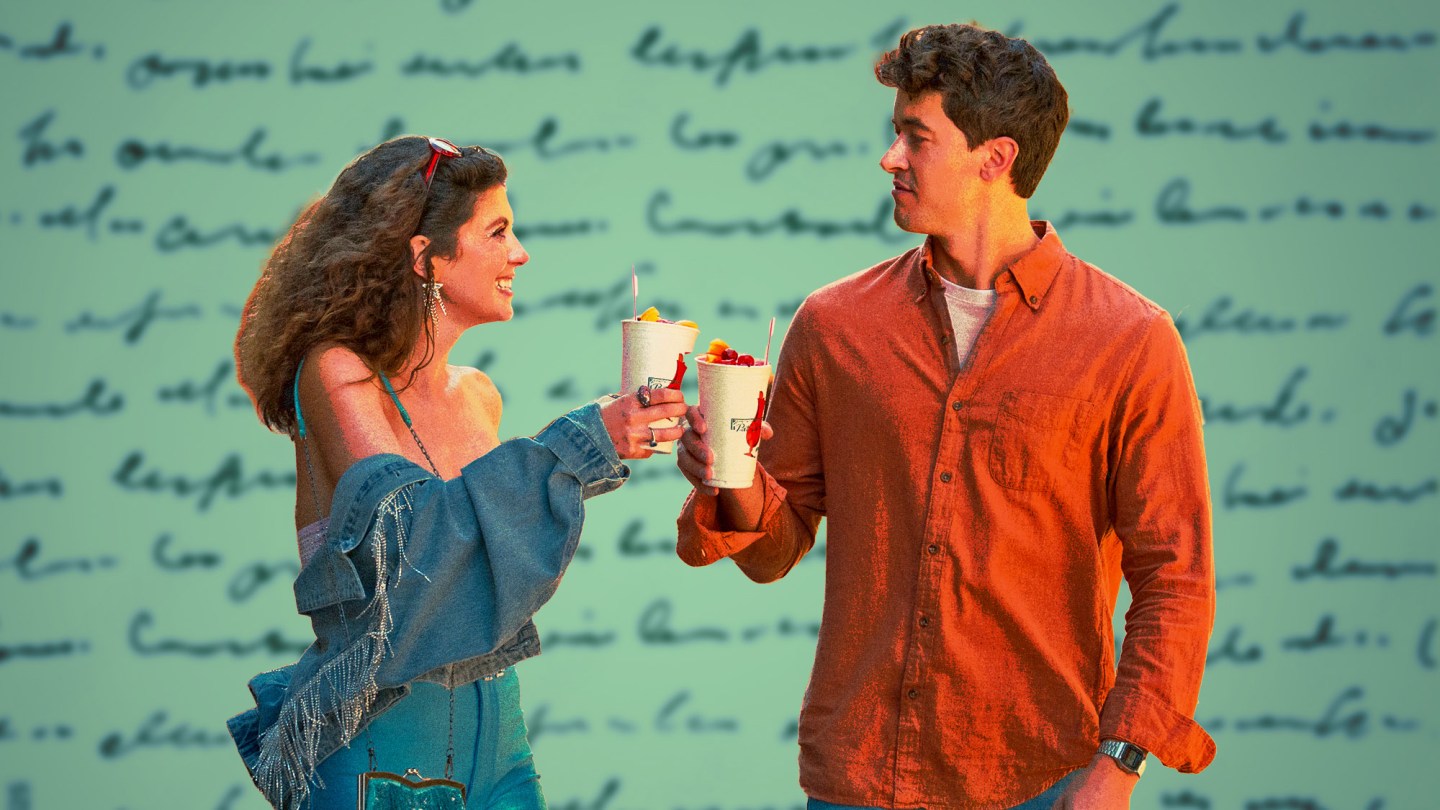
People We Meet on Vacation stars Emily Bader and Tom Blyth as free-spirit Poppy and routine-devoted Alex, two best friends who spend every summer vacation together. Though an unlikely duo due to their differences, their friendship is put to the test after a falling out, with the pair left to contemplate the true nature of their feelings for each other. The film, directed by Brett Haley, offers a modern rom-com that abides by the friends-to-lovers trope, one notably depicted in the late Rob Reiner’s When Harry Met Sally. The comparison is inevitable, and Kuang notes that “it’s hard not to see the classic romance “in the DNA of pretty much any friends-to-lovers movie. The 1989 film also “sets the tone” and lays the groundwork for the modern rom-coms that followed.
“I think Rob Reiner and Nora Ephron had this really beautiful collaboration that led to this moment of magic, and looking at the rom-coms that we knew and loved, they all kind of pulled from the same well,” Kuang says. “It’s important to keep the torch moving forward. You don’t want to keep returning to the well and try to recapture the magic until the water is gone. I don’t think we were trying to do the exact same thing that they were trying to do, but it is a remarkable movie, because I think it’s a truthful movie. It’s examining something timeless. It’s about love, sex and friendship. And I think, as time goes by, the fundamental things still apply.”
Kuang recalls even having a framed script of Reiner’s film on her desk when learning she got the job to work on People We Meet on Vacation, something she feels is “kismet.” “I didn’t know Rob Reiner personally, but his work really, really impacted me. And I just feel so grateful,” she emotionally shares.
Finding the balance between creative freedom and a worthy adaptation that makes the “EmHen hive” happy was the goal, they explain. And after reading the book, it was clear what was important to include in the film version for fans.
“You need them making out under a plastic tarp,” Vernon says. Kuang says keeping the sequence of Alex taking care of a sick Poppy was also important. Randazzo emphasizes the importance of consistent romantic tension. Meanwhile, the only thing from the book that Henry hoped to see in the film was the funny scene in which Poppy’s mom (played by Molly Shannon) gives her a pack of condoms before going on a trip with Alex. Apart from that, Kuang says the author gave them free rein to be creative and “see what would work on the screen.”
The writers had the ingredients for an ideal rom-com (comedy, passion, emotions, grand love gestures and the iconic rain kiss) but faced the challenge of taking the audience on a “ride where they feel something” despite knowing where that “ride is going.” Kuang jokes that she pitched the film as an “emotional thriller” because “we shouldn’t know that it’s definitely going to work out” between the two leads, and a happily ever after isn’t always guaranteed. “I think part of the genre is that it’s going to work out, but we shouldn’t know for sure. That’s how it feels in real life,” she adds.
“There’s pining and longing, and that’s what you want when you watch a romance. You don’t actually want to see two people in love. You want to see two people falling in love,” Randazzo notes.
Kuang is also set to direct the adaptation of Henry’s Beach Read, which she teased is currently casting. “They’re very different books,” she says of working on People and Beach Read. “They both have that thread of Emily’s writing that feels like a warm hug. But I think they’re warm hugs after different events. They’re very different books, so I didn’t want to just copy and paste.”
In separate interviews with THR, Kuang, Vernon and Randazzo spoke about adapting Henry’s bestseller, the rom-com mood board for crafting the film version and why writing the film version felt like a “complex Rubik’s Cube.”
Yulin, I read that you didn’t discover Emily’s work organically; her manuscript was sent to you early on, and you resonated with it. How did you specifically connect with the story and what were your initial thoughts?
YULIN KUANG It came to me, I want to say, like the top of 2021. I remember I read it in one sitting, and once I got to the end, it was such a compelling puzzle for an adaptation, because it had all this depth and emotion and yearning that I really love in romance, and it was executed on such a high level that it was beautiful to look at from a craft perspective [and] as a romance reader and as a romance lover. It was also doing this thing where it felt like it wanted to be a movie. It reminded me of some of my favorite rom-coms that made me want to make movies, like When Harry Met Sally, but it felt like it was doing something fresh and bringing Emily’s humor, tone and perspective into it. It felt very modern and of the times. It also reminded me of the feeling I got when I watched these Canadian ice dancers, Tessa Virtue and Scott Moir, skate. The yearning they’re capturing feels like something I’m also seeing in this book. So, it reminds me of all my favorite things when I think of yearning and romance and spanning relationships and friendships that can sometimes become something, wrapped up in a package that also had more locations than a James Bond movie. How do we turn this into a movie like When Harry Met Sally, that’s mostly like two locations? It was just a compelling Rubik’s Cube.
AMOS VERNON We heard of Emily Henry. I had never read any of the books, but they loom large in culture. I see them at every airport I go to ….
NUNZIO RANDAZZO Barnes and Noble, Target…
VERNON The covers are ubiquitous. Once there was a possibility of working on this project, I knew it was very popular with lots of people, which piqued our interest. And then we both read the book, and it was immediately clear that this was a fun story we wanted to be a part of. We love rom-coms. It seems like they’re back in books, but they need to be back in movies.
I imagine it’s one thing to adapt a book, but it’s another to adapt one with this level of anticipation and fandom. Did the popularity of the book ever feel creatively intimidating, or did it serve more as motivation to craft a worthy adaptation?
RANDAZZO It’s definitely intimidating because we don’t want to betray the book and the fans. People are very interested in getting this story right. They want Alex and Poppy depicted on screen the way they imagined it in the book. So, it is intimidating. But we were really trying not to just copy the book, necessarily, but to kind of capture the book’s romance feeling. And obviously, stuff has to change with an adaptation.
VERNON But we were always making those choices with the goal of being in the spirit of the book and knowing in the back of our heads that Emily Henry is going to read the script. I’ll say in the very beginning, I think ignorance was our friend. Because I knew they were popular books. I did not know the level of the fandom. Yeah, it’s one thing to have people who like a book. It’s another to have a fan base. I didn’t know the term “EmHen.” I didn’t know the subreddit, and I’m very glad I didn’t go on the subreddits before working on this, because it frees us up a little bit.
RANDAZZO Yeah, it’s a lot like when Peter Jackson did The Lord of the Rings.
VERNON (Laughs.) It’s a lot like that!
RANDAZZO They’re probably more passionate about Emily Henry.
VERNON Those movies are 29 hours long, and they had about 400 hours. You have to make hard choices. But we knew that, and we never, ever, ever wanted to do that without care and know that we’re truncating something so that we can accentuate an emotion that’s more important, or a character trait, or dramatize something that in the books is in their head, and you can’t be in their heads, so we need to show it. There was a lot of that. And then there are changes you have to make, just because you get a location in Barcelona, not Palm Springs.
KUANG I mean, it’s a little bit of both. It was daunting to see the number of comments on the [film] announcement. I was on Instagram and thinking, “Oh, people are paying attention.” Not that I didn’t think they were before, but now I have a face. You get hit with this tidal wave of how much people care, and it’s impossible not to feel it. But then I think what’s also lucky for me is that I had access to Emily throughout all of this. I really zeroed in on listening to her voice. There were times when I had a question about something related to the world-building, I would text Emily to ask. And you couldn’t do that if it were [adapting] Charlotte Brontë or Jane Austen. It was really great to have Emily there for that, and it kind of helped me block out the other voices when it wasn’t serving the project.
Did your background in writing fan fiction give you an advantage in knowing how to approach adapting a story like this with a strong fandom and knowing what fans probably want or don’t want but still expressing your own creative liberties?
KUANG I loved the book so much and I knew there were certain things I would want to see in the movie if I were a book fan. And you’re right, like my fandom experience has colored my entire career and my perspective. So, I kind of always look at it first from the view of a book lover and then eventually have to come at it from a different angle. I truly believe that the purpose of a good adaptation is to bring new audiences to the source material, and so the movie should stand on its own, and it shouldn’t be something that you can only understand if you’ve read the books. So that was important to me as well: it would be something that hopefully drew people back to the books. And I want to say I am so grateful to my co-writers, Amos Vernon and Nunzio Randazzo, for their work. I’m just really glad that movie is what it is. I think the fans are really going to be happy.
In conversations with Emily, what were the non-negotiables that she said needed to be in this, whether it be specific events or dialogue from the book?
KUANG Emily has been such a dream collaborator through this process that she has never initiated conversations like that. She brought so much trust to the process that I was kind of like, “If I were in your position, I wouldn’t” (Laughs.) She was so wonderful about it, and I think that allowed us to be creative, free and see what would work on the screen. I did ask her, “If there’s one scene from the book that you wanted to see in the movie, what would it be?” And I think it was the condom scene. I remember that was one of the early things we wanted to preserve from the book.
In other interviews, you’ve mentioned that your relationship with Emily felt like you were put in a marriage of convenience by your respective industries. So how would you say your close creative relationship helped with the process of bringing this book to life?
KUANG I would say the trust was the thing that was the most precious to me throughout this because I think as somebody who comes to adaptation, as a reader first, it would have been very hard for me to do this if I felt like a posture of arms folded, “What are you doing?” So, the fact that she was so giving of her trust in the process, I think that was wonderful, because it allowed me to just try things and not think so much of like, “Well, what is the adaptation that Emily wants?” It was more of what do I want to bring to this as an artist? Because I know that’s how Emily sees me, and she respects me as an artist. And so that’s what I’m going to show up and deliver. That was wonderful of her. I just remember, after delivering the first draft, I got an Instagram DM from her [saying], “I just read it, and I was shaking and I cried!” That’s such a nice message to get. It was special to just get that vote of confidence on a first draft. And let me tell you, the movie out is not the first draft! (Laughs.) From the very jump, Emily has just been so giving and wonderful and just a dream collaborator.
Were there specific scenes or dialogue from the book that you felt were important to bring to life in film?
RANDAZZO Yes, a lot!
VERNON You can tell which ones must be there, even if they’re not the same. Like you need them making out under a plastic tarp.
RANDAZZO Also capturing Poppy and the way that she thinks, talks and this vulnerability that she has deep inside of herself, and her relationship with Alex, too. You read the book, and you’re like, God, how do we put this on screen? Because it works so well as a book. Hopefully, it’s some percentage as good as the book.
VERNON There are so many iconic scenes and moments that you don’t know which scene to go in, but you know you need them to say this. You need her twisting an ankle and him carrying her on his back. Where that’s going to end up in the movie, it might not be the same place as the book, but you only have so many locations you can get to. He hates the saxophone. He loves running. She doesn’t love running. These are things that need to be in there and their characters.
KUANG I think that was a big focus, given how much of the book there is. Where can you pull the most part out of? And we have to be economical with our time. Filmmaking is always a dream, meeting the cold, hard reality of budgets. It’s art and commerce. You can never film every single page of the book. And so, every line is a decision. I remember a couple of things I really, really cared about were the sick-bed scene, because it’s a caretaking scene. And I think that’s something that romance readers always love. Sometimes you don’t feel good, and you just want somebody to take care of you. You want to believe that you’re strong all the time [and] you can take care of yourself, [but] it sure would be nice for somebody to show up at my door and make me soup and tuck me into bed.
This story chronicles the friends-to-lovers romance between Poppy and Alex. What made Poppy and Alex’s relationship feel uniquely romantic to you to explore?
VERNON I mean, it feels very modern, even though it’s everywhere in our world, to have on film a male-female friendship that is platonic in the beginning. And we’ve both had many of those and then had big questions on these women throughout our lives.
RANDAZZO Romance really needs tension. They already have a good relationship. It’s a friendship. And the fact that this friendship is at risk because of, “Oh, are we going to cross a threshold that we haven’t?” That’s a really great thing to play with. There’s pining and longing, and that’s what you want when you watch a romance. You don’t actually want to see two people in love. You want to see two people falling in love.
VERNON People will joke, “They’re two hot people. Why aren’t they just hooking up?” And that was big in the book. You really get it because you’re in their heads. And we really want to feel it in the movies, where the longer their friendship goes on, the more important it is. It’s something they treasure, and the cost of ruining that is so high, so it makes the risk of becoming romantic that much greater every year that goes on. It just feels modern. They’re millennial. They’re talking like us. Their references are things that we like. They’re meeting each other’s significant others throughout their lives. You feel the passage of time. We want it to feel like an old, old friendship.
KUANG They felt so fully realized and felt like real people. Poppy’s job was interesting to me because I kind of came up through new media, and influencer culture wasn’t really discussed in traditional media. But that is what Poppy is in the book. She’s an influencer, and to see it handled in a way where it’s not like, “oh, all influencers are narcissists.” It was, “No, she’s a writer, and she’s a romantic, and she’s a traveler, and she has wanderlust and all these things.” I thought that was really special. And then Alex is like all of Emily’s heroes. He is a perfect book boyfriend. You want to crawl into his arms and be like, “Take care of me.” I just really loved that about both of them. I remember that at that point in time, part of my process was to assign an Enneagram type to the characters I was working on, because it helped me understand them better. It would tell you their greatest fear and what they’re like when they’re healthy and unhealthy. I found their Enneagrams very easy to understand because they were well-developed. Poppy’s clearly a type four, that was the individualist. Alex was very clearly a type two, which is the helper. As I was reading about what these types are like and what they’re like in relationships, I was like, “Oh, this is exactly the kind of book that Emily wrote.”
What were some of the classics that were on the mood board for this? Can you talk about crafting this story in a way that maybe pays homage to the rom-coms that we know and love?
RANDAZZO A good rom-com should have some sort of running at the end. That’s almost a prerequisite for a rom-com. Someone needs to be running towards someone else at the end.
VERNON A meet-cute with some friction. Once they connect romantically, it’s got to be steamy. You have to feel like they’ve been dying to get here. Something we really enjoyed was having them have a little falling-out and show how they’re different, so we could see the sacrifices they make when they’re together.
RANDAZZO There’s a scene in the movie where they pretend to be married. So, play acting being in a relationship is very rom-com and lets you kind of explore. It’s a fun little sequence.
KUANG It’s hard not to see When Harry Met Sally in the DNA of pretty much any friends-to-lovers movie. And that particular movie was so meaningful to me. I remember when I was just a grubby little intern, I went to a Writers Guild event where there were a couple of screenwriters who were comedy writers, and they mentioned that they kept a script of The Apartment on their desks as inspiration, as to hope it would seep through osmosis into their own work. I remember I printed out my favorite rom-com at the time, which was When Harry Met Sally, and I just put it on my desk. I would have it there, hopefully, like seeping into all my work. And that was like years before I ever got to People We Meet on Vacation, and it was still on my desk at that point in time, when I got the job. It really felt kismet. I feel like we all owe a tremendous debt of gratitude … I’m getting emotional! I didn’t know Rob Reiner personally, but his work really, really impacted me. And I just feel so grateful.
When I think of When Harry Met Sally, it kind of sets the tone for the modern rom-com. When you look at romances before When Harry Met Sally, they felt different, and they had a different structure to them. But I think Rob Reiner and Nora Ephron had this really beautiful collaboration that led to this moment of magic, and looking at the rom-coms that we knew and loved, they all kind of pulled from the same well. It’s important to keep the torch moving forward. You don’t want to keep returning to the well and try to recapture the magic until the water is gone. I don’t think we were trying to do the exact same thing that they were trying to do, but it is a remarkable movie, because I think it’s a truthful movie. It’s examining something timeless. It’s about love, sex and friendship. And I think, as time goes by, the fundamental things still apply. We still have love; we still have sex; we still have friends. And so, it’s kind of looking at the recontextualization of that in our time, and how we can tell this story now, but we owe an immense debt of gratitude to the people who came before.
Though this movie is a love story, viewers also see the individual journeys of Poppy and Alex. How did you want to rework or expand on Poppy and Alex’s stories individually, while chronicling them as a unit?
VERNON I would say expand would be the word, because it’s all in the book. I think really expanding thematically on the kind of person that Poppy is. She’s always moving. She’s always vacationing. She has no home to come to, and infusing that in her personality, so that when she learns the value of home, it really means something.
RANDAZZO Alex is the like opposite. Obviously, he is home. His thing is about being in one place and [having a] routine.
VERNON I really like Alex and relate to him. He is such a hunk — that’s not the part I relate to — but it was important to us to give him a POV that has the tiniest bit of he’s not just there for her. He has his own agenda, his own plans and his own flaws. He is perfect to Poppy, but he’s flawed in his own way. And Poppy kind of calls this out that he’s sort of stagnant and settling. It was important to us to add that little, teeny bit of edge to both of them.
KUANG I think we were always focused on them as a unit. I think it is a little bit more her story than I would say it’s Alex’s story. We always wanted to kind of take her on this journey from [being] this restless person, and it’s like, what is it that she’s running from? And get her to a place where, not necessarily that she’s rooted in one place forever, but that she’s found her home, and it’s with Alex, wherever he is. And that was kind of the journey that was driving everything through. For Alex, I think it was always about clarifying his emotional arc with Poppy. Why is he friends with her? They are so different. How did we end up here? And I think that drove one of the early changes from the book, how they kind of become friends. With Alex’s character, it was always about finding this balance between him being a protector, a provider and a helper, and also being his own person. And it’s like he does have his own life and his own dreams that are what he wants. And that’s kind of what he’s saying to Poppy. Again, it’s a credit to Emily. It’s such a delicious thing of these two people with these two completely opposing wants. But they found each other, and they love each other, and how are they going to live without each other? They can’t! (Laughs.)
In the book, we’re able to access the internal thoughts of Poppy, but we obviously don’t in the film. What was the hardest part of translating the years of unresolved fear into visual moments?
KUANG I think our director, Brett Haley, did such a beautiful job of bringing the subtext of the scenes and all of that into the visuals. They say you can’t film a thought, but I actually don’t think that’s true. I think when you have phenomenal actors and a phenomenal filmmaking team around them, then you really can film the thought because it’s in their eyes or it’s in the way that they breathe. I think Emily Bader and Tom Blyth are just phenomenal to watch work, and I think that was how that happened. So, I don’t feel like I can take that much credit. Brett, Tom and Emily did such a wonderful job that it feels like you’re watching all those unspoken thoughts when you’re watching them. But, yeah, I was just kind of trying to imbue the script with the feelings so that hopefully they would know when they got there.
The book and film jump between different locations and time periods. But each place and time is setting the foundation for Poppy and Alex’s relationship. Can you talk about writing the progression of their relationship amid the structure of this film?
KUANG I think dual timeline is so hard. It’s such a feat that Emily pulls it off in the books. It’s like watching somebody land a triple axel. It’s beautiful. I think what she does so well in the book is build the tension more and more each time we see them. It’s those layers of history. It’s like watching sediment rock grow over time. And so, I think that was kind of what we were kind of pulling towards. It was building that tension through the past and seeing the layers of this friendship develop, which I think is a beautiful thing to watch. It’s like a bonsai.
VERNON That is a challenge! It really works in the book [because] you’re reading back and forth, but to be able to track an emotional arc that is consistent of feeling throughout an hour, 40 minute movie, while you’re cutting to different parts of their life where they’re feeling different things, that was almost like the biggest challenge, the jigsaw nature of the movie.
RANDAZZO It was a little like a Christopher Nolan film. (Laughs.)
VERNON (Laughs.) The comps for this, if you haven’t read it, are Lord of the Rings, Inception and, I would say, Dune 2.
RANDAZZO We had never really written a script that jumped around in time. There are some things that are challenging about it, but it’s also super fun, because something’s happening in the present, and then that reminds us of this thing in the past. But that was in the book, too, and it was such a fun part of the book.
VERNON I’d also like to give a shout-out to Emily and Tom. Their performances really make that work, because you’re cutting to old versions and young versions of them. I really felt watching this like you feel someone who has matured 10 years and there’s a younger version. And so they really brought life to those different periods of their life.
We see the romantic payoff in the end with Poppy running to Alex and them finally being together. Can you talk about writing that finale moment?
KUANG Our producers were always very focused on pulling out the emotions and really delivering on that at the very end. And I know they wanted this big rom-com set piece at the end. I think we were always chasing that, Amos, Nunzio and I. We were chasing the feeling. There’s running at the end, because there’s a breathless quality to get to the happily ever after of a romance. You have to chase it. If you don’t catch it, it might pass you by.
VERNON That scene has always been there in some form, because there’s the iconic speech at the end of the book that is mostly there. So we knew the speech needed to happen, and that it needed to build to some moment. There are words that are changed for context and to match the rest of the movie, but there was a big discussion over where, when and how to make it exciting, cinematic, emotional and funny all at once. Honestly, the director, Brett, made it happen. It’s very funny and moving all at the same time. Then Emily Bader … I type these words, but I’m crying while watching her say them.
RANDAZZO We’re the least talented people in this whole process. (Laughs.) Phenomenal actors, a phenomenal director, a phenomenal book.
When looking back, were there any scenes that were a personal favorite of yours to write, and then were there any that were the most challenging to write?
VERNON I love New Orleans.
RANDAZZO The New Orleans sequence is fun, romantic and sweet. I think the most challenging scene to write would have been their fight in Tuscany. Honoring who these characters are, fighting and saying things that go two percent further than they should. … That’s challenging. Trying to keep them likable, trying to keep us still on their side, [but] making us as an audience, be like, “I could see her point. I could see his point.” That’s difficult. It’s a scene that deals with a little bit of heavier stuff.
VERNON Another one of my favorite scenes is after their car trip, where they’re in the motel. It’s the first connection they have. They’ve been like oil and water all day, and she reveals some very personal stuff, and he responds in a way that is surprising and so empathetic. I think that scene, we’re really proud of it, and it felt really impactful and moving.
Typically, the good rom-coms have an impact on the audience. When the audience watches People We Meet on Vacation, what do you want the story to do for them, and how do you want them to feel?
KUANG I always think that art belongs to the audience as soon as you release it. I never want to be that prescriptive, but I know I wanted them to feel the yearning and the coming home. For the two pieces, love can be deeply painful. And I remember pitching this movie as an emotional thriller, because I was like, we shouldn’t know that it’s definitely going to work out. I think part of the genre is that it’s going to work out, but we shouldn’t know for sure. That’s how it feels in real life. So, I hope the audience sees a piece of themselves in it. I also hope if they were looking for a sign to ruin the friendship… (Laughs.) You have to feel out the vibe. Take a risk with consent!
VERNON We want them to believe the choices these characters are making and believe their friendship. Why they choose friendship first over lovers and believe how they tip into this longing.
RANDAZZO Like when Alex, like, looks at her [Poppy] at the wedding, we want you as an audience to be like, “Oh my God, just kiss each other!” If we can make someone do that, you’ve done your job. And I hope that that is achieved.
VERNON That is the goal, though, and the only way to do it is to get in the script and just read it, and imagine you’re watching it and imagine how you or someone who hasn’t read this would feel. It’s a bit of a mind game and when it works, it works.
Do you have a favorite Emily Henry story that you loved reading just as a fan?
KUANG Book Lovers. I think it’s a perfect book. I think that one’s also a very hard adaptation puzzle, because I’m like, “Well, it’s the perfect book. So I don’t know what you’re gonna do!” (Laughs.) And I also really love Funny Story.
VERNON We haven’t read any of the others. As these projects come out, I will! All my Gen Z cousins have read all of them. I’m terrified for them to see this movie. So I really need them to like it, looking at you, Kate, Susanna and Allison. But I certainly will read them. I just needed it to be summer and on a beach. We’re just excited for the world to see this and for the EmHen hive to hopefully love this movie.
Yulin, you are directing the adaptation of Beach Read. I know you can’t give too much away, but what stage are you at with that adaptation?
KUANG We are casting!
Do you have people in mind already for the leads?
KUANG I have no further comment. (Laughs.)
What did you take from your experience and working on People that you’ll apply to Beach Read?
KUANG Oh my gosh, so much! I really do owe a debt of gratitude to our director, Brett Haley, because he was very open with me throughout the process. I told him, early on, I’m going to have my nose pressed watching what you do, because I want to learn and figure out what it is I want to do. They’re also very different books. They both have that thread of Emily’s writing that, as you’re saying, feels like a warm hug. But I think they’re warm hugs after different events. They’re very different books, so I didn’t want to just copy and paste. I will say I think there were just like little asides that our producers, director and actors would say throughout this process that I think I just took in, and I thought to myself, “Wow, that’s just really great to have.” But I’m very cautious about saying too much more, because I feel like I kind of have to be this black box of information when it comes to developing ongoing works in progress. I definitely learned a lot. I remember the night after I watched People We Meet on Vacation for the first time, I sat down, and I wrote myself an essay, as if I was in film school, everything I felt I had learned and internalized. It spanned a decent chunk of my life! I remember we closed the deal on People We Meet on Vacation the Friday before my wedding. So, it was very memorable. And that was in August 2021, and the movie comes out in January 2026. It has been this, very long process. I am so grateful to the people I met while working on People We Meet on Vacation because they’ve really helped leave a mark on me as an artist, and I’ll be forever grateful to this project for that.
People We Meet on Vacation is now streaming on Netflix.
Read the full article here