




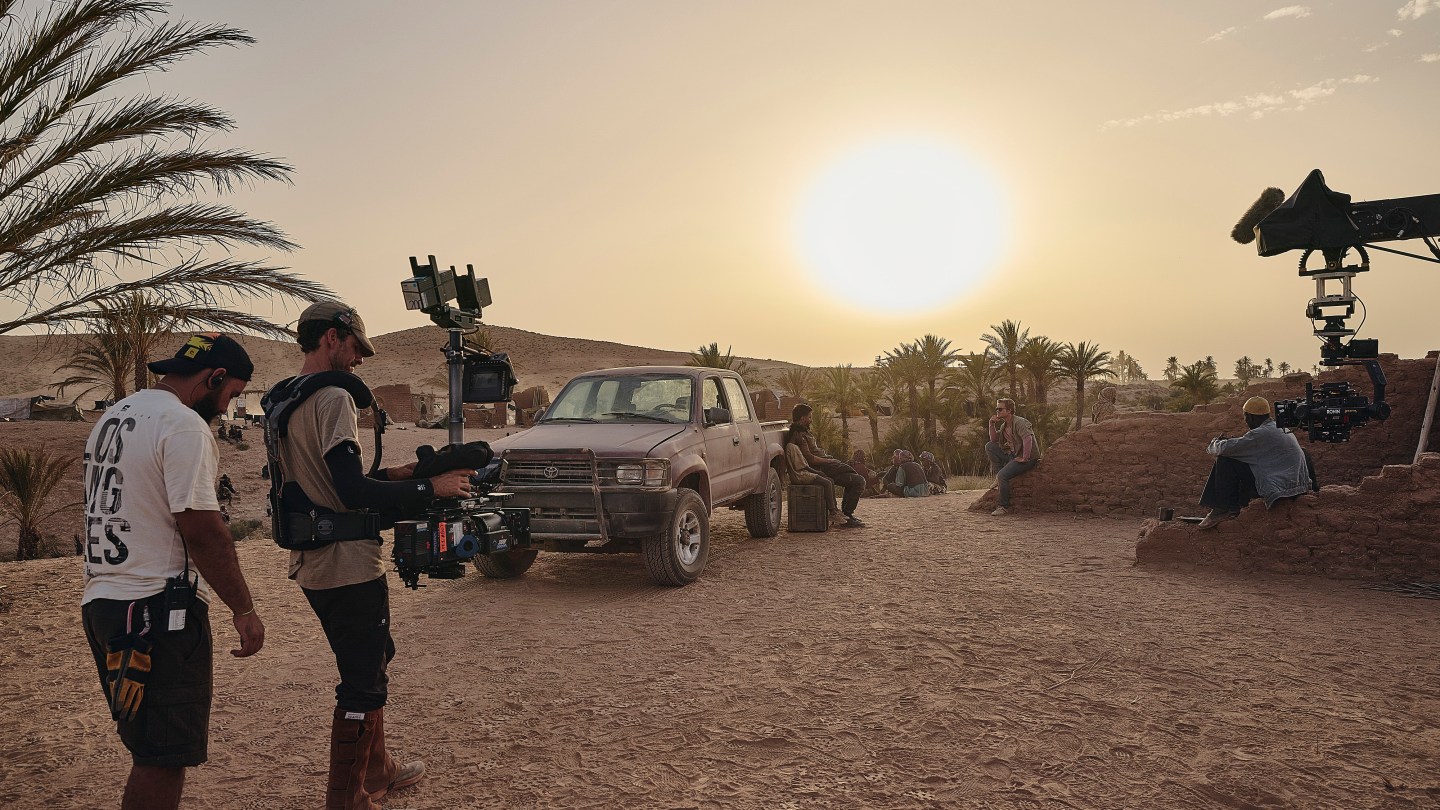


For more than a century, international productions have chased Morocco’s light, its chameleon-like geography and its infrastructure — a place where the Atlas Mountains can stand in for snowcapped worlds, the Sahara can double for the Middle East and historic cities such as Marrakech and Casablanca slip between eras.
What’s changing — and what the European Film Market spotlights by selecting Morocco as its 2026 Country in Focus — is its coming of age as a creative engine, driven by an increasingly export-minded generation of producers.
“Morocco has established itself as a dynamic bridge between Africa, the Arab world and Europe. Filmmakers such as Sofia Alaoui, Hicham Lasri, Maryam Touzani and Nabil Ayouch reflect the strength and visibility of contemporary Moroccan cinema, including the rising presence of women directors,” says Berlinale Pro Director Tanja Meissner. “This combination of creative momentum, industrial capacity and openness to international collaboration makes this the right moment to spotlight Morocco and engage in a broader conversation about its role within global line production.”
For Kasbah Films founder Karim Debbagh, Morocco’s presence this year in Berlin is a full-circle moment. “When I was 19 years old, I met a German filmmaker from Berlin who was scouting for three films that were based on Paul Bowles’ short stories [Frieder Schlaich’s Paul Bowles: Halfmoon],” he says. “This is how I entered the film industry. In 1995, the film premiered in Berlin; I was invited, and it won the Critics’ Prize. Now, after 30 years, I am back in Berlin to present my own project for the first time. It means a lot to me.”
Debbagh’s arc reads like a case study in Morocco’s current evolution: international training, a decisive return to local storytelling and a pragmatic relationship with global production dollars. “I went to the German Film Academy in Ludwigsburg and studied film, and afterwards I tried to make my living in Germany. But then I realized that I am not the one who’s going to tell the stories of Germans. I would rather go back to my country, where I identify with my culture and tell our story.”
What he found on returning to Morocco were “very small opportunities for financing films. That’s why I got into the world of production services,” he says. In 2005, he created Kasbah Films to support Moroccan and international auteur cinema and to provide executive production services for major foreign productions filmed in Morocco.
“Around 2008 was my first American movie with Dan Myrick, The Objective,” Debbagh says. International TV series and films such as The Wheel of Time, Men in Black: International and A Hologram for the King followed. Kasbah Films’ productions include Moroccan films such as The Damned Don’t Cry directed by Fyzal Boulifa, featured in the official selection of the Venice Film Festival in 2022 and the recipient of multiple international prizes; Life Suits Me Well by Al Hadi Ulad Mohand, winner of the grand jury prize at the Tangier National Film Festival in 2022 and selected for Rotterdam in 2021; and Traitors from Sean Gullette, selected at the Marrakech and Tribeca film festivals and awarded at several international festivals.
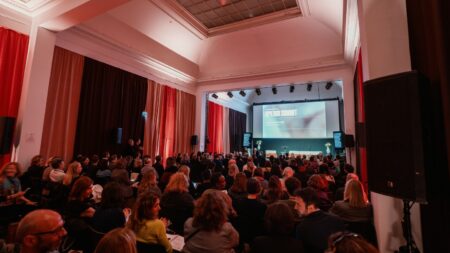
This year, Debbagh arrives at the Berlinale with projects to pitch, including Eternal Peace, directed by Boulifa, Looking For Bacchus, directed by Ali Essafi, and Interzone, a series created by Michael Dreher. At Morocco’s Country in Focus programming — including a Producers’ Spotlight on Feb. 13 — he and nine other producers are presenting fiction, documentary and series projects intended to reflect contemporary Moroccan storytelling. The Berlinale Series Market Showcase, on Feb. 16, crystallizes one of Morocco’s most strategic shifts: moving from a service destination for other people’s stories to a creator of exportable intellectual property, including series designed from inception for international co-production.
Titled “Moroccan Series on the Rise: From Local Success to Global Ambitions,” the event promises an overview of Morocco’s TV fiction landscape spanning drama, comedy and crime. The showcase centers on a core question: What structural shifts are needed to move from local success to globally oriented productions?
Salim Cheikh, CEO of broadcaster 2M, is slated to address audience success, production figures and the role of public broadcasters in building a production culture and regulatory framework. Producer Khadija Alami will share insights from her series K-1, including genre choices, production models and strategies for international visibility. Debbagh will introduce Interzone as an international co-production play. Producer Lamia Chraibi will present an approach rooted in auteur-driven and pan-African projects. Moroccan documentary producer Hind Bensari (475: Break the Silence) will moderate.
Alami, a pivotal figure in the Moroccan film industry, launched her production services company in 1998. Her career began in 1985, with work on the John Landis film Spies Like Us, starring Dan Aykroyd and Chevy Chase, and on Elaine May’s Ishtar, starring Warren Beatty and Dustin Hoffman. But an experience tied to her work on George Lucas’ early-1990s television show Young Indiana Jones Chronicles forever changed her life. “I was working as a coordinator on a show and they invited me to Skywalker Ranch,” she says. “It was mind-blowing and I discovered this whole new world … the scale is so big compared to what we have in Morocco. [I started thinking] it would be great to have a facility like this [in Morocco].” Alami began purchasing land in Ouarzazate, known as the “Hollywood of Morocco,” and in 2015 created Oasis Studios for international and domestic productions. She lives between Morocco and Los Angeles.
In 2017, she became a member of the Academy of Motion Picture Arts and Sciences — the first Arab woman producer and the second Moroccan filmmaker to receive the distinction — and now serves as vice chair of the Academy’s international committee. K-1 is also programmed for Berlinale Series Selects screenings on Feb. 16 at CinemaxX and Feb. 17 online. The show follows an elite police unit traveling across Morocco to pursue organized crime while confronting personal struggles that shape them into “deeply human and empathetic characters.”
“I’m using all the things I learned with foreign productions … to do something Moroccan. I’m the showrunner. I had the writing room. I had three different directors. It’s a limited series, eight episodes,” she says.
Morocco, by most measures, offers a trifecta for international film, television and streaming productions: financial incentives, skilled technicians, experienced executive producers, and diverse filming locations and casting pools. Structurally, this is supported by a 30 percent cash rebate for foreign productions, official co-production agreements with numerous partner countries and initiatives such as the Ateliers de l’Atlas, which foster emerging Moroccan and regional filmmakers.
Through the Moroccan Cinema Center, foreign producers can recover up to 30 percent of eligible in-country expenses, including equipment rental, local crew wages, transportation, logistics, sets and postproduction services. Additional advantages include simplified customs clearance for equipment, symbolic tariffs for filming at historic sites and monuments, VAT exemptions on goods and services acquired in Morocco and air transport rebates from Royal Air Maroc. Government support extends to agencies including the Royal Armed Forces, Royal Moroccan Air Force and Royal Moroccan Navy, alongside streamlined logistics for productions involving military elements or weapons.
Alami notes that productions can open temporary foreign accounts for project-specific entities, maintain control over funds and close the account once filming wraps. “You don’t have to pay taxes here, you don’t pay fringes on crew, you have your own bank account, and you get a 30 percent cash rebate on the eligible spends in Morocco,” she says. The rebate rose from 20 percent in 2018 to 30 percent three years later and requires shoots of at least 18 days and a minimum in-country spending of 1 million euros ($1.1 million), verified through an audit.
Kasbah helmed production services on one of the early beneficiaries of the incentive, the Netflix film Mosul, produced by Joe and Anthony Russo. The company later collaborated on Cherry, the Russo-directed feature released by Apple TV+, and contributed to major global projects including Amazon’s fantasy series The Wheel of Time. More recently, its work has extended to upcoming productions such as Matchbox and the in-development sequel Lords of War, starring Nicolas Cage.
Bianca Gavin, Vice Studios’ head of production for scripted and chair of the Production Guild of Great Britain, recently worked with Kasbah on 2025’s Atomic, a five-part action-thriller series created by Gregory Burke for Sky Atlantic.
“We did a lot of feasibility studies looking at different countries and Morocco was by far the right place for us. Morocco has exactly the kind of mixed terrain and architecture in a relatively small area to double for many different countries without crossing borders. The skills that [their filmmaking] legacy builds make working in Morocco really attractive, because you know they can achieve complex shoots … they’ve done it before.”
She added that, in terms of the rebate, “once we had our shooting permit, there’s no ceiling, so you just know that whatever is qualifying, you’ll get back.”
In a major strategic shift, the Moroccan Cinema Center appointed Mohamed Reda Benjelloun as director in July 2025, setting a forward-looking agenda centered on emerging talent and global positioning. “Moroccan cinema has a long, rich and diverse history, and that legacy is extremely important,” he says. “But from the moment I stepped into this role, I felt it was essential to rebalance our focus toward the future — toward young and emerging talents, new voices, new forms of writing and innovative narrative formats — while positioning Moroccan cinema more strongly on the international stage.”
He points to the European Film Market’s selection of 10 project holders — “the majority of them women” — spanning fiction, documentary and series as evidence of an intergenerational shift connecting established professionals with rising creators.
Benjelloun believes Morocco is reaching a moment of cinematic maturity: “This allows us to reclaim our own narratives — to tell our stories ourselves, to share our realities, imaginations and plural identities with the world, rather than having them defined from the outside.”
Read the full article here