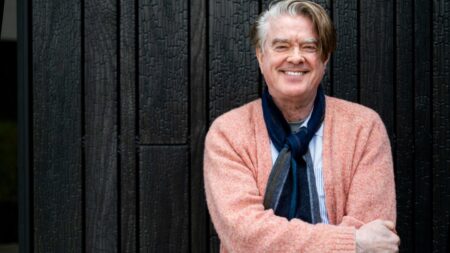





In less than a week, Laurie Metcalf accepted two prizes live on stage in New York: one, a Gotham TV Award for her hilarious turn in Dan Levy’s Big Mistakes, his TV follow-up to Schitt’s Creek; the other, a Tony for her devastating portrayal of Linda Loman in the new Broadway revival of Death of a Salesman. She’s still giving that performance at the Winter Garden Theatre eight times a week, between all of the attention and accolades.
“I forgot what it’s like doing a show during Tony season,” she says over Zoom with a wide grin that indicates she’s definitely not complaining.
It’s an exciting time for the 70-year-old Illinois native, who’s emerged over the past decade as one of her generation’s most decorated stage actors — she’s taken home three Tonys in nine years — while continuing to break new ground on screen. Having emerged with her Emmy-winning work on Roseanne, she’s since won another trophy from the TV Academy for Hacks, HBO Max’s character-driven comedy which just brought Metcalf back for a surprise appearance in its final season. She also recently took on one of the darkest roles of her career in the divisive new season of Monster, centered on Ed Gein (Charlie Hunnam), as the suspected serial killer’s fanatically religious and abusive mother.
On a quiet afternoon just before the Tonys, and a few hours before Salesman showtime, Metcalf caught up with The Hollywood Reporter to talk about all of that and more.
When you do have your work in two projects being honored at the same time, in Big Mistakes and Death of a Salesman, how do you get your head around that? Especially when the latter remains ongoing.
It’s been a year of getting everything I wished for. I didn’t realize at the time how much that was. But when it all came true, then it all came together. During the past year, I’ve gone from Big Mistakes to two Broadway shows, and now it’ll be back to Big Mistakes again, a couple of weeks after Death of a Salesman is over. It’s one of those seasons that actors can only hope for, and the fact that they’re both being celebrated is such a rarity. I am trying to appreciate all sides of it because something like this just does not happen very often.
You were recognized for a revival in Death of a Salesman, but you did another Broadway show this past fall just before it, Little Bear Ridge Road, which was nominated for best play. Are original works on stage important to you, in terms of what you say yes to? You’ve done a number of them of late.
I love working on a new play. I love being in the room with the playwright, and I love coming up with the very first incarnation of the character, and you’re right, I’ve been able to do that recently with Lucas Hnath and Sam Hunter and Bruce Norris. I got to be in the room with these people and originate their parts, their words. I find that especially thrilling. I’ve never had a negative experience, let’s put it that way, of the playwright being in the room. And I didn’t know how spoiled I was with all these plays being 90 minutes long. (Laughs.) I don’t know the last time I even did a play that had an intermission in it. It was probably Virginia Woolf, and that closed down during COVID — we were the first show to shut down. So Death of a Salesman has been a good wake-up call for me. This is not a lightweight show to get done eight times a week.
Am I right that Little Bear Ridge Road ended up closing early?
Yes, it did.
So what was that like? I am curious about how you’ve found bringing these shows to life, because it’s been challenging for new works to find an audience since COVID.
I feel like that’s not even in my lane. I don’t have any experience in that. I’m surprised, with all the moving parts, that anything gets produced — things can change every other day. I’m always surprised that we end up in a rehearsal room somewhere and we’ve made it that far. As far as the longevity of things, that’s out of my hands. I like to be counted on to bring 150 percent to rehearsals and to the run and try and give an audience the best ride that I can come up with in the rehearsal room.
In the times I’ve seen you on stage, I’ve always been surprised by your approach to a character, whether it’s Hillary Clinton or Linda Loman.
I love interpreting parts, especially parts maybe that I wouldn’t be cast in normally. Say Virginia Woolf: I don’t get mistaken for Elizabeth Taylor, but my challenge in a part like that is to figure out, “Well, what’s a different way in? How can I get the same things that this character wants? How can I do them in my own way?” I love roles like that that make you think way outside the box. We used to do that back in the day at Steppenwolf too, because we couldn’t find plays that had eight 20-year-olds in them, so we would pick a play based on two really good young parts, and then everybody else had to play way too young or way too old. It shakes things up, makes you get really creative.
Rehearsals are part scavenger hunt, part treasure hunt, part anthropological dig where you’re just going clue by clue by clue with what-ifs: “Oh, you’re doing that,” or “Well, maybe I’ll do this.” Then it’s just discovery after discovery and a lot of dead ends, a lot of wrong turns. Sometimes the parts in the script that I have the most trouble with in the rehearsal room, because they don’t come easily, are the areas that I enjoy in the end doing the most during a play. It’s funny. That’s why it’s like a never ending job. It’s never going to get stale ever.
How do you find that, to pivot, with your role in Big Mistakes? It’s a television show for one thing, but also a very different tone. Is it still the same process of trying to find an unexpected way in?
Yes. I look very different than I thought that I would look in that. When I first read it, I had an immediate image of this character, and then after talking to Dan Levy, he imagined it a whole different way. So step one, I’m going to look very different than I thought. So we get rid of that comfort zone idea. I couldn’t have seen this, but the way that he was shooting the show was not what I had expected. Sometimes in TV, I’m used to not as much overlapping and spontaneity and maybe even ad-libbing. That was wide open to us, and that was a big learning curve for me, just because I’m not used to it. I usually stick to my lines and figure out a unique spin on a line.
Now that we know that we have season two coming up, I hope to be a little less intimidated by working that way. I hope that I’m able to join in, especially with Dan and Taylor Ortega, in the kind of banter that they’re able to do, because when you can do it, it makes the whole thing just really come alive and look so spontaneous. I am going to dare myself, challenge myself, in season two to come out of my shell a little bit. If those guys depart from the script, I’m going to see if I can hang in there toe to toe with them a little better.
You’ve done quite a bit of TV comedy. Was that a new way of working for you?
Yeah, the only other experience I had that was with Getting On.
A brilliant show.
It’s one of my favorites. It wasn’t necessarily that we were doing all this overlapping or anything, but it was shot in a similar way where we had a couple of floating cameras that moved and you weren’t ever really even sure where they were. Even though you have a monologue, maybe it’s not even on you. They’re getting reactions from different people. So that’s the only other time I got to experience that.
You came into that show with two other very noted comic actors in Alex Borstein and Niecy Nash-Betts, and yet all of you were doing something different than what you were known for at the time.
It was wonderful casting, and I don’t know if those guys knew what they were doing, but the three of us together — we were all a little different from those original characters [in the original British version], of course in our own ways, but the three of us hit it off off-camera immediately. The writing was so funny. Sometimes in that show, you just had to play against the humor, in order to just get through scenes, because they were so funny and character-driven. I was talking to Alex just the other day and lamenting that there wasn’t a reboot of Getting On, because I would be there in one second. She said, “Well, I’ll approach the guys, see what they’re thinking.” I secretly have my fingers crossed about that happening.
You also returned to Hacks near the end of its run this season. You get to really go for it there, but you’re also coming in as a guest star, which is different for the process, right?
It’s different. They are in the middle of a very well-run machine. When you’re a cameo actor or whatever coming in for one day, maybe two, I find myself scrambling to get the feel of the place at first and the rhythm and how everything works. You’re just dropped in, and you’re going to drop out the next day. A lot of it for me is trying to scope out what the tone is for the show: How big can it go? How small does it have to be tonally in the performance? Jean [Smart] actually came on and did an episode of Getting On, so we know each other, but it’s her show. Maybe she felt the same coming onto Getting On because I was in the machine and she was dropped in on that one. Because even for people with a lot of experience and TV under their belt, it’s a little intimidating.
The fact that those writers originally came up with a character named Weed still makes me laugh. And the fact that they found a perfect way three seasons later to bring Weed back in a clutch situation, I also find hysterical. I was so happy, and I’m sure audiences thought, “Well, we’ll never hear from that character again,” because basically she got fired and kicked off the bus and never heard from again. All of a sudden, Deborah really needs her. It was so clever the way they brought her back. And they saved the costume. It’s the exact same costume and everything. So that was like an old glove, I’ll tell you.
Coming in for a shorter period of time, though, do you maybe feel that permission to go a little bigger? Weed is certainly a disruptive force.
Yeah. I’ve been lucky on shows like that. If I make a big, bold choice — you’ll either be told, “No way,” or “Go ahead.” I did one episode of Monk and I was playing a character that interacted with Tony Shalhoub. It was a quirky character, but I took it to a level that was beyond quirkiness. I changed my look. It was outrageous. When I started pitching what I thought she would look and act like, it scared a lot of people on that well-oiled machine. Tony just said, “Ah, just let her do what she wants.” And so they did. I’ll have to go back and look at it and see if it’s as broad as I think it is, but I’m pretty sure it is.
Was Hacks the same way?
Yeah. I got into the wardrobe and without much supervision, I don’t think, from the writers. Then I showed up on set and just started screaming. I started being way too loud, and they let me go for it.
I don’t think you’ve been in a show with a tone like Monster before, which also aired this season. I imagine that was pretty tough skin to live in. How did you experience that?
I know that the scenes came across as intense and maybe even cruel, I’m not sure — definitely intense — but I’ve got to tell you that I did most of my scenes only with Charlie [Hunnam], and between the two of us, we actually had some fun. We knew that we didn’t want to have their relationship stereotypically set in the way that mother was just this monster; we were trying to find a balance whenever we could of, “OK, it’s misguided, but is there some love under there? Is there someone trying to teach her son some life lessons?” That’s what he and I were searching for, just not to let it just be black and white, to find a little bit of gray in the mix. I don’t know if we succeeded, but it kept us from just being burnt out at the end of the day because we were looking for nuanced, smaller moments where they could even enjoy themselves a little bit or have a nice meal or do a little dance. So those things helped us, helped me. I was a drop in the bucket in that series, but it helped me not crash and burn at the end of a day.
Why do you say you don’t know if you succeeded?
I don’t know if people could see any heart in any of the relationship, or any of the love. Did it just remain too unbalanced, that he was just the victim of her? I don’t know. I don’t know what audiences took away, but that’s what we were aiming for.
Is audience or critical reaction something you try to avoid?
I try to. I don’t know what a specific audience member will pick up on or relate to. I have no idea. I just try to stay out ahead of the audience. I try to build in some surprises along the way. I don’t want to be predictable as a character. I guess that quality equals boring to me. I don’t want to be boring. That’s unforgivable.
Read the full article here