

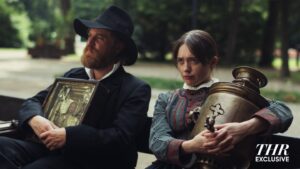

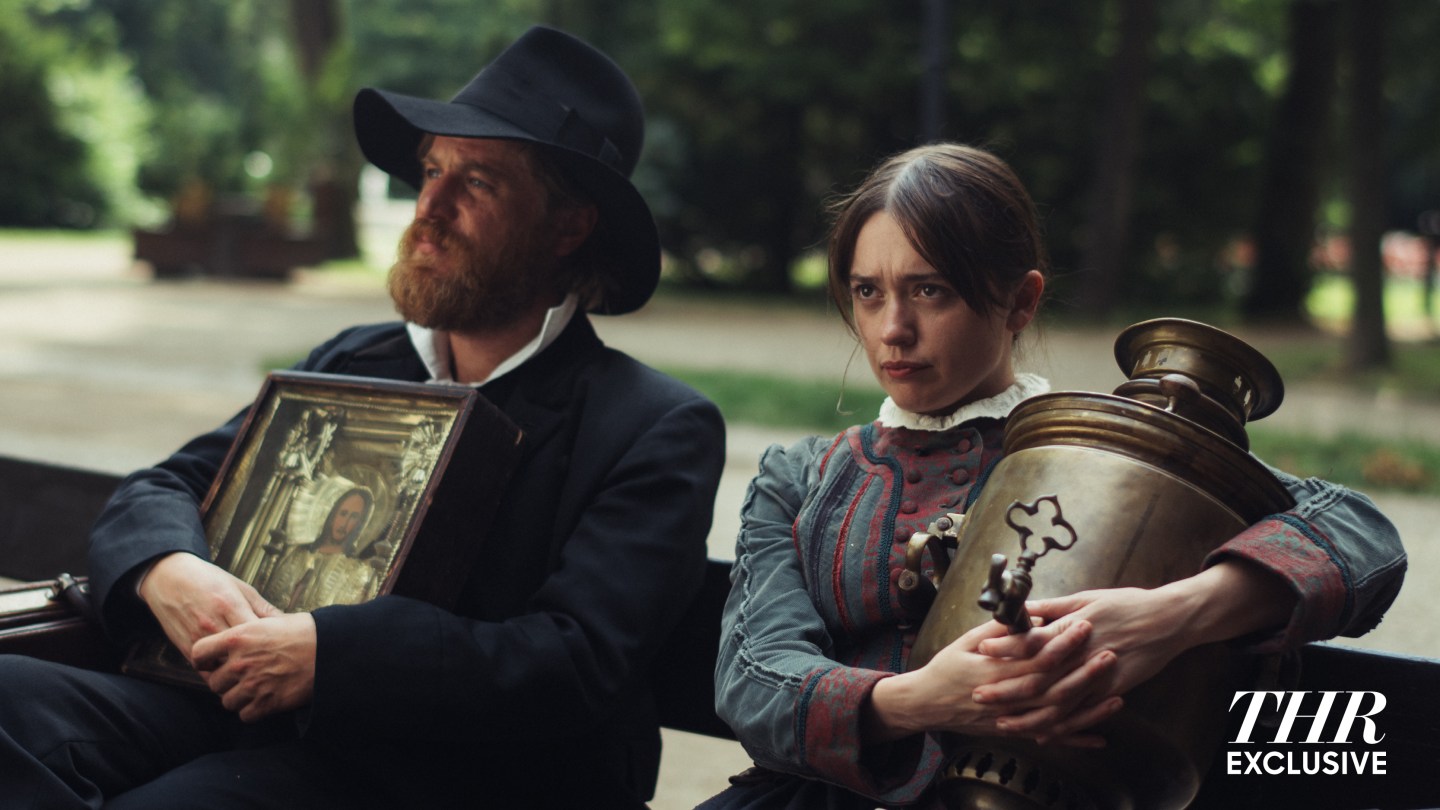


What went into one of the wildest works from one of our greatest literary minds? The Idiot(s) cannot be fully trusted on matters of factual accuracy, but in the unhinged spirit of its portrait of the love between Fyodor Dostoevsky (Johnny Flynn) and his great love of the time, Anna (Aimee Lou Wood) — set during the period when the former went on to write his novel The Idiot — you can trust that the filmmakers and artists had their own kind of singular, bizarre creative alchemy going.
The movie, directed by filmmaking partners and former life partners Małgorzata Szumowska and Michał Englert, imagines the pair on a kind of dizzying romantic holiday, causing constant chaos everywhere they go. Fyodor, as we meet him, is an addict and a bit of a mope; Anna is his great supporter and, also, his great equal in terms of unpredictable temperament. And so they go on a series of strange adventures best witnessed rather than described. Except for the few that Flynn and Wood tease in their first conversation about The Idiot(s), which premiered Friday night at the Telluride Film Festival and next heads to Toronto. True to their film’s form, it’s freewheeling, oddly insightful and surprisingly sweet.
This is a highly idiosyncratic project from two Polish filmmakers. How did you get involved?
JOHNNY FLYNN I’d met Małgorzata for another film years ago and thought she was incredible and I was really sad that that one didn’t work out. Then I’d been a huge fan of Aimee’s for a long time and we have many mutual friends and everyone just kept saying, “You guys are going to love each other.” Sometimes you see the top line of who’s involved and you’re like, “I think I really want to do this.” It was a huge leap of faith in lots of ways. We ended up doing a lot that wasn’t even on the page, a lot of improvisation. And I mean, it was absolutely nuts, I have to say. Absolutely crazy. But brilliant. The best time I’ve ever had on a film. It was really, really special. I’d read Crime and Punishment in my 20s and it really made a big impact on me. I was like, “Who the fuck comes up with that?” So this very bonkers script about this couple who were the engine of this incredible, imaginative storytelling; I just thought it was brilliant. And meeting Aimee was the best thing that ever happened to me.
AIMEE LOU WOOD I met Małgo on Zoom and she told me that she had the perfect part for me. We spoke about the film for about five minutes and then for two hours or something we just spoke about astrology, our whole life stories, everything. We just went completely off. It was not a conventional kind of meeting. And we just loved each other so much. The movie was always changing and shifting, including when we were filming it. There was a lot of off-the-cuff stuff.
What was so unusual about the process?
FLYNN For a long time, Aimee and I were attached to it and the characters were going to speak with Slavic Russian accents. It was written in that way; then before we went out to shoot and just before we turned up for rehearsals, Małgo and Michał got in touch to say that they didn’t want to do the Russian accent thing anymore. They’d seen another film where somebody was doing that and they thought it was “shit.” And I panicked. I freaked out because I was like, “Oh, you’ve just taken away my whole performance,” because, in my head, Dostoevsky doesn’t sound like me.
For the whole week, I had this midnight idea before we turned up for the first day where I’d play him as Welsh. I don’t know where I got that from, but it was a bloody stupid idea. Małgo and Michał were very good at entertaining this idea that I’d had and they were very sweet, but then I could see them looking at each other like, “He’s crazy.” At the end of the week, I was like, “Fuck it, I just need to embrace this and go on this journey and surrender.” I got in the car with Aimee on the first day of filming and she’s like, “Do you want to pull a tarot card?” And she pulled the high priestess and I pulled the fool. The fool is just pure surrender — go where the road takes you and play and be goofy along the way and throw everything to the wind — and that’s what I needed to get out of myself. I just went with that. We both did.
WOOD There are moments in the film where I’m watching it and I go, I’ll be laughing because I’m thinking that was the day that we almost could not get through anything because we were deliriously laughing. In the script, something that looks quite pedestrian and functional becomes this very kind of gnarly, strange, charged moment. It was very electric because we did not know what was going to happen next, and it was that surrender. It was nuts because it was also how I think it should be more. I think it’s how work should feel more often: We’re going with the flow. The vibe between me and Johnny influenced the vibe of the film.
FLYNN And that was actually really important, that sense of surrender. There’d be days where they would say, “Oh, we’ve got a good idea. Today you’re going to be shitting on your landlady’s doorstep.” I was like, “That’s not in the script.” It required a certain amount of bravery, but once you just said, “We will do whatever you say and we will trust you and we’ll all be in this together,” then amazing things happened. It was kind of magic. We were in no resistance to what they suggested.
What you’re describing is reflected in the tone of the movie — a kind of wild, comic audacity. When it came to the story of Anna and Fyodor Dostoevsky, why do you think that matched their sensibility?
FLYNN There was a sense of these people as chaotic and messy and passionate, and that is what makes them brilliant. It was all set up very carefully for them to be so outside the situation. In Germany, they’ve gone on this kind of honeymoon thing, but actually they’re trapped because they can’t go back — they’re in debt and stuff. So they’re in this kind of chaos spiral, but also within that, there’s such humanity and realness and passion and love and heartbreak that it’s not about these two studious people who sit down at desks.
They’re having to play so many games, but then between the two of them, there’s this real, deep love and connection — despite what modern Western audiences would call toxic behavior, they love each other through that. That’s a really amazing, responsible story to tell now, when people are very prudish about people fucking up. People get thrown under the bus very quickly, but actually, here are two real damaged people. They come with all their trauma and it all plays out. You get to watch it and in between it there’s these amazing connections, whether it’s romantic or intellectual or whatever or reactionary. And then in the middle of it, there’s a story happening that you don’t really realize until the end.
WOOD Małgo and Michał say they feel a very deep connection between the two of them and the two of their characters. They always have felt like misfits of a certain film vibe; they were at film school together. In these more kind of conventional places, Małgo and Michał feel probably quite like the couple feel in the film — out of place. There’s something so endearing and gorgeous about that, how it really is the guts of the two of them to just be who they are and not code switch, nothing. They just are who they are. And that’s why I think that really helped as well. Really, really being so comfortable with strangeness and other people not understanding. They know their relationship and they know the push and pull of it and they understand it.
Anna and Fyodor don’t need all these people in the West to understand what they’re doing because they get what they’re doing and they get what they’re doing when they’re writing together. They don’t have a system and a process that is recognizable to anybody else. It’s different. And that’s the same as Małgo and Michał.
What would you both describe as your wildest day on set?
WOOD The last day was quite wild because we knew it was the last day and we were all so bonded. From the moment I woke up, I had that feeling in my tummy of the end. It was so sad and devastating, and you just start to try and maybe put a few little tiny walls up to protect your heart a bit from the leaving. But you can’t do that in that world because our leaders are so not that — they’re like, “No, let’s go into it. Let’s go into that feeling. Let’s not turn away from each other. Let’s be in the ache.” We had so much to do, and we just also were dealing with huge, huge feelings. I just remember walking around with that little portable speaker and we’re dancing — because we had to carry a speaker around with us everywhere we went just so that we could not fall into despair; we had to have constant cheery music on — and we kept going and going. The day kept getting longer and longer. In between scenes, we’re all hugging each other and sobbing. And then we shaved your beard, Johnny. We went and shaved your beard and then we burnt the beard. Or did we burn the beard?
FLYNN Burnt the beard in a ceremony. On a Saturday night, every weekend, there’d be a community dance and they’d play really good music, but it was all these people over the age of 50 dancing and doing quite classic dance moves in this huge, beautiful hall. And we ended up there in the garden burning this beard.
WOOD While crying.
FLYNN It smelled awful. Yeah, it was all mad and all brilliant, and embracing the madness was a big creative leap for me. It taught me a lot about trusting that openness that you need in this business. In a time where film is so locked into the concept of marginal error because of financing and stuff, doing something that embraced bold storytelling was so refreshing because it was normally stuff that gets shut down by producers and financiers: “What do you mean you’re going to do an extra scene where X, Y, Z happens?” Then that scene ends up in the film and it’s one of the most beautiful moments. I mean, there’s a whole sequence in the film that’s a dream sequence where it starts in our apartment and then the camera spins around and you realize that everybody, all the characters from the story, are watching us play this out. That whole couple of days was absolutely nuts. Insane. I didn’t know I was going to be whipped naked by Aimee’s character’s mum until it was happening, and it was just like, Yeah, great.
You mentioned the improv. The film also features a lot of intentional anachronisms and, as we’re discussing, plays by its own rules. Were there parameters for the experimentation? Could you truly go anywhere?
WOOD There was a definite structure and there were definitely very sturdy anchors for us. It was more what would be added on the day, like a brand new thing. We kind of did everything that was scripted, I would say. It was like we had two scripts, maybe — the second one, we did not know of until we arrived on set. It was like there were kind of two going on at the same time that were merging.
FLYNN The more we got into it and the more we brought, the more they responded. We realized that that’s what they wanted was for us — to be invested in that level. There’s the scene where Anna finds me drunk being thrown out at the casino and it’s all the local people. And the scene that was written was a tiny scene in the middle of that, but everything that spans either side of it, which I love so much — that’s improvisation we did after that went on and on and on.
WOOD So crazy. It was so long because they just let us go. We were walking down the street in this gorgeous little town, fully screaming at each other and jumping on each other. But that was a tiny scene in the script, and that is probably my favorite moment.
FLYNN I’ve never had that kind of symbiosis where, especially on any film of this size, it’s always trying to punch above its weight in terms of how much you’re shooting and what you’re trying to achieve. But it was just so hungry for what you would give it, and you felt that reciprocal kind of relationship. We knew our characters so well by then, and we would just be chucking more in. It felt so playful and so raw and fun and quite rare for an indie film to be that brave.
Read the full article here