





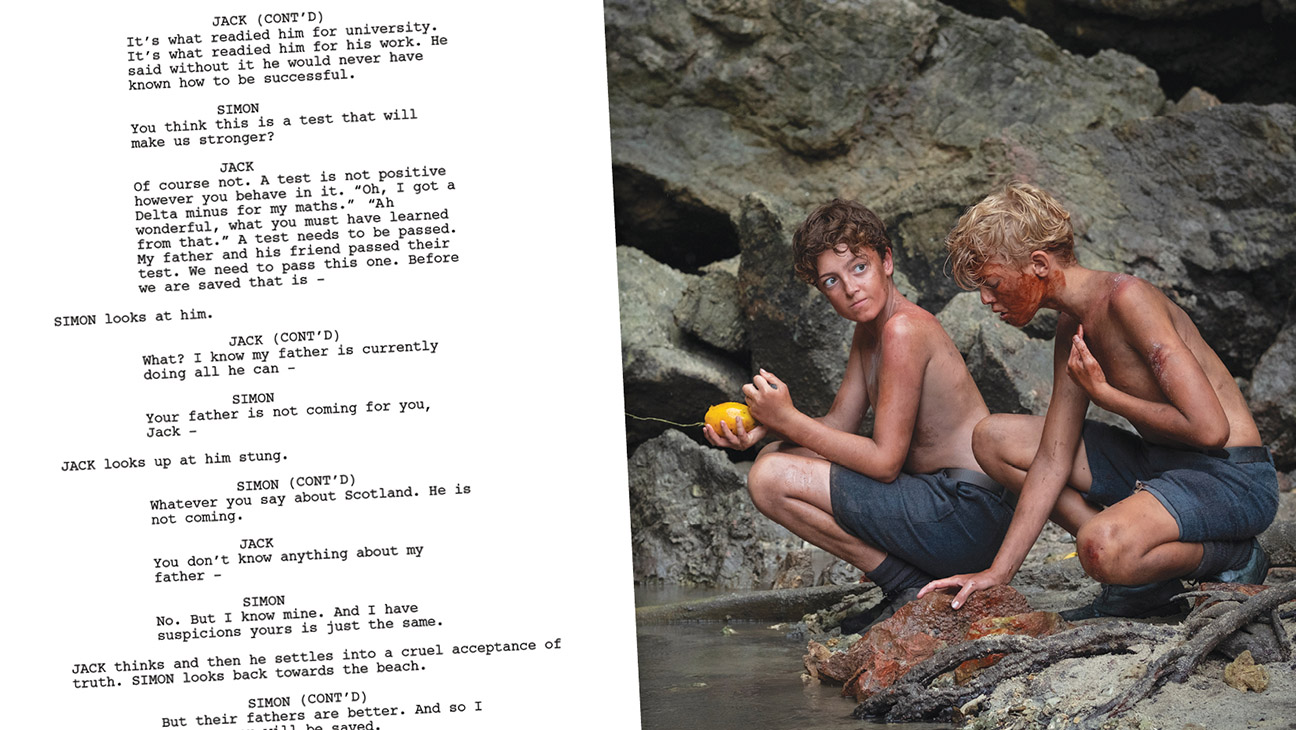


In Jack Thorne‘s unsparing and often harrowing adaptation of William Golding’s classic novel Lord of the Flies, honoring the source material ruled the day: “Our biggest aim in the entire telling of this show was to be incredibly faithful to what Golding had done,” says the Emmy-winning writer for Adolescence. That did not always mean strict scene-by-scene repetition, however — far from it. Each of the Netflix hit’s four episodes was told through the lens of one of the main boys stranded on an uninhabited island, making dangerous choices to govern themselves and survive. In this excerpt from the third installment, we see a pivotal interaction between the cocky Jack (Lox Pratt) and the relatively subdued Simon (Ike Talbut) that enhances the themes of the original novel. “I tried to lean in to complicating the story rather than simplifying the story,” Thorne says. “And Jack and Simon’s relationships with their fathers have a lot of similarities to them.”
Jack has just relayed to Simon a story his father often tells him about a 10-day hike from his youth that made him the man he is today, to signal that this, too, could be an experience of proving one’s mettle. It’s insight we get into the character because he’s speaking to Simon, specifically. “This is the first proper time we’ve seen Jack and Simon alone,” Thorne says. “And we see that when they’re alone, they talk in a different way than when they’re around people — and that’s accepted by both of them.”
Simon is challenging Jack in a way we haven’t heard him do before this point in the series. For Thorne, that turn is crucial to the adaptation for two reasons. One: “Simon was me when I was a kid — he was the outsider who doesn’t really understand the logic of friendship.” And two: This imagined new scene offered an opportunity to honor Golding’s writing in a fresh way. “Simon is revealing a different side of his character, but actually he does in the book show this slightly flinty edge a few times,” Thorne explains.
“The lessons that Jack has taken from his father are crucial for how you understand Jack on this island, and the lessons that Simon took from his father are crucial for how Simon behaves on this island,” Thorne argues. “What Jack is doing at this moment is going, ‘I’m here because I’m not going to let myself down and I’m going to pass this test.’ What Simon does, ever so gently, is stick a needle into that, and the balloon slowly dissolves in front of Jack. … It allows us to have a whole new understanding of Jack.”
Jack’s abstract, prideful story about his father allows Simon to guide them to a brutal reality: They’re not about to be rescued. “I knew that the scene had to get to the point of: ‘Our fathers aren’t coming,’ ” Thorne says. “It had to get to the point of: ‘I know your truth and my truth, and you may dress up all sorts of things to the other boys, but I’ve sat with you crying at 8 years old when our fathers didn’t come for us — and there is no way they’re coming for us now.’ “
The scene ends with Simon painting Jack’s face, after he’d initially walked in on him trying to do it himself — to great frustration. It’s among the most intimate, warm scenes in the series, one that has sparked considerable speculation about its deeper meaning. “I’ve ended up talking to a lot of [viewers] about it, where they’ve been searching for a meaning: ‘Is it sexual? Is it this? Is it that?’ What I do know is that they have enjoyed physical intimacy, by which I don’t mean touching each other sexually — I mean hugging each other when they’re upset or lying with each other when they’re sick,” Thorne says. “But I don’t know what the sexuality of either of these boys is, and I don’t know that they know at this moment what their sexuality is. They’re not quite at that place yet.”
This story first appeared in a June stand-alone issue of The Hollywood Reporter magazine. To receive the magazine, click here to subscribe.
Read the full article here