



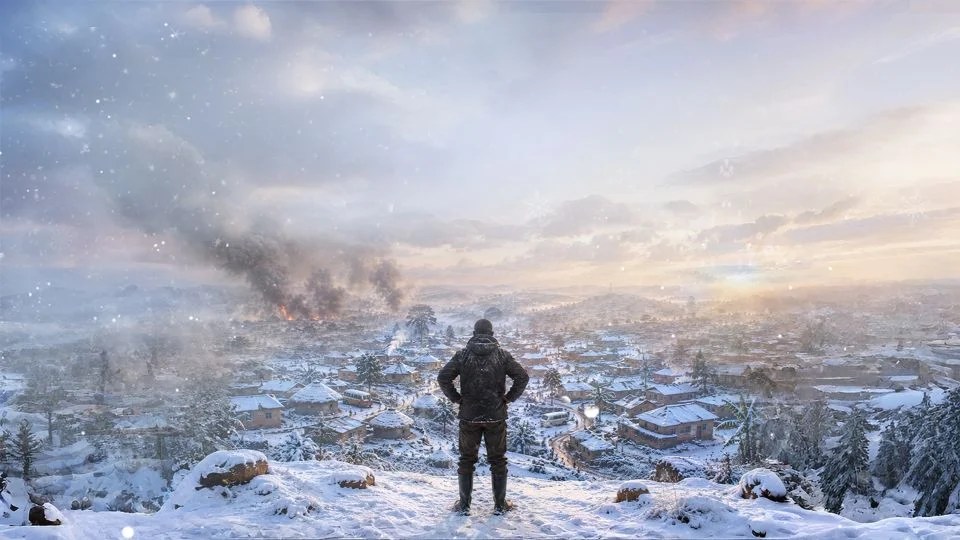


Snowfall in Uganda? Welcome to the world of A Vineyard for A Lobster, one of the works-in-progress film projects presented during the 2026 edition of Open Doors, the Locarno Film Festival‘s co-production platform and talent development program for filmmakers from equity-seeking communities and regions where artistic expression is at risk.
It is in the works from Talemwa Pius (short films Engaito, Rations, Bitingu) and producer Emmanuel Gashumba of Uganda’s Gripmagic Uganda Limited.
The team behind the project, presented during the second edition of Open Doors with a focus on films from Africa, was one of the two main winners of the Open Doors Grant.
THR has compiled highlights about the movie and insight from Pius about the project and the themes it explores.
Synopsis
The equatorial village of Rukumba has endured months of drought when suddenly snow falls overnight, an impossible event blanketing the land in white. Kamuturaki (48), a failed trader once mocked for selling winter jackets under the blazing sun, becomes an overnight success. Byeitaka (40), a disgraced preacher, declares the snow divine and sells melted snowflakes as holy water to frightened followers. Kagoro (38), the timid chairman, watches his authority erode as the village reorganizes itself around the miracle.
When British envoys arrive, promising support for Rukumba’s independence from Uganda in exchange for access to the snow for scientific research, the village committee embraces the deal as progress. As competing ambitions take hold across the village, tensions rise and unrest erupts, forcing Ugandan military forces to intervene. By the time the snowfall melts, Rukumba is no longer a community but a collection of competing interests each convinced the miracle belongs to them.
Director’s note
A Vineyard for a Lobster grows out of my interest in how colonial structures continue to shape authority, belief and communal life in Uganda decades after independence. It begins from a question of what happens when something foreign enters a fragile social order and exposes what was already unstable.
In the film, an impossible snowfall in a Ugandan village becomes a political allegory, echoing colonial intrusion. Its origin is never explained; what matters is what it reveals. As each character assigns the snow’s meaning according to their needs, the village begins to fracture. I explore how collective failure forms through ordinary self-serving decisions. The arrival of outside interests reflects a pattern that has shaped much of Uganda’s history, where promises of advancement often come tied to the erosion of local agency. I want the film to feel grounded and unsettling, immersing the audience in a community breaking under its own contradictions.
What was the inspiration for you to want to make this film?
The film came from a question that has been sitting with me for a while. What really changed after colonialism, and what didn’t.
Growing up in Uganda, you get used to certain things just being the way they are. But at some point you start feeling that a lot of these colonial systems are still there. The way authority works, even how belief is organized. It looks stable on the surface, but there’s always tension underneath it.
The idea of snow falling in a drought-stricken village came as something like a foreign presence entering a place and forcing people to respond to it in different ways. From there, the story became about what that kind of presence would expose in the village. The snow doesn’t break the village. It brings to the surface what was already unstable, so we can finally see it clearly. Almost like putting a face and name to it. And then the question becomes, now what. How do we become responsible to each other? How do we build better systems?
I’m interested in how people react to it. Some try to profit from it. Some turn it into belief. Others try to control it. And in the middle of all that, you start to see how weak the sense of collective responsibility really is.
That’s where the film comes from for me. Not the event itself, but what it reveals about people when something bigger than them enters their world.
How universal are the themes of the film, and why should people outside your home see it?
Even though the film is set in a small Ugandan village, it’s really about colonialism across time. Not just what happened in the past, but what carried forward, and what is still happening now in different forms. You can see it in how resources are controlled and how decisions are made for communities from the outside.
The film speaks to people who have lived through that kind of history, and also to those who are experiencing it in the present, whether they call it that or not. Because at its core, it’s about what happens when something external or foreign enters a system and begins to reshape it, and how people respond to that kind of pressure.
At the same time, it’s also about responsibility. About what happens inside a community when systems are weak, when accountability is not strong, and when people start choosing individual survival over collective responsibility.
We are very conscious of that while developing the film. Even though it has a strong commercial direction, we’re also thinking about how it can create impact beyond the screen. We’re already considering an impact campaign that can engage with communities where these questions are still very present, not just in Uganda but in many parts of the world. So the film is not only meant to be watched but it’s meant to start these kinds of conversations.
What is the next step for you and your collaborators after Open Doors?
Right now the focus is on writing the script. Open Doors helped clarify a lot of things, so the next step is to sit with that and push the project into a solid draft.
At the same time, we’re continuing conversations with collaborators we connected with in Locarno, and looking at how to structure the project for the next stage of development and financing.
We’re also considering a short film version of the project as a way to further explore the world and tone, and to build momentum around it as part of the larger journey of the feature.
So the focus is really just on moving the project forward in a concrete way, both on the page and around it.
Read the full article here