





How do you balance the pressures and demands of a cut-throat low-wage business with your human connections and touch? Or maybe the question should be: can you?
I Understand Your Displeasure (Ich verstehe Ihren Unmut), the fiction feature directorial debut from German writer-director Kilian Armando Friedrich (co-director of the 2023 documentary Nuclear Nomads), who co-wrote the screenplay with Tünde Sautier and Daniel Kunz and edited the film with Leila Fatima Keita, explores such questions, while taking us behind the scenes of the hidden world of the cleaning sector.
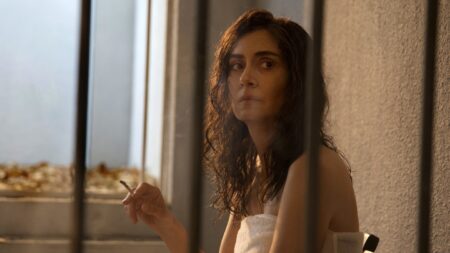
Don’t be surprised not to find past roles for star Sabine Thalau online. After all, she leads a cast of non-professional actors, which also features Nada Kosturin, Werner Posselt, Sadibou Diabang, and Nigyar Velagic.
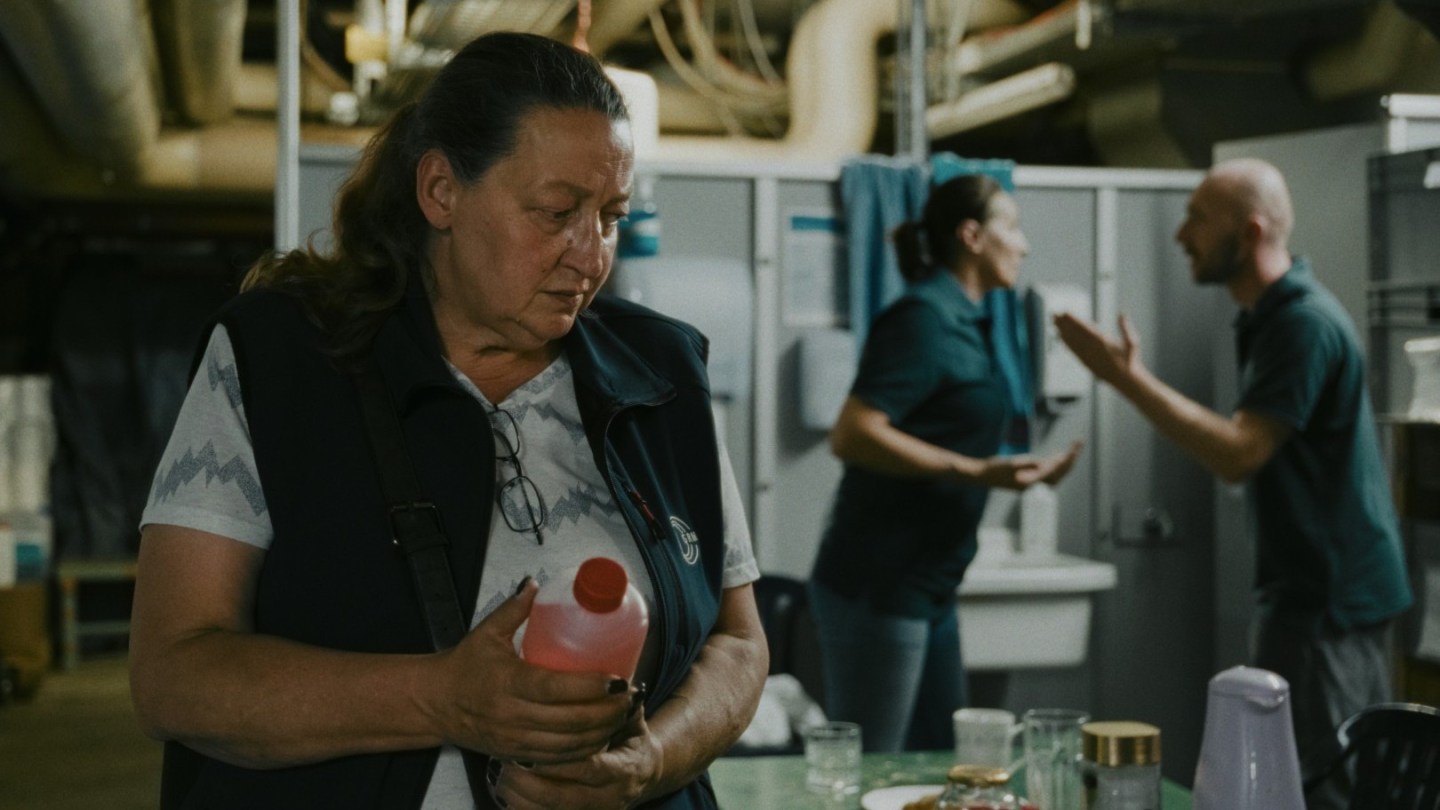
Thalau is Heike, 59, who works as a customer service manager at a cleaning company, a role in which she must mediate between clients, management and cleaning staff. Her attempt to poach a worker from a key subcontractor of her firm leads the subcontractor to threaten an end to their collaboration unless Heike secures more hours and revenue for him. The only way to do so may be for Heike to dismiss one of her own employees. How far will she be willing to go?
Audiences will find out when I Understand Your Displeasure world premieres on Friday, Feb. 13 in the Panorama section of the Berlin International Film Festival. Films Boutique is handling world sales for the movie produced by WennDann Film.
You can check out a trailer for I Understand Your Displeasure here.

Friedrich talked to THR about the personal origin of I Understand Your Displeasure, his love for the early films of the Dardenne brothers, whether fans may be able to see star Thalau in future films, and what may be next for him.
Where did the idea for I Understand Your Displeasure come from?
During some of my school years, an occasional housekeeper worked in the house of my parents. Besides that, she was also a cleaning manager in the business with her own company. This company suffered from a personnel shortage. One day, she asked me if I wanted to join and work for her. So, we started to work together – we cleaned swimming pools, offices, and a chocolate factory. Her workload deeply impressed me, and these experiences stayed with me long after our working relationship ended.
Many years later, we decided to write a screenplay together and started to work on it, but she suddenly took her own life.
I didn’t [understand] what happened with her and why? But I was always convinced that some part of this was the daily pressure of her job, the lack of acknowledgement, and the moral conflicts she found herself [facing] all the time, trying to implement the mindset of a really cost- and efficiency-oriented market on an interpersonal level.
With this film, I want to create visibility and, together with our protagonist Heike, search for a moment of happiness instead of surrender.
Can you tell me a bit more about the pressures of the cleaning sector?
It is really tough because you somehow have to work with a contradiction in this job as a cleaning manager. You have to always fight [and decide between demands of] customers, clients, bosses and cleaning personnel. These are competing interests that are very difficult to reconcile. A contradiction arises between the drive for efficiency and sustainable, humane working conditions. So, I started to do a research to really find out more about the moral conflicts [facing] these people every day. The market has become a race to the bottom. Since the mandatory master qualification was dropped, countless small businesses have emerged, leading to extreme price wars. Unfortunately, clients choose the lowest price over quality or standards – because there is still this stereotype of cleaning as an “easy-job” everyone can do – so it has no recognition.
Watching I Understand Your Displeasure, I felt the protagonist’s and other characters’ stress and breathlessness. Can you talk about some of the creative and production decisions that you, cinematographers Louis Dickhaut and Frederik Seeberger and others made to create such a physical experience?
One decision was to be, all the time, physically close to this character. Through this closeness, we really wanted to eliminate everything outside of the lived experience of our main characters, outside the real-life conditions. Handheld cameras and physical proximity mean you cannot escape into a voyeuristic distance. You are always with her in an immersive experience. That’s also why we didn’t want to use wide [establishing] shots [before zooming in]. We didn’t work with the concept of shots or shotlists. This pressure needed to be translated into an aesthetic form to make the pressure real. We wanted to make sure we would not push our own aesthetics above the character.
In general, it was also important to stay in real time as long as possible and not manipulate the experienced time in a scene with a lot of edits. But when we do edit, it should feel like a real cut, and you’re thrown into a new world. I think this is why you may have experienced this breathless feeling.
The result is maybe not really a beautiful experience, but an intense experience. Also, because these are non-professional actors, it was really important to eliminate this aesthetic approach and say: “Okay, it’s about you, and we follow you. Don’t worry about the camera! We just run after you.”
Sometimes we were rehearsing and then doing 10 or sometimes 15 takes. It became a really physical experience, and I hope that we achieved to [capture] this intensity and authenticity, because everyone really suffered a bit [from this approach] on a physical and psychological level.
Why did you cast non-professional actors for the film, and how did you find them?
I come from a documentary background. That means I am used to working with non-professional actors. But at the same time, these actors are professionals in their world. They are experts in the world I want to tell a story about, which allows me to learn from their experiences. And I learned that these experiences are bigger than any vision I could imagine. How we work is that they can always improvise. They don’t always need to learn a text. There is a script, but there is always freedom to express the words in one’s own way. I give them some words and ideas, but they use them in their own way of talking. I don’t need to tell them how they talk in the cleaning industry, because I didn’t work there for 20 years – that’s a way of giving people a form of security. I don’t want them to feel like doing this for me. For example, Sabine, the main character, gave me a lot of interesting input as well – so directing is not a one-way street. The difficult thing is that you have the final sign-off and decision-making power.
Another reason why I work with non-professional actors is that I try to [avoid using] a hero in the story. Here I am influenced by [Cesare] Zavattini and his Neorealist approach. A hero is so far away from daily life. It’s like putting a wall between the audience and what they see. But when you see a person who looks more like someone you see in your daily life, then your view of this person changes, and you cannot put up this wall between your viewing experience and the real world.
I think that’s a beautiful sense of cinema. I come a bit from this new realism point of view and this documentary background. Real people at the moment fascinate me more than actors. Backgrounds fascinate me more than aesthetics. The consequences of these convictions are always a bit of a chaotic way of making a film, which is also quite hard for the whole team, because you always work with surprises and problems you could not imagine.
What can you share about the ethical responsibility that comes with this?
The cleaning industry is based on invisible labor. You are not allowed to see them. They work during night shifts. They work just one or two hours at a location, then often change the locations, so they have to be fast. And then suddenly you have people from the film industry who are interested in you and say that you belong in front of a camera as an actress. It can be tough and complex for someone who never experienced something like this before. You have a responsibility to be with the people and also find a space to talk about everything we experience together.
What happened with Sabine, our main character, which I’m so happy about, is that she went back to her work as a cleaning manager, but she really wants to continue with acting. I think she has a great talent, and she wants to find an agency. People who have seen the movie have been asking me: “Who is this actress?” The film allowed her to really connect with her artistic identity. It’s a wonderful thing to witness. I could see her in all sorts of roles, even as a great crime inspector, because she has this strength and charisma at the same time.
Do you have any influences or role models? Did I detect a bit of Ken Loach while watching your film?
My influences are, for sure, the movies of the Dardenne brothers, their early works, such as Rosetta and The Child. I like the approach to show an individual experience rather than systematic propaganda. You know what I mean? I don’t like saying, “Here’s the oppressed hero.” For me, that may be a bit of a problem with some Ken Loach characters. But I still love Ken Loach. He’s also a great role model.
When I watched Rosetta or The Child, many questions arose when I saw these characters and thought about these moral conflicts, philosophies, and this big question of how do we treat each other in a society? I love films that allow me to maybe walk out of the cinema and feel connected to a person I used to ignore.
[Albert] Camus wrote in one of his books that people walk differently when they saw a movie. I think he meant this feeling of being a part of someone’s life for 90 minutes, which can be overwhelming, like voyeuristic empathy. I also like films by Cristian Mungiu, the early films of Andrea Arnold, Agnès Varda, Roberto Minervini, Mohammad Rasoulof and also a lot of documentaries.
Tell me a bit about the size of the cleaning sector…
The cleaning sector is Germany’s largest craft sector by number of employees. Sometimes referred to as a “silent giant,” it holds immense economic significance, yet frequently operates under precarious conditions. While 700,000 employees are formally registered for commercial cleaning, there are millions more in private homes, many of whom are not officially declared.
Do you have any new projects or ideas for future films that you could share?
I have some ideas and have been developing another idea. This other movie is about being kidnapped by your own family, because that happens. The family youth welfare office sometimes decided that a child has to be taken out of the family, but there are families who don’t accept that and “kidnap” the child and go into hiding. And I want to make a story about a parent who then goes on a journey with the child through different countries in my home region – the Germany, France, Luxembourg, Belgium region – to try to make a new life. So, I want to tell a story about the emancipation of a child who, at one point, wants to stop this voyage.
Read the full article here