




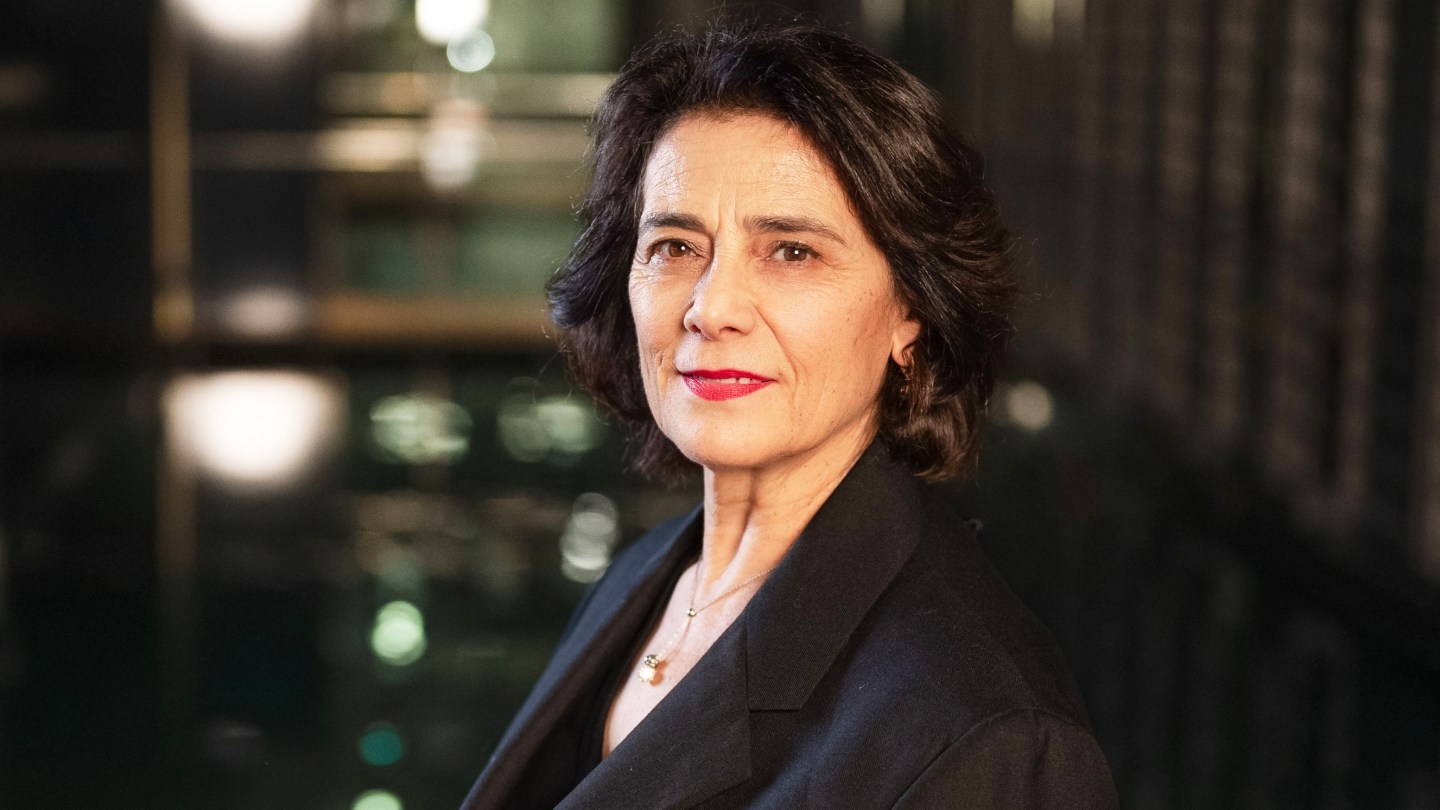


You likely know Palestinian actress Hiam Abbass (Munich) as Marcia Roy from the HBO hit drama Succession.
At the 55th edition of the International Film Festival Rotterdam (IFFR), she stars in Annemarie Jacir’s Palestine 36 and Malek Bensmaïl’s fiction debut The Arab, which world premiered at the Dutch festival on Saturday. On Sunday evening, she appeared in an IFFR “Big Talk” together with Italian actress and director Valeria Golino (Rain Man, Portrait of a Lady on Fire, Hot Shots!, Fuori).
But of course, politics and identity also came up. Growing up as a Palestinian woman, with “a huge inheritance of injustice,” she said acting became a “space of freedom” from pressure. Her goal was, “being a woman that is making choices that go against the traditions that are inherited … from one generation to another, trying to exist as a woman for myself and not for the others, in my eyes and not in the eyes of the other. Suddenly any space of existing for my own and for myself became a space of freedom.”
Abbass also discussed how her recent work has been affected by Oct. 7 and its aftermath and the political and other dimensions of her acting choices. “When you were born in a struggle, really, sometimes you don’t make a difference between the artistic [choice] and the duty,” she said. “And [Palestine 36] is one of the examples. I think another example, very recently in my life, would be Bye Bye Tiberias by my daughter [Lina Soualem, a documentary] that is involving me as who I am and not the actress that I am.”
She continued: “Both movies for me are almost a visit to inheritance and the history that I inherited, and they became, not a slogan, but a duty, really, to be there as part of Palestinian history, when every day it’s threatened to be erased and forgotten. And so it was very important for me to say yes to this movie.”
Abbass added about Palestine 36 that “the participation in that movie was really very important for all of us that said yes to this movie, because it was a duty of registering the archives of Palestinian history forever into a movie that becomes our future archive.”
The shoot was delayed. When the creative team was supposed to shoot, “everything was ready to go, with a fictive village that they built specifically,” the actress said. “So the village was constructed, the team was there, the actors were just flown in. Everything was ready to go on Oct. 14, 2023 but we all know what happened Oct. 7, and then it was just like, ‘What do we do? What do we do?’ So we waited one day, two days, three days, a week, two weeks; no one knew what was happening.”
The delays continued. “But the genocide kept being worse and worse, and the village that they had built became a target of the settlers in the West Bank against the Palestinian villagers,” Abbass said. “And it became too risky even to bring people back… It was really impossible, even insurance-wise.” In the end, after dividing the shoot into two parts, one part was relocated to Jordan. “It was a victory to finally be able to do this movie,” she concluded.
Abbass also chimed in on the debate about method acting, which her Succession co-star Brian Cox has participated in, particularly in relation to their fellow co-star Jeremy Strong.
“I’m really not a method actor,” Abbass emphasized. “I have a hard time working with method actors, but I understand them. Some I understand, some really annoy me, but I deal with [that] as best as I can.”
She explained: “I try so much to separate myself from the character that I play as soon as we say ‘cut,’ to know that I’m not hurt anymore … It’s really important for me, and I don’t want to go home with her feelings or whatever belongs to her.”
Among other topics, the two also addressed how they got into directing. “I wanted to direct since I became an actress” at age 18, Golino shared. “But I think that the obstacle was me. Nobody stopped me. … It was the impostor thing.” She also offered: “Sometimes, being a woman is not all roses. … I am a middle-aged actress, but I am a young director.”
Abbass said she turned to directing out of “necessity” to express what she had to say as a woman and a mother. “One day, I woke up with ideas streaming through my head,” he recalled, which led her to write a short.
The two women also discussed their international careers and how they shape their characters in the conversation moderated by Kristy Matheson, BFI festivals director, head of the London Film Festival and member of this year’s IFFR Tiger Competition jury.
Golino also shared that she remembers seeing Bambi, calling it “a very traumatizing” movie and a “masterpiece.” Abbass recalled playing a woman who loses her son in her village when she was eight or nine years old, causing everyone to cry. “Wow, this is magical,” she recalled thinking at the time.
But Abbass chose learning photography rather than an acting education, to avoid becoming a doctor, before going into theater acting and later moving into movies, she shared.
Earlier in the Rotterdam day, John Lithgow shared his views on J.K. Rowling’s anti-trans stance, calling it “ironic and inexplicable,” and he spoke about what he described as the current “war on empathy.”
IFFR runs through Feb. 8.
Read the full article here