





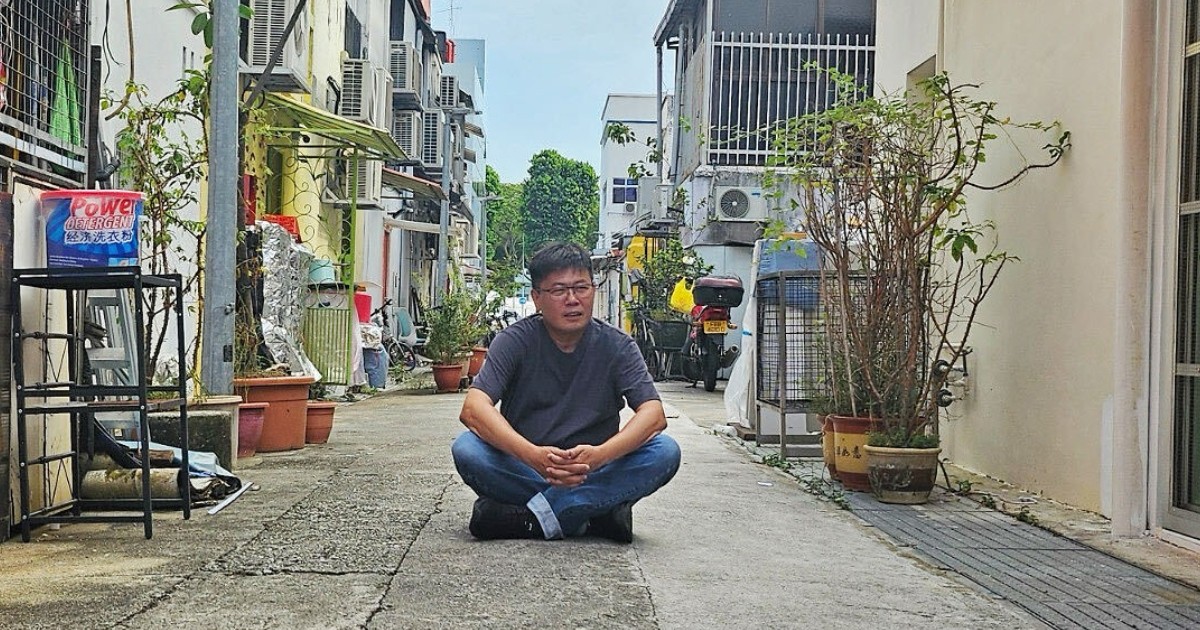


At 51, Allan Lee is the chief operating officer at private education provider CSM Academy International and a strong advocate for mental health.
Looking at him now, it’s hard to imagine that some time back starting in his late 30s, he was struggling to keep himself afloat.
Speaking to AsiaOne ahead of World Suicide Prevention Day on Sept 10, Allan shared about his road to recovery, where he went from what he described as rock bottom to now being able to help others.
At the time, he was working in the media industry, where he held a senior position.
But outside of work, several parts of his life were beginning to unravel.
“There were so many struggles. I was in media, so I was very stressed out. I was also struggling with finances because I made some really bad investments,” he told us.
“What made matters worse was back then, my marriage was also breaking down. I think these were the three main things that made me spiral.”
Hearing voices, losing sleep and appetite
As his struggles mounted, Allan began grappling with voices in head — which would contradict his thoughts.
Any attempts on doing something positive would warrant negative input from the voices, and confusingly, vice versa too.
“The voices that I heard were very troubling,” he said, adding that he attempted to manage it by simply ignoring them at the time.
However, as the voices were coming from within, it proved difficult.
“It caused me a lot of issues with decision-making, especially professional decisions. I was half-confused most of the time,” Allan recalled.
The effects of his deteriorating mental health gradually began spilling over into his daily life.
According to Allan, the most “prominent” consequence was losing sleep.
“You start to sleep lesser and lesser, and you come to a point where you can’t sleep. You may be laying down, your eyes closed, not moving at all, but you are wide awake,” he said.
His insomnia led to fatigue in the day, which affected not only work, but personal safety.
“During work days, I would be struggling. I started to lose concentration, even to a point of when I’m driving, my mind started to drift off. I had many near miss accidents,” he recalled.
He also lost his appetite, and at one point, found himself going without food for three days.
“I didn’t feel hungry. I just wanted to keep going.”
Putting up a strong front
Yet despite everything that was happening, nobody around Allan could sense that he was struggling.
“Back then, I did not share with anyone. There was a pressure to put up a very strong front,” he recalled.
As someone in a senior position at work, Allan said he felt there was an “unwritten rule” that leaders, especially ones at his age then, had to appear strong regardless of what they were going through.
That pressure was not limited to work.
Not wanting his parents to worry, Allan continued behaving as though “nothing had happened”.
“I show up. I smile. I talk like how I behave every day,” he said.
And while nothing gave him away, he said everything was “breaking down”.
Despite what he was experiencing, Allan did not seek professional help at the time.
The stigma surrounding mental health, coupled with concerns over his career and reputation held him back, he told us.
Instead, he convinced himself that he could manage it all on his own.
Not one, but two attempts
His struggles eventually culminated in his first suicide attempt when he was around 40 — which he survived.
He was eventually diagnosed with bipolar disorder after undergoing counselling and speaking to a psychiatrist.
But before that, it did not occur to Allan that he may have had a mental condition.
“It just felt like I was surrounded by problems and troubles, and I just couldn’t seem to get out of them,” he said.
Despite receiving a diagnosis, the road forward was far from straightforward.
Around six to eight months after his first attempt, Allan experienced what he described as a “relapse”.
Recovering brought challenges of its own, as he had to rediscover himself and relearn parts of his life.


He also had to deal with people who did not always understand what he was going through, and may end up saying “insensitive words” or belittling him, he told us.
“The way up is actually harder than falling down,” Allan said.
Another incident eventually triggered a second suicide attempt, which Allan also survived.
The only way is up
It was only after the second attempt that his perspective began to shift.
“I think it’s a sign that my job isn’t over yet,” he said.
“Instead of turning more negative, I started to look at the whole episode again in a more positive light,” he said, explaining that he felt he had hit rock bottom.
“You know the saying, what goes down must come up.”
From there, he began focusing on getting better.
Recovery, however, was “not linear”, Allan said, adding that the first two to three months were “really difficult”, likening it to “healing a wound”.
Having to establish a routine from there was also “very, very challenging”.
To give himself some sense of structure, Allan began setting small goals for himself each day.
“I started to form a very strict structure, like what I want to attempt every day,” he said.
Rather than focusing on everything at once, Allan tried to take things one step at a time.
He also celebrated small victories, recognising each successful attempt at meeting an objective he set for himself.
“That’s how I tried to put myself in a more positive position,” said Allan.

Beyond keeping to a routine, Allan also returned to activities he enjoyed, including music and photography.
He currently plays in a tribute band for Hong Kong rock band Beyond, and specialises in insect photography.


He became more conscious of having too much idle time, as he noticed that his mind tended to drift when he had nothing to do.
“When the flashbacks come back, it’s painful,” he said.
Support from loved ones
Support from those around him was also an important part of his recovery.
He pointed to several close friends who made an effort to check in on him, including David Pang, a photography store owner, who would call him every day even if their conversations were brief.
“He would just ask me ‘How are you? Have you eaten?'” Allan recalled.
Another was Trisha Lim, whom he met at photography club, who would accompany him for dinner every day for three years.
“I have friends like these, so it actually helped a lot. They would pull me along for their activities which I hate, such as jogging,” he quipped.
Allan’s mother, too, became an important part of his support network.
She started to show “a lot more concern”, and made sure that he had warm food when he got home.
Looking back, he said the support from his mother and friends helped shine a more positive perspective on his life.
“I think all these put together, I realised that actually this life is not so bad after all,” he said.
Over time, Allan began channelling his own experiences into supporting others.
His journey of mental health advocacy started around the Covid-19 period, when a career transition took him into the education sector.
While working in a school, he said he encountered a lot of “stressed out” people who had been displaced from their jobs and were taking courses while figuring out what to do next.
Many were dealing with uncertainty over work and their families, and some began opening up to him about what they were going through.
Though he was not professionally trained, Allan found that simply having someone to listen and talk to appeared to make a difference.
He told us he later began receiving thank-you cards.
[[nid:736316]]
A second calling
The experience made him wonder if this was his “second calling” — as helping others left him feeling happy that his “small little actions” or “few kind words” could have saved or helped someone.
Wanting to understand more, Allan began speaking with his counsellor friends.
“I started to realise that it’s something that I can dabble in a bit more,” he said.
Allan stressed, however, that he is neither professionally trained nor certified in mental health care.
Instead, he tries to point people in the “right direction” — whether that means encouraging them to approach a counselling centre, or in more serious cases, seek urgent professional help at the Institute of Mental Health (IMH).
Over time, more people began approaching him, including colleagues, friends, people from his hobby groups and even neighbours.
Allan’s advocacy eventually extended beyond these one-on-one conversations.
He began writing about mental health and contributing articles, while also sharing his experiences at talks and events.
“I don’t tell people what to do, I’m telling people what I think,” he said, stressing that his approach is rooted in personal experience rather than professional advice.
He has spoken at hospitals and other venues.
Allan is also an ambassador at MindsHeart Singapore, a corporate counselling organisation which works with companies to help employees manage workplace stress.
[[nid:740513]]
Rise in suicide deaths for adults in their 30s
The 51-year-old’s past experience isn’t an isolated one.
There are growing concerns over suicide deaths among adults, especially those in their 30s.
According to statistics released by the Immigration and Checkpoints Authority (ICA) on July 28, suicide deaths among those aged 30 to 39 rose by 50 per cent in 2024.
It is the second leading cause of death among adults of the age group.
Males also accounted for 65.8 per cent of all suicide deaths that year.
But what could be driving the increase?
Speaking to AsiaOne, Associate Professor Daniel Fung, senior consultant at the Department of Developmental Psychiatry at IMH said that suicide is “almost always multifactorial”, and an increase in one year does not necessarily point to a new risk factor specific to the age group.
“We need to be careful about attributing the increase to any single cause,” he cautioned.
Still, Assoc Prof Fung said: “The 30s can nevertheless be a particularly demanding period. Expectations relating to career progression, financial commitments, housing, marriage, children and the care of ageing parents may converge at this stage of life.”
He added that there may also be a “painful gap” where society expects someone to be and where that person perceives themselves.
“At 20, uncertainty may feel normal. At 35, the same uncertainty may be experienced as failure,” he continued.
These pressures can also build on other difficulties — including relationship problems, financial strain, social isolation, illness and loss — as well as vulnerabilities that may have developed over time, Assoc Prof Fung added.
Gender may also play a role.
According to Assoc Prof Fung, the figures show that suicide deaths are “disproportionately male”.
“Gender can affect suicide risk partly through differences in help-seeking,” he noted, explaining that males may be less likely to recognise or acknowledge that they are struggling, view their experience as a mental health issue, or seek professional support.
Their distress may consequently remain undetected until it becomes more severe, he observed.
[[nid:723700]]
Why aren’t they seeking help?
Explaining why some may be hesitant to seek help, Assoc Prof Fung said that shame may be a factor.
“There may be shame associated with struggling at an age when people are expected to have achieved stability. A struggling teenager may be seen as still growing up, while a struggling 38-year-old may wonder why they are not coping when everyone else appears to have their life together,” he said.
Some may also feel that mental health services are not relevant to what they are experiencing.
“Relationship breakdown, loneliness, financial pressure, caregiving, disappointment and loss of status are not necessarily psychiatric illnesses. However, when several occur together, they can make life feel unbearable,” he said.
Assoc Prof Fung noted that “apparent success” can also make disclosure “even more difficult”.
“When others assume that someone is doing well, it may be especially hard for that person to say, ‘Actually, I am not coping'”.
These tie into a broader misconception that people should have achieved stability by their 30s and are therefore less vulnerable to distress.
“In reality, this may be the decade in which personal, professional, financial and caregiving responsibilities intensify,” said Assoc Prof Fung, adding that there is also an assumption that “conventional success” offers protection from serious distress.
“Having a job, home, or family tells us relatively little about whether someone feels connected, valued, or hopeful,” he pointed out.
Assoc Prof Fung also added that while mental health conditions can increase risk and should be treated, other factors should also be considered such as relationships, losses, financial strain, substance use, isolation and accumulated adversity.
To make it easier for people to reach out, Assoc Prof Fung said support needs to be accessible through different avenues — as a spouse, friend, colleague, supervisor, GP clinic, religious leader or family member may be the first to notice that someone is struggling.
People in these different settings should be equipped to start supportive conversations and guide the person towards community, primary care or specialist services where necessary, he suggested.


“Mental health literacy should extend beyond recognising psychiatric diagnoses. It should also help people understand how to cope with adversity, support one another and know when professional intervention is needed.”
Support, Assoc Prof Fung added, should begin before someone reaches a crisis point.
Families, workplaces and communities can look out for changes such as irritability, sleep difficulties, excessive work, increased alcohol use, withdrawal, physical complaints, relationship conflict, declining performance, exhaustion, or hopelessness.
When such changes are observed, the priority should be to reach out without judgement and understand what may be happening in the person’s life, he advised.
“Suicide prevention is therefore not solely the responsibility of healthcare services. It also takes place in our homes, workplaces and communities.”
Seeking help is not weakness
This emphasis on seeking help is something Allan also strongly believes in.
Having once convinced himself that he could manage on his own, he now encourages others to reach out.
“Seek help,” said Allan, adding that he recognises that too often, there is a real societal pressure to “look good in front of everybody”.
But to him, voicing out is not a sign of weakness.
“There’s nothing wrong with seeking help. You are protecting yourself,” he encouraged.
“In fact, if you ask me, it’s a brave thing to do to seek help.”
SINGAPORE HELPLINES
- Samaritans of Singapore: 1767 (24 hours) / 9151-1767 (WhatsApp)
- Singapore Association for Mental Health: 1800-283-7019
- Care Corner Counselling Centre (Mandarin): 1800-353-5800
- National mindline: 1771 (24 hours) / 6669-1771 (WhatsApp)
- Silver Ribbon: 6386-1928
- We Care Community Services: 3165-8017
[[nid:728015]]
carol.ong@asiaone.com
No part of this article can be reproduced without permission from AsiaOne.
Read the full article here