




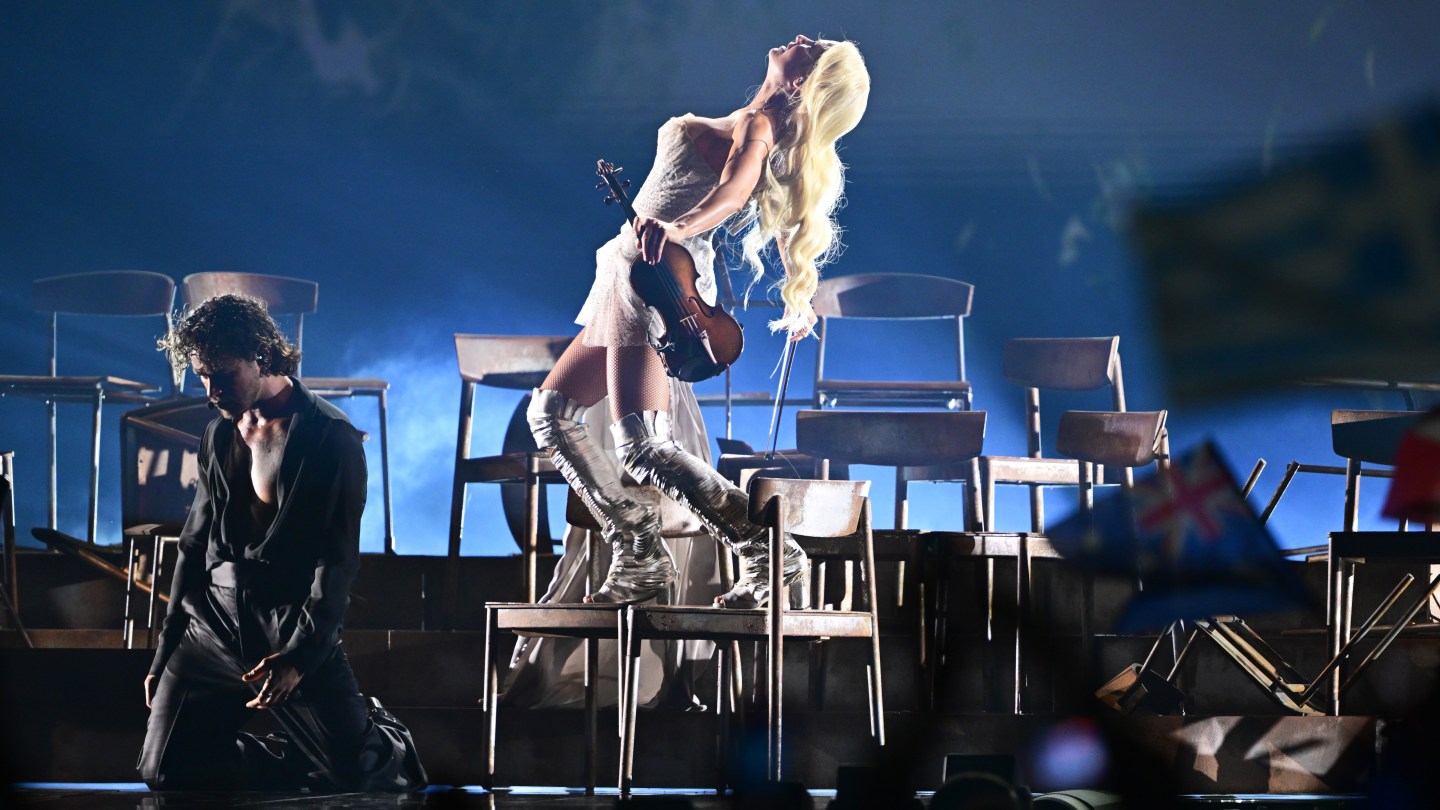


The scene on stage at the Eurovision semifinals in Vienna this week has been the expected assemblage of cheesy love: Greece’s Akylas’ tiger-costumed ode to bling, Satoshi’s rappy anthem to Moldova (“aloha, adio, vida loca”), and, yes, Israel’s Noam Bettan’s French-Hebrew homage to his mythic Michelle. All three advanced to this weekend’s final.
Behind the scenes, though, a scramble has been intensifying to hold together a fragile coalition politically and tenuous competition financially. If the effort fails, this could be the last viable year of the 70-year old mega-institution that is Eurovision. The bold experiment in pop-culture unity — and birthplace of ABBA and Celine Dion — could be no more.
Sources familiar with Eurovision and the European Broadcasting Union that runs it say as a result of Israel’s inclusion, corporate sponsors pulled out this year to the tune of significant double-digit revenue drops from 2025, while the lost licensing fees from the five boycotting countries (Eurovision broadcasters renegotiate their deals every year) caused a further hit. Spain, Slovenia, Ireland, Iceland and the Netherlands are all boycotting this year’s competition and will not air the telecast; the countries pulled out after organizers decided not to hold a vote on banning Israel in late 2025 in the wake of a ceasefire in Gaza.
According to sources, the contest in fact nearly tipped into the abyss with an additional half-dozen countries poised to pull out over the Israel inclusion. Those nations — Belgium and multiple Scandinavian countries are said to be among them — were eventually talked back from the ledge. Had that not happened, it would have been a realistic possibility that Eurovision would have been scrapped in 2026 given losses the organization would have incurred, a highly placed source who asked for anonymity because they were not authorized to speak about the situation publicly tells The Hollywood Reporter. Member fees are the group’s greatest source of revenue, followed closely by sponsorships.
This year’s participation of 35 countries is the lowest since the expansion of the format to include a semifinal round in 2004; at its post-Amsterdam Treaty Eurotopian peak in the late 2000’s as many as 42 countries participated.
What’s more, the financial picture is not much brighter next year. Spain and Slovenia are unlikely to come back, and a continuation of Netanyahu military policies could mean other countries join the boycott, resulting in a potential scrapping of the contest in 2027 with that much revenue exiting.
On the other hand, if the EBU chose to try ban Israel without a clear rules violation in the hope of wooing back those countries, it could make for a rough look for a contest that was “founded with the aim of bringing together public service broadcasters across Europe [and] strengthening ties between nations.” Israel-allied countries could also themselves pull out in protest.
The EBU would not have much grounds to ban Israel; almost no nation ever is no matter how fast and loose they play with voting campaigns. Russia was banned after the invasion of Ukraine, but its media is state-run, and the country has a history of international sanctions that Israel does not.
After the first ten countries, including Israel, were selected in the first semifinal on Tuesday, another ten will be selected Thursday, with those winning 20 and five nations with automatic berths competing in the final this weekend. All will take place against the backdrop of Gaza protests inside and outside of Vienna’s Stadthalle.
The ultimate nightmare scenario for the EBU: if Israel, after nearly winning Eurovision last year, wins this year. The 28-year-old son of French immigrants who sings in French, English and Hebrew, Bettan is considered one of the favorites this weekend with “Michelle,” particularly for the televoting that composes half the final score (the jury makes up the other). If the country won it would mean it would host the 2027 competition — a move sure to trigger further boycotts. Israel has won three times before, most recently in 2018, without major backlash.
Of course it’s that televote that has become such a lightning rod. Israeli broadcaster Kan has encouraged an Israeli diaspora in Europe to vote multiple times — current rules allow ten per phone — in an organized campaign that critics say flouts the rules and defenders say is in fact practiced by a host of countries with strong diasporas. Some critics have also noted that there is evidence that at least some of the money for the campaigns have come from the Israeli government (Kan is independent) — the New York Times ran an investigation this week into the issue. Defenders say that social campaigns from other countries also intermingle funds and a double standard is being applied to Israel. And what is a national popular-song contest for, they ask, if not to boost the standing of the nations or restore a small measure of patriotism to its embattled citizens?
And while boycotters say the contest was never meant to legitimize countries with problematic governments, defenders of Israel argue that plenty of countries participated under right-wing governments — Poland under Law and Justice and Hungary for a time under Viktor Orban — and Israel is being targeted as a Jewish nation.
At any rate, the EBU — either seeing Israel’s rule-bend as too far or perhaps just worried that the country will win and cause it more headaches — last weekend sent a desist letter to Kan last weekend to stop the campaign, which it did. The country still advanced to the finals.
The EBU is in a bind on the televoting rules: it could reduce maximum votes from ten per phone to five or fewer (it’s already come down from 20), but people would just use different phones and, at any rate, the contest benefits financially and engagement-wise from more votes. The best lever might be for the EBU to privilege the jury more than fan voting — but that would undermine the populist nature of the contest and potentially turn many viewers off.
The best hope for the future of the contest, spoken openly among EBU brass: a Netanyahu electoral defeat in the fall. If Israel takes a swing to the center and pulls back in Gaza and Lebanon, it could mean a return of many countries. Or at least so organizers hope.
An EBU spokesman did not respond to a request for comment; a Kan spokesman also did not immediately reply to that request.
Eurovision was founded as an institution above politics, a way to simultaneously stoke national pride while also subsuming the ugliest parts of such identities. As silly as it is on one level (one of the finalists last year was a Finnish ode to the orgasm titled “I’m Coming”), Eurovision remains an oddly powerful ode to the binding power of music and even democratic voting, a Magna Carta in spandex.
Of course, all that was conceived in a haze of postwar broadcast optimism — before the echo chambers of social media, before the balkanization of politics and yes, before the recent resurgence of far-right parties. Whether Eurovision can be antidote to those diseases or just another victim of them remains to be seen. Even if Israel elects a more centrist government, EBU organizers are privately worried, according to sources, that Continental countries could take hard-right turns — the National Rally holds a polling lead in next year’s French elections and Nigel Farage has been making inroads in the U.K. — threatening to turn the whole contest into a kind of democracy wackamole.
If the contest did go away the hand-wringing will begin: did the EBU script its own demise by insisting on including Israel? Or did the boycotting countries kill a good thing for no good reason, especially given that a slew of countries with right-wing governments or in military conflicts have been included before?
For the moment, at least, it soldiers on. Organizers hope that other countries could return even if Israel boycotters don’t; Hungary, for instance, has not been back since Covid but could make a return with Orban now out of power. Eurovision has, its defenders note, endured through plenty of unrest in Europe itself over the past 70 years, from the Balkan Wars on down. As Satoshi tells us in his translated Esperantized Romanian: “Goodbye, crazy life … Forever it calls us to work, to the soup.”
Read the full article here