





Public interest media is being marginalized, generative AI is flooding the market with content, and communalities are evaporating. That was a scenario outlined by AI based on a prompt that was presented by Beadie Finzi, one of the co-directors of documentary non-profit Doc Society, on Monday as part the industry section of the 23rd edition of the Copenhagen International Documentary Film Festival, or CPH:DOX.
Bruno Patino, head of ARTE France, which works on the European public service channel ARTE with ARTE Deutschland, a subsidiary of German public TV networks ARD and ZDF, addressed this scenario and outlined his vision for public media in Europe in a keynote address. “These are not predictions. This is already our present,” he offered. And he outlined what he described as the key risks for a future, in which “AI determines the citizens’ place in society, deciding the information, the culture and entertainment they have access to.”
Patino noted how in the social media age, social networks are “the primary gateway to information,” describing that as an algorithm-driven “push era.” He concluded about media consumption behavior: “People wait for content to reach them.”
At the same time, “the very notion of scale is changing,” with global players looking for more weight and market power, such as in the Paramount Skydance deal for Warner Bros. Discovery, he said. Plus, the “funding ideas of our cultural model are under pressure.”
All in all, in the social media age, “virality became central,” the executive concluded, leading to the “rise of the attention economy.”
With AI, though, content creation becomes easier than ever, but the diversity of voices may be going in the opposite direction. There is “more content than ever before, but diversity could be shrinking,” Patino suggested.
In the AI age, “everything becomes blurred between human and machine, authentic and synthetic, reality and fiction,” he argued, warning: “Media no longer speak directly to citizens. They speak to an agent that speaks to citizens.” He described this new age as “the age of the relationship economy.”
The AI-driven agents, though, deliver “the narrative of our own mirror rather than [of a] community,” Patino cautioned, concluding: “We may simply end up talking to ourselves.”
The ARTE France chief mentioned such European media industry challenges as discoverability, “in an age when AI is controlled by U.S.-based giants,” and the ability to create content, meaning “Europe must rely on the power of coalitions” and imagine Europe as a tree with a strong trunk of shared values and many branches of different languages and cultures. “ARTE is one of these tools. It was made for this,” Patino offered, citing its mission to create common ground. “ARTE can become the European public square.”
The goal here is “not to create a European Netflix,” but “a complementary offer” to national broadcasters in European countries, Patino said, addressing industry attendees: “We invite you to be part of an alliance to oppose the power of data with something essential – the power of imagination, of representation and of symbols that we share.”
He offered that vision as a way into an alternative future. “We can all avoid the dark scenario of AI that governs our lives and our relationships to the world,” he concluded.
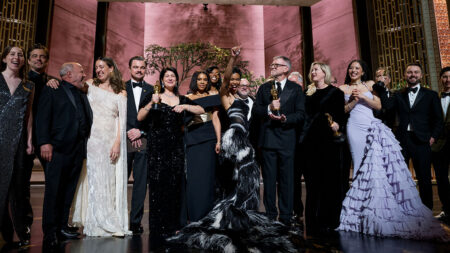
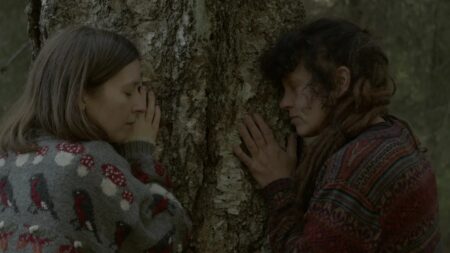
To much applause, Patino on Monday also highlighted that ARTE co-produced the best documentary Oscar winner Mr. Nobody Against Putin and Arte France Cinéma also backed Joachim Trier’s best international film Oscar winner Sentimental Value.
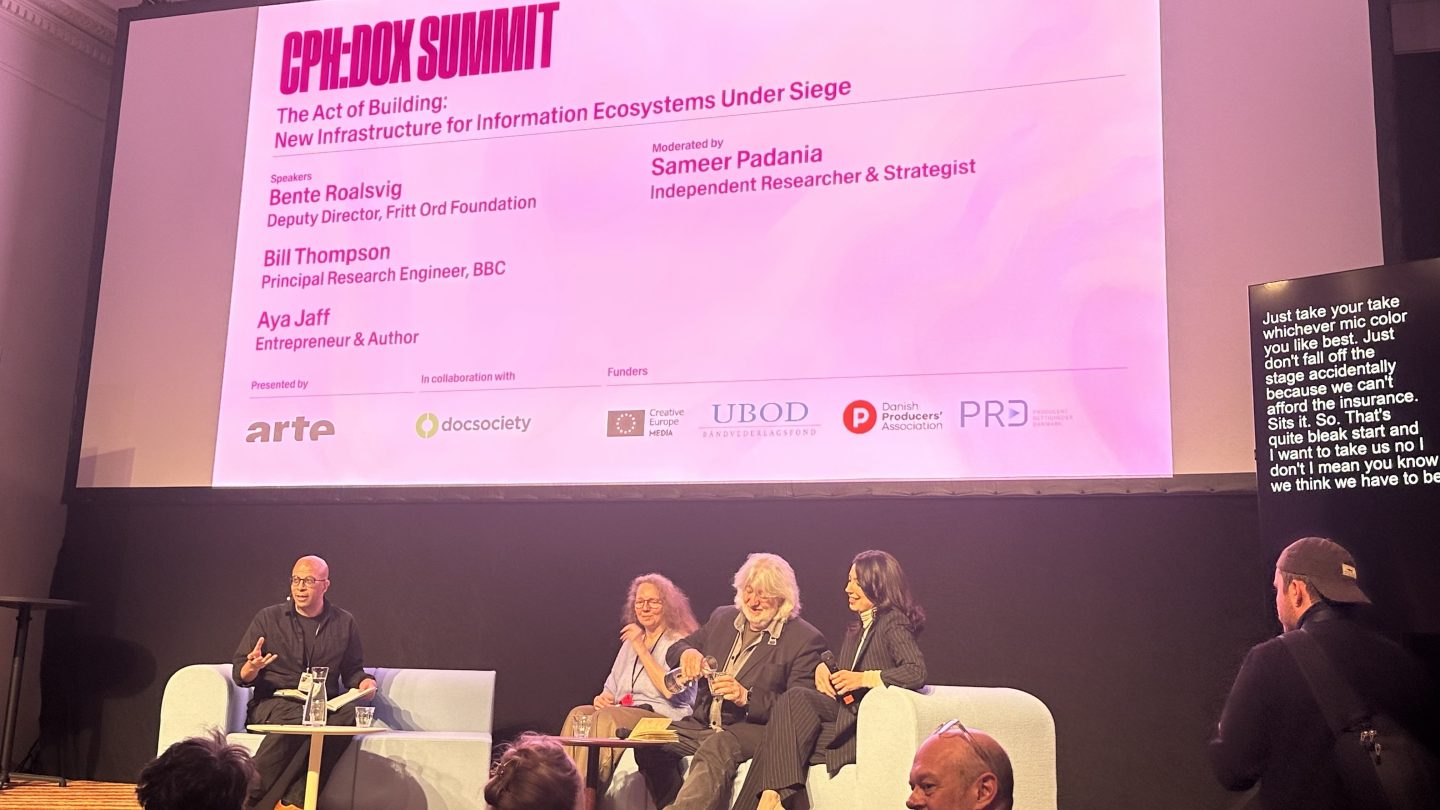
Bill Thompson, principal research engineer at BBC Research & Development, said during a panel discussion later in the day that traditional media have been part of the problem. “Over the last 40 years, independent media in particular became complicit in the activities of organizations that actually do not have our interests at heart, and we’ve allowed ourselves to be taken and absorbed and used in ways that create the crisis that we heard about earlier,” he said. “We’re at the point where things are breaking because the media environment is so toxic. So our inheritance is ultimately that a large number of people, including me, fell for it many years ago.”
They cooperated with “the devil, and we were wrong, and the technologies that we thought could help us turned out to have been designed in ways that could never deliver what we wanted from them,” he concluded before asking: “Are we actually locked into systems which are now under the control of the people who can just take away our freedom when they need to, by killing accounts for independent media organizations on YouTube, by shifting their algorithms so as to privilege certain messages and not others?”
Comparing digital technology and its power players to toxic exes, Thompson said that tech giants now are “replacing direct access to our material with AI-generated, they call them, summaries, … which create another layer between us and our audiences.” His takeaway: “What we’ve inherited is a bit of a mess, and I hope that we can do something about it. And oddly enough, I am optimistic about being able to do something about it, because what technology is taking away, technology can [also] deliver.”
Creating communities where people can “feel the sense of belonging” would be a key goal for the road ahead, Thompson said.
Entrepreneur, coder and author Aya Jaff shared her experience working with Silicon Valley power brokers, saying when they talk about “freedom,” they mean being “free of democratic control.”
Since having turned her back on the tech giants and their financiers and become a vocal critic of what she dubbed, in a book title, the Broligarchie, she has noticed something interesting. “Funnily enough, the more critical I become of this world, and the more critical I am of all of these tech platforms, I realized that I’m also getting offers from them,” Jaff said, sharing an anecdote. “I didn’t have to sign an NDA for this. What they’re trying to do is really tasteless. Amazon reached out to me, and they were like, ‘Oh, we can see you’re gaining so much attention with your critical views, and we like your videos and your stance. How about you do a show with us talking about the perils of the gig workers, for Amazon itself, talking about the negative sides of all of that gig economy. And let’s call the show Eat the Rich.”
Jaff’s reaction: “Really?! Amazon wants to call the show Eat the Rich? Now you want to also monetize the movement against you?! Of course, I said no, but I did want to share that.”
Later in the summit day, investigative journalist Carole Cadwalladr warned: “There is less time than you think. … If we do not act now, we are not going to be in a position to tell some of these stories.” She pointed to the “total collapse” of press freedom in the U.S. as a sign of the velocity of change. “We have seen the speed at which U.S. press freedom has collapsed, all forms of democratic accountability, within one year,” she said.
Cadwalladr also warned that we “still live in this sort of fantasy land that the billionaires are going to come and save us in some respect, that there’s going to be some magic pot of funding that’s going to appear and is going to actually solve a lot of these problems.” She concluded: “The general public is quite far behind in understanding the urgency and the gravity of everything you’re talking about in this room. So I would say, those of you who are commissioners, please, really get out there and start telling your audience. Find those stories which communicate that.”
Read the full article here