




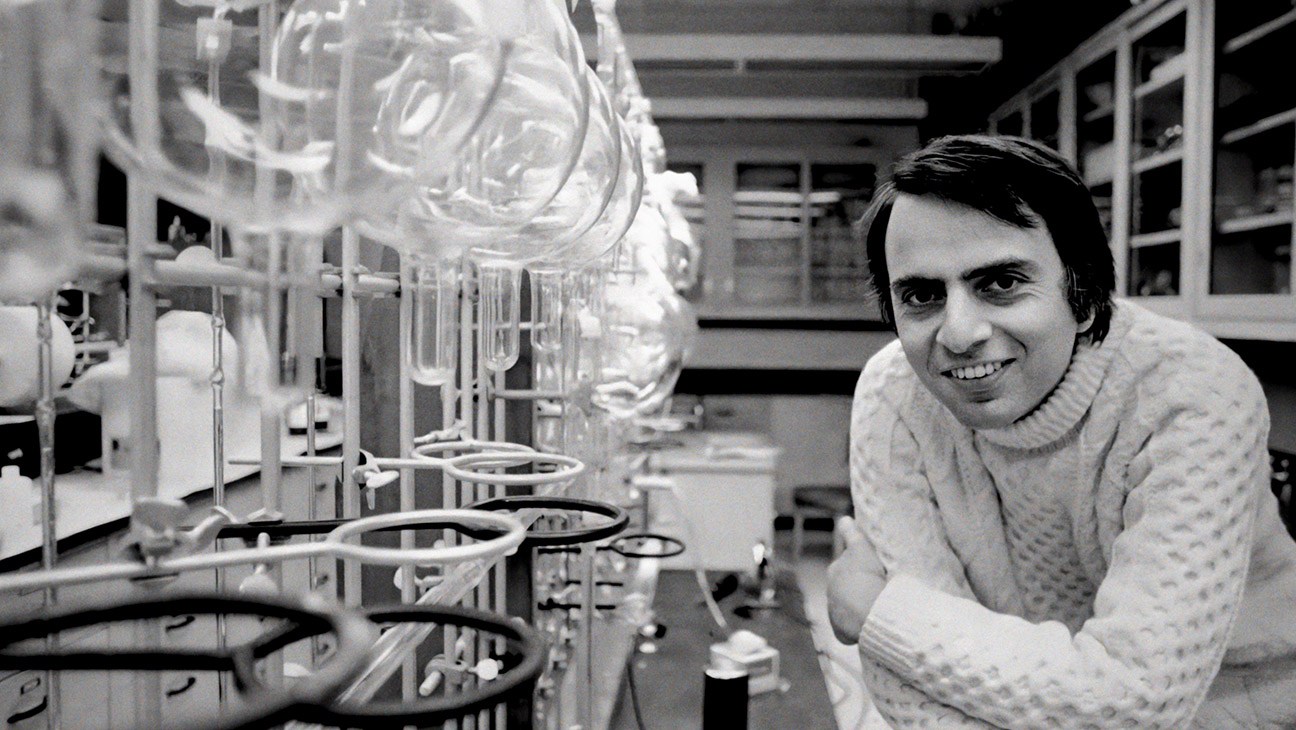


If Carl Sagan‘s landmark PBS docuseries Cosmos offered a pleasingly populist point of entry for viewers curious about our place in the universe, a gateway to more rigorous exploration, Nanette Burstein’s Carl Sagan: We Are Made of Star Stuff offers a pleasingly populist point of entry for audiences curious about Carl Sagan, leaving more rigorous exploration for the individual viewer.
The 98-minute National Geographic film, which boasts Sagan’s widow Ann Druyan and Seth MacFarlane, the man behind Fox’s more recent Cosmos update, as producers, promises and delivers no intellectual rigor. It’s light, fast-moving and looks back at a time when public intellectuals were able to use platforms like The Tonight Show to promote ideas instead of upcoming commercial ventures.
Carl Sagan: We Are Made of Star Stuff
The Bottom Line
Brings a brilliant man down to earth.
Venue: Telluride Film Festival
Director: Nanette Burstein
1 hour 38 minutes
Yes, you could say that it’s limited and limiting to come away from a documentary about a paradigm-shifting genius fixating on the sloppy, if ultimately gratifying, transition from his second to third marriage and the role that drugs played in his scholarly process. But it’s probably equally humanizing.
The documentary’s title refers to Sagan’s theory on the celestial origins for our cellular makeup, a unifying theory that connects us to the cosmos. But We Are Made of Star Stuff puts its emphasis on something far more terrestrial, a unifying theory connecting the chronicler of the cosmos to the more earth-bound masses. We are stars and this star was one of us. Only much, much smarter.
Burstein is aware, I think, of the differences in scale between her goal and Carl Sagan’s goals.
Sagan was a key piece of the Mariner, Viking and Voyager programs, missions that allowed us to visualize the galaxy in a way that was revolutionary. The pictures sent back by those probes defied expectations, boggled minds and went far beyond what anybody could have hoped. Burstein can show us the pictures from those probes, but the impact can never be the same.
Instead, the documentary relies heavily on animation from Imaginary Forces that tends toward the whimsical over the mind-boggling, the amusing over the illuminating. It’s very much about the spirit of the thing, not the substance. I wrote “Cool” in my notes after an animated sequence soaring through the solar system, but there’s none of the jaw-dropping wonder that fueled either Sagan’s Cosmos or Seth Macfarlane’s version, which was far better than many people feared it would be given the Family Guy of it all.
I think there’s a version of a Carl Sagan biography that talks in depth about what he learned, that helps us see the world through his eyes. In that case, Burstein might have populated it with a roster of astrophysicists and astronomers and whatnot, the people who stand today on Sagan’s shoulders. Then again, how many times do we really need to see Neil deGrasse Tyson — host of the Seth Macfarlane Cosmos — dumbing down the things that Sagan already tried to dumb down?
Yes, the animation illustrates Sagan’s boundary-pushing concepts, but in an “understand things for five seconds before moving on to the next thing” way rather than a “convey knowledge that will stick with viewers for a lifetime” way. Sagan himself does a bit more of the knowledge-imparting in countless clips from Carson and other mainstream sources, the sort of thing we’re told irritated more serious scientists. Is there a single representative from that wing of the academic community? Nope. The haters are dismissed as haters and the documentary moves right along.
What we’re given in lieu of Sagan’s students and surviving peers is mostly the people closest to him. Druyan plays a key role in the doc, sharing loving and candid memories of the origins of their love affair, their marriage and that time she and Carl dropped acid with her father.
Yes, Druyan’s talking head segments are giggly and affectionate, but she also anchors one of the more rigorous segments, explaining the process of gathering music for the gold record containing music, voices and information on humanity that was sent into space with Voyager. I’ve seen dozens of documentaries that touch on this process, and it’s fascinating every single time — even if in this case it’s funny to approach that gold record mostly as a prelude to Sagan and Druyan deciding to leave their respective spouses for each other.
Nick Sagan, Carl’s son with second wife Linda, offers few details on how thoroughly the divorce, which stretched across several years and much legal wrangling, crushed his mother, but he’s so affectionate toward Carl and Ann’s love story that Linda becomes a speed bump. That’s more than Lynn Margulis, Sagan’s first wife, gets. While acknowledging that she was a renowned evolutionary biologist in her own right, the film presents her as a brilliant set of relationship training wheels, a failed marriage so that Carl could do things slightly better the next time and then far better the third and final time.
Sagan’s kids with Druyan are there to provide emotional memories of what Carl Sagan was like as a good father, while Jeremy, one of two sons with Margulis, offers the “he wasn’t around very much” side of things. The trope of the exceptional man who proves to be a subpar husband and father until a later-in-life relationship (usually with a much younger partner) brings out his best is a documentary favorite — see Mr. Scorsese, among many, many others — and Burstein doesn’t try very hard to make this version different. But tropes are tropes for a reason, I suppose.
Carl Sagan definitely helped us comprehend the incomprehensible, while Carl Sagan: We Are Made of Star Stuff helps us comprehend Carl Sagan. Expect much of the former here and you’ll be disappointed. Expect the latter and it’s an engaging 100 minutes.
Read the full article here