



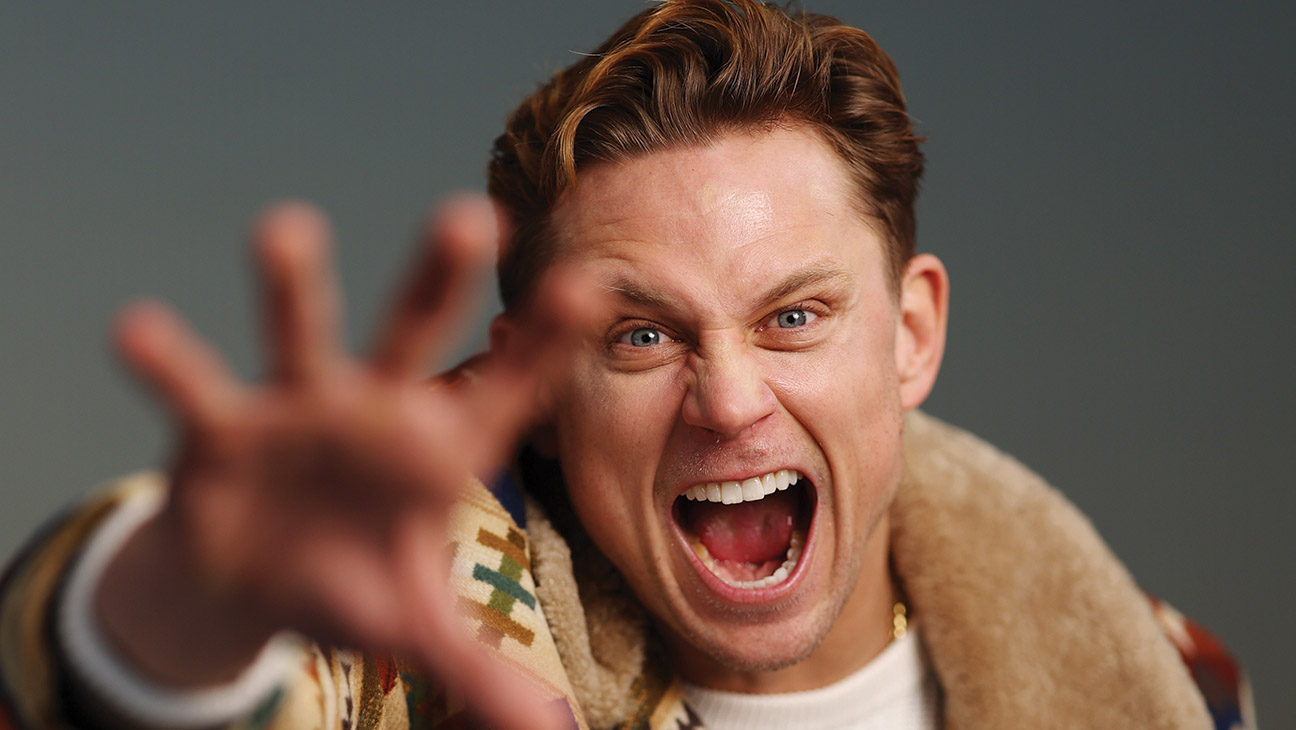


To play Duncan Park, the head of a data-mining company who’s desperate to join the upper tier of the tech industry hierarchy in the AMC drama The Audacity, Billy Magnussen has to find a deep well of neediness and striving.
“I empathize with that,” says Magnussen. “I think we all have that imposter syndrome, and that’s easy to relate to with any character.” On the other hand, he explains, “It’s exhausting, his never-ending drive, because he wants to be the top dog. At what point does your bank account look big enough? How much property do you need?”
His character’s answer, not unlike many real-life tech founders, would probably be, “As much as possible, and then some more.” Duncan’s anxiety about his place in Silicon Valley is his animating force, an outward projection of deep-seated psychological issues.
“Not good enough, weak, just below par,” is how Magnussen thinks Duncan sees himself, pointing to a scene in episode three when his character seeks out a diagnosis by taking a neurodivergence test and can’t accept the psychiatrist’s assessment that he’s “typical.”
“He’s constantly searching for, ‘Why do I have this pain?’ And he wants it because I think in the valley, the culture is that you want to be a little off to the side. You want your mind to be different,” says Magnussen. “I don’t think he loves himself, and he’s kind of looking for the answer that would give him clarity on why he hates himself. The truth is, chill out, man, you’re fine.”
Duncan, at least ostensibly, seems to know he needs to work on some things, which
is why he sees a therapist, JoAnne Felder (Sarah Goldberg). “I’m on the fence about that,” Magnussen says with a laugh. “It goes back to the point where he’s hunting — he wants to know that something’s wrong. He’s asking everyone else to identify him instead of him identifying himself. And I think it probably was the cool thing to do in Silicon Valley. Everyone goes to JoAnne for advice.”
The relationship between Duncan and JoAnne is not a typical client-therapist one, to say the least. He calls her at all hours, she’s combative with him — oh, and she’s insider trading, based on what he tells her, and he’s trying to sell a potential angel investor, Carl Bardolph (Zach Galifianakis), on his company using information she let slip about another client.
Offscreen, the actors are much more in sync than their characters, who were crafted by series creator and showrunner Jonathan Glatzer (Succession, Better Call Saul). “[Goldberg] has an artillery of weapons as an actor, and she knows how to wield them with such grace and ease,” says Magnussen. “We would talk about our scenes — do we know what we’re going to do? No, but we trust each other enough to say, ‘Let’s just see where it goes.’ ”
In doing research for the role, Magnussen read up on real-life tech moguls and found himself captivated by some of them — though not always in a positive sense. “How can you say that empathy is a weakness? Who are these people who want to live forever?” he wonders. “They fascinated me. I would go on these deep dives trying to understand, what was the thing they were trying to create in Silicon Valley? What was that genesis of the first, probably optimistic, idea they had? I think they realized they made a lot of money doing it a different way, and they got greedy. I find that kind of heartbreaking.”
As for his own professional trajectory, Magnussen is relishing the chance to be at the top of the call sheet after playing a number of supporting roles in series like Boardwalk Empire, Black Mirror, Maniac and The Bold Type.
“A lot of times in my career, I’ve played side characters, just helping the main character move through their story. This opportunity came up, and for some reason, I knew I could show the vulnerability, the fear, the excitement, the anger, all the sides of who Duncan Park is,” says Magnussen. “Every character I’ve played has had some sort of effect on who I was as a person — what I had to discover as Billy. Then Duncan came in, and I had to go to these dark places that Duncan’s asking [of] himself, and weirdly, I’m going to be asking myself the same questions.”
This story first appeared in a June stand-alone issue of The Hollywood Reporter magazine. To receive the magazine, click here to subscribe.
Read the full article here