




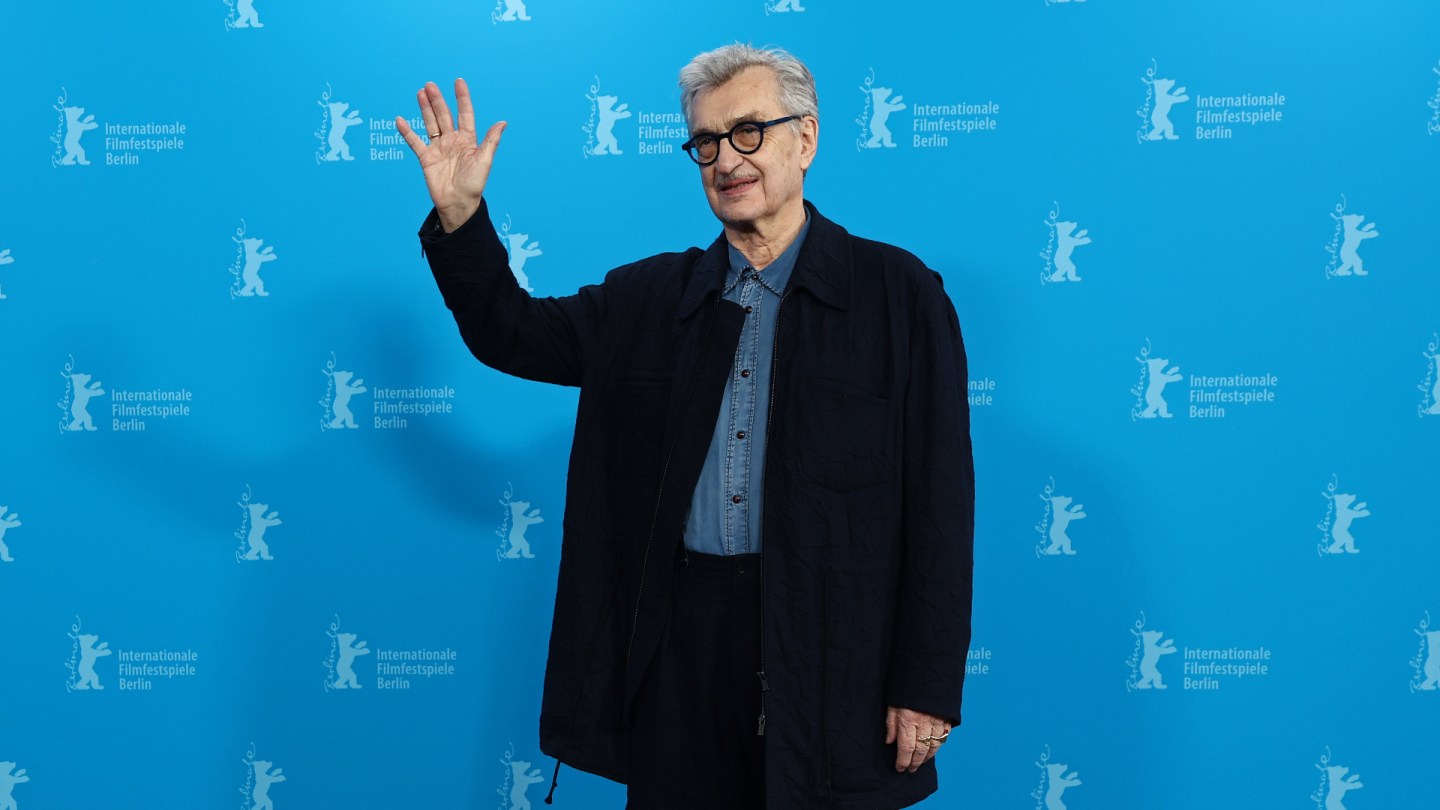


“We have to do the work of people — not politicians,” declared legendary German filmmaker Wim Wenders as the Berlinale’s international jury presser kicked off Thursday.
The Paris, Texas director was joined on the jury by South Korean actor Bae Doona, Polish producer Ewa Puszczyńska, American director Reinaldo Marcus Green, Nepali filmmaker Min Bahadur Bham, Japanese director of Rental Family, Hikari, and Indian archivist Shivendra Singh Dungarpur.
The presser swiftly turned to politics at just the second question, when a journalist said the Berlinale “doesn’t happen in a vacuum,” but has, historically, as an institution, “been able to show [loyalty] with people in Iran and Ukraine.” He then asked the entire jury about the German government’s “support” of the war in Gaza and “its role as main funder” of “the genocide in Gaza.” He asked: “Do you, as a jury, support this selective treatment of human rights?”
Puszczyńska immediately said the question was not fair. “The films are not political in the way […] you think of the meaning of the word,” the Polish producer began. “Asking this question is a little bit unfair. We use the words ‘change the world,’ but of course, we are trying to talk to every single viewer, to make them think that we cannot be responsible for what that decision would be — the decision to support Israel, or the decision to support Palestine… You just pointed to the biggest [war].”
“But there are many wars with genocides, and we do not talk about that,” she continued. So this is a very complicated question, and I think, as I said, it’s a bit unfair asking us how we support [or] not support our governments… Because that’s the politicians. I’m speaking for myself — I go to elections, I vote using my pride, as a citizen of Poland and as a citizen of Europe, of the world.”
Wenders interjected and lent his support for Puszczyńska: “We have to stay out of politics,” he said. “We are the counterweight of politics, the opposite of politics, we have to do the work of people — not the work of politicians.”
Puszczyńska added that Wenders had summarized what she was “nervously” trying to say.
The press conference had gotten off to a slightly lighter start just moments before, as Wenders was asked if movies can change the world.
“Movies can change the world, not in a political way,” he answered. “No movie has really changed any politician’s idea, but you can change people’s idea of how they should live… Cinema has an incredible power of being compassionate and being empathetic. The news [is] not, politics [is] not empathetic. But movies are.”
Toward the end, American creative Green, director of Bob Marley: One Love, was asked a question about Netflix’s bid for Warner Bros. and the possibility of losing theatrical films to streaming. “As a filmmaker, we want the opportunity to have as many eyeballs as we can to see our film,” he replied. “I think we have to adapt to the times,” he added, discussing the difference between his experience growing up and watching movies compared to that of his children. “For young filmmakers, I think there’s more opportunities now than ever. So I’m nostalgic for certain ways,” he said, and added: “I think it’s up to us to uphold that quality.”
The 2026 Berlinale, opening with Shahrbanoo Sadat’s No Good Men, kicks off Thursday evening and runs until Feb. 22.
Read the full article here