







Having a baby in today’s economy can be pretty costly but if you’re planning to, already expecting or have just become parents, congratulations are in order.
Regardless of your parenthood status, welcoming a bundle of joy is always precious, and for first-time parents, sorting out your finances before all the sleepless nights and puke on your clothes can take away one stressor that you do not need.
The good news is that brand-new parents and parents-to-be also have help from the Singapore government, in terms of cash gifts, tax reliefs, support and more with the Baby Bonus Scheme. Let’s look at these baby benefits for 2026.
Summary of Baby Bonus Scheme benefits in Singapore 2026
The Baby Bonus Scheme comprises 2 components: Baby Bonus Cash Gift (BBCG) and the Child Development Account (CDA). We break down the details for you.
Baby Bonus Cash Gift 2026: How much will you get for having babies?
Raising a child is expensive but the government is willing to give parents a jump start with some cash gifts. And as an incentive to prop up our low birth rates, the more kids you have, the more money you get.
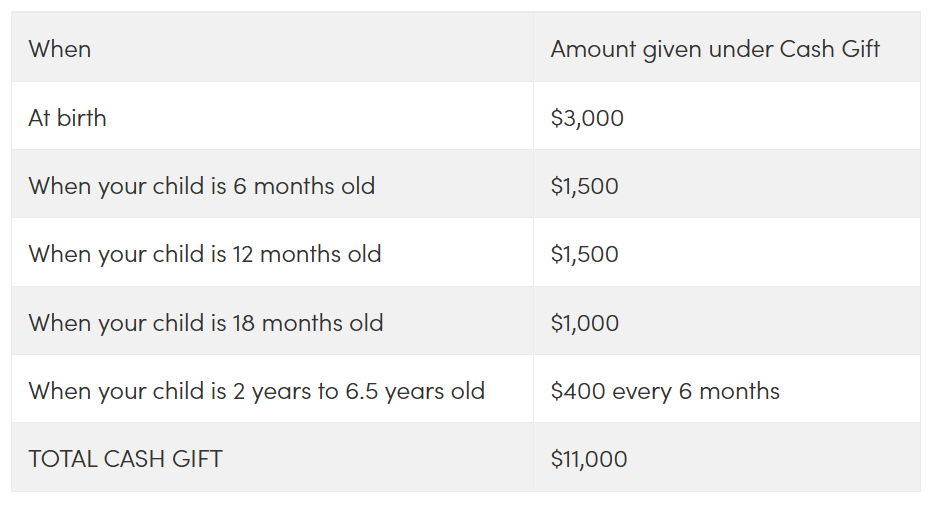
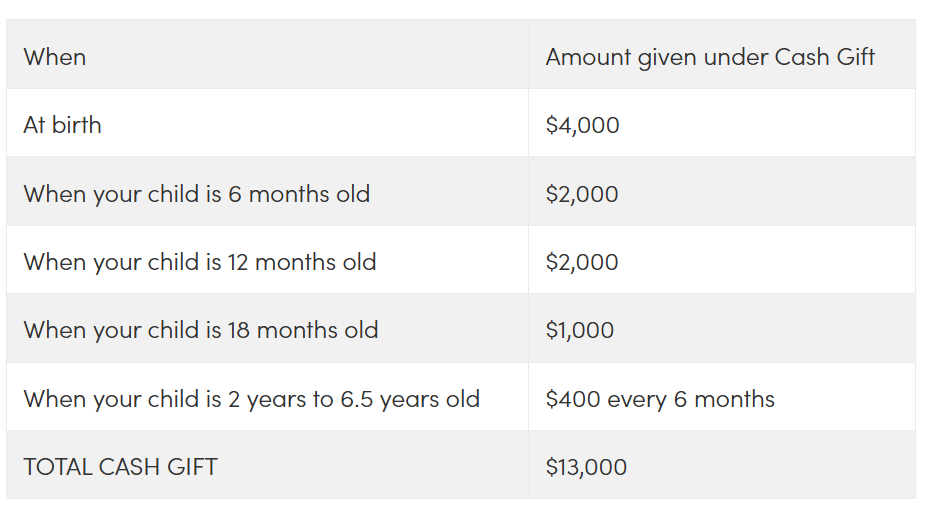
The Baby Bonus Cash Gift increased to $11,000 from $8,000 in 2023 for couples with their first child. But the government is smart in that they don’t give you a lump sum at once. Instead, the Baby Bonus Cash Gift is disbursed every 6 months until a child turns 6.5 years old. This way, it feels like you’re getting a bit of free money over a period of time. This was previously paid out over an 18-month period.
Here’s the payout schedule:
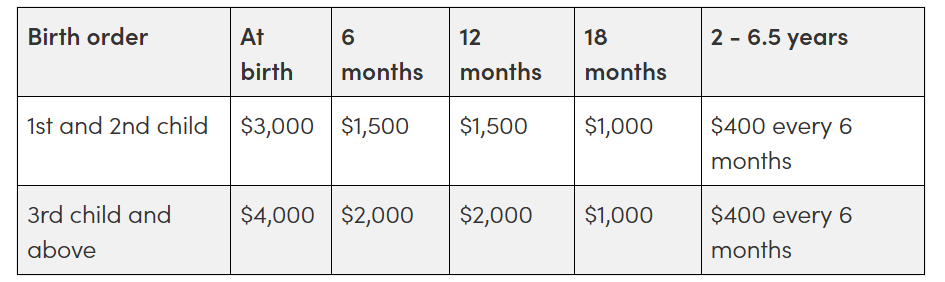

The first cash gift will be deposited in the Child Savings Account within 7-10 working days of your account opening. To keep you looking forward to the 6-monthly cash gifts, the government will SMS or email you 3-5 working days before it comes in.
To qualify, these babies must be Singapore citizens and their parents must be lawfully married. If the child was not a Singapore citizen at birth, the amount will be pro-rated. The pro-rated amount will depend on when the child becomes a citizen.
The next few sections elaborate on further details of the Baby Bonus payout according to birth order.
Baby Bonus for 1st child (up to $20,000)
For your 1st child, the government will give you a Baby Bonus of up to $20,000.Here’s how it works out:
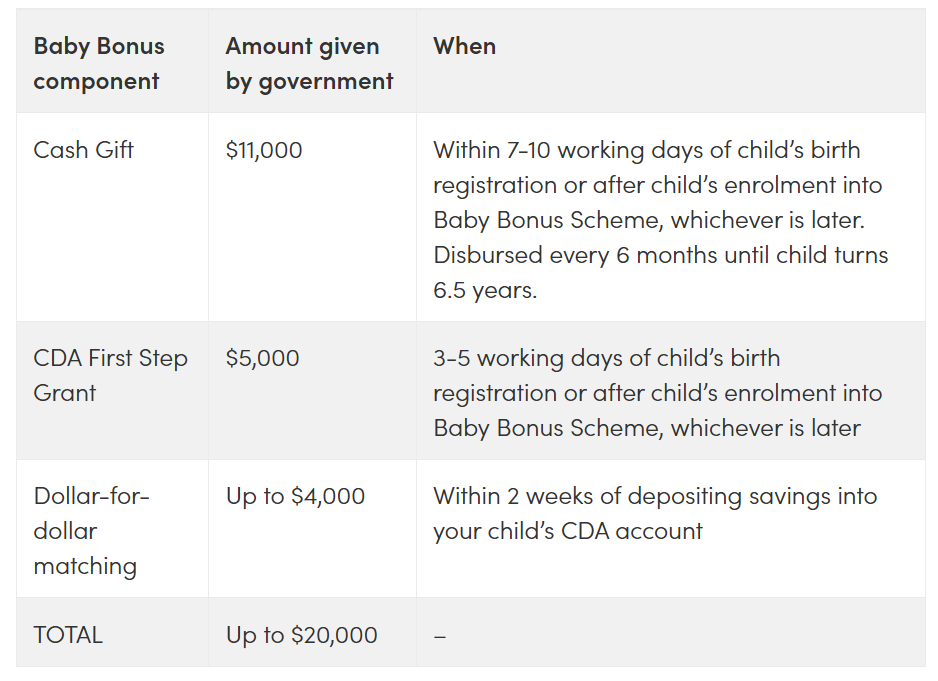

The Cash Gift component of the Baby Bonus is staggered according to the following schedule:

Baby Bonus for 2nd child (up to $23,000)
For your 2nd child, the government will give you a Baby Bonus of up to $23,000.Here’s how it works out:
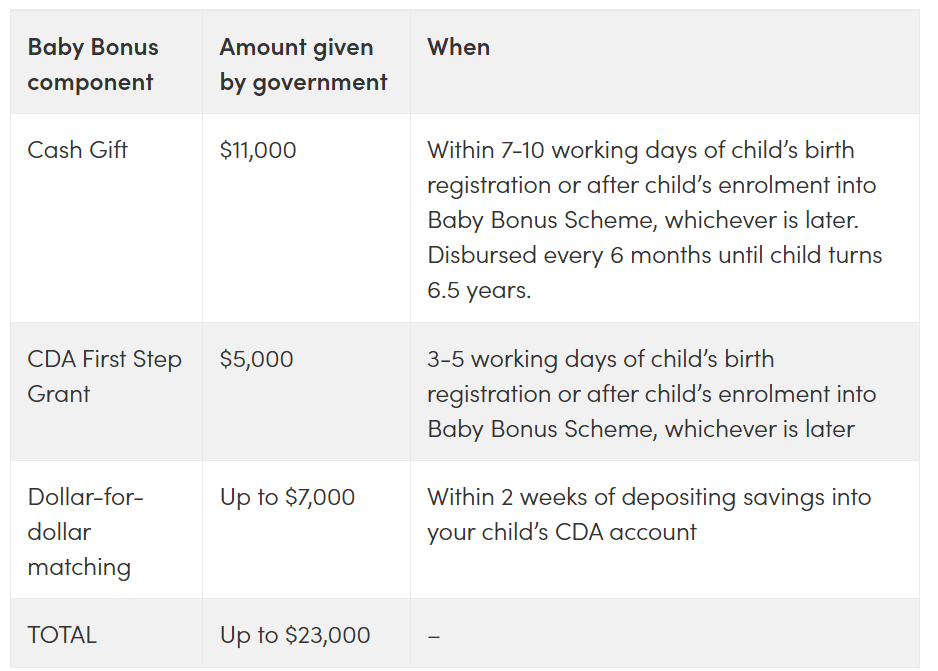

The Cash Gift component of the Baby Bonus is staggered according to the following schedule:

Baby Bonus for 3rd or 4th child (up to $32,000)
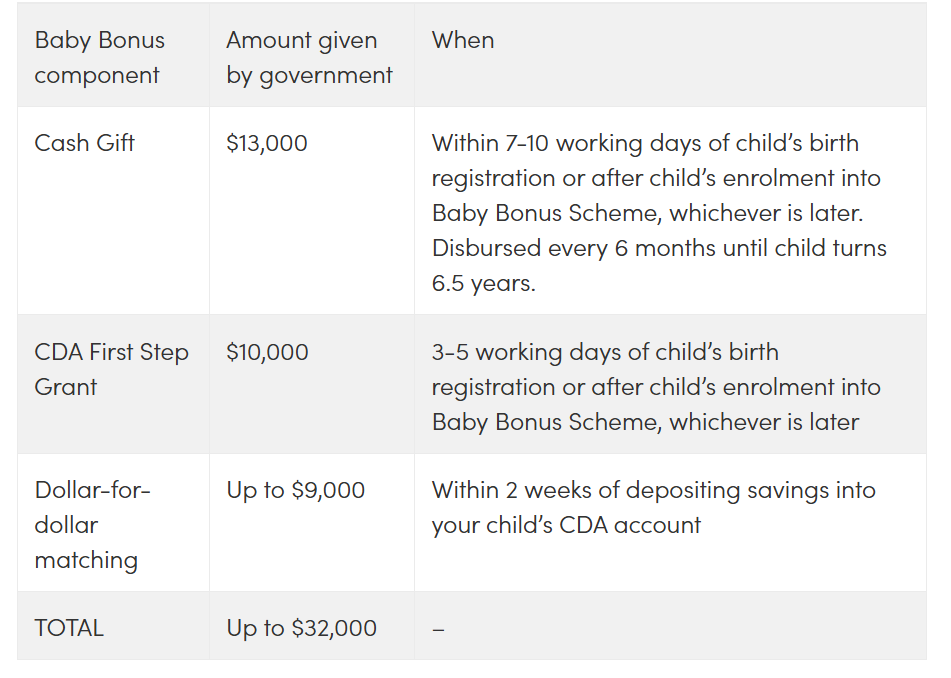
For your 3rd and 4th child, the government will give you a Baby Bonus of up to $32,000. Here’s how it works out:
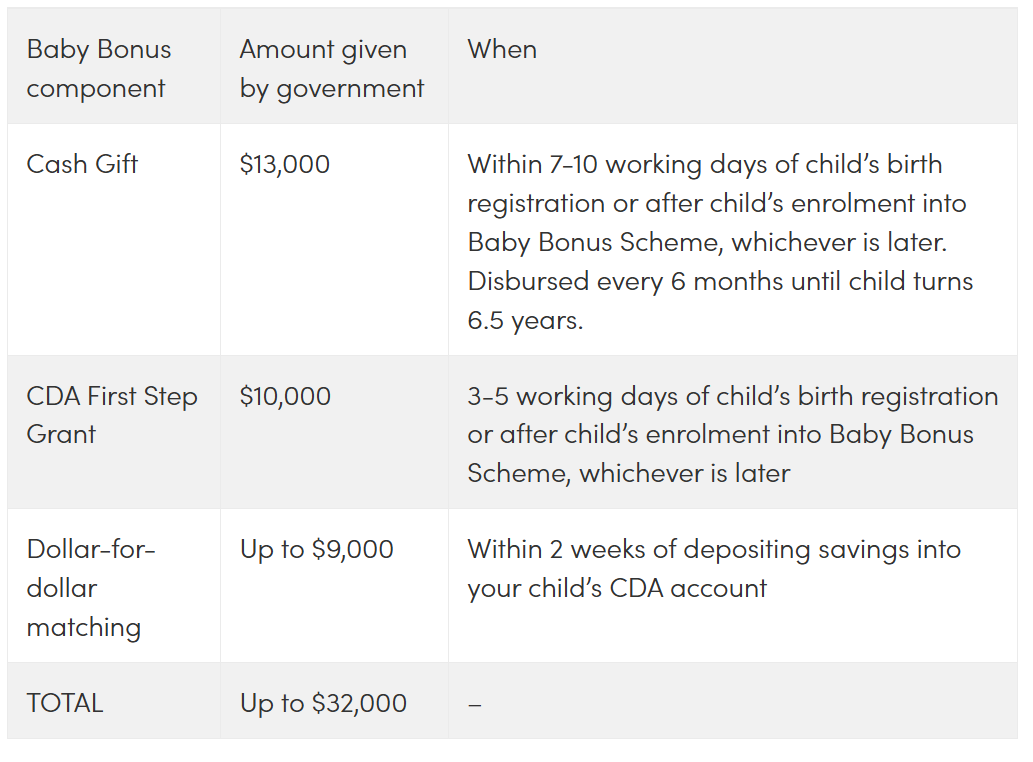

The Cash Gift component of the Baby Bonus is staggered according to the following schedule:

Baby Bonus for 5th child onwards (up to $38,000)
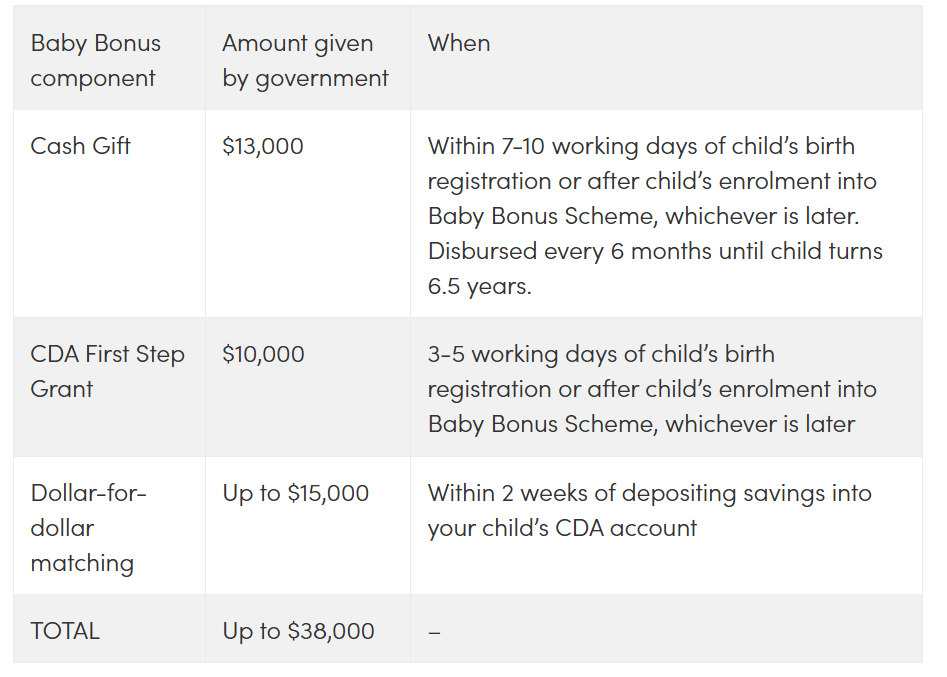

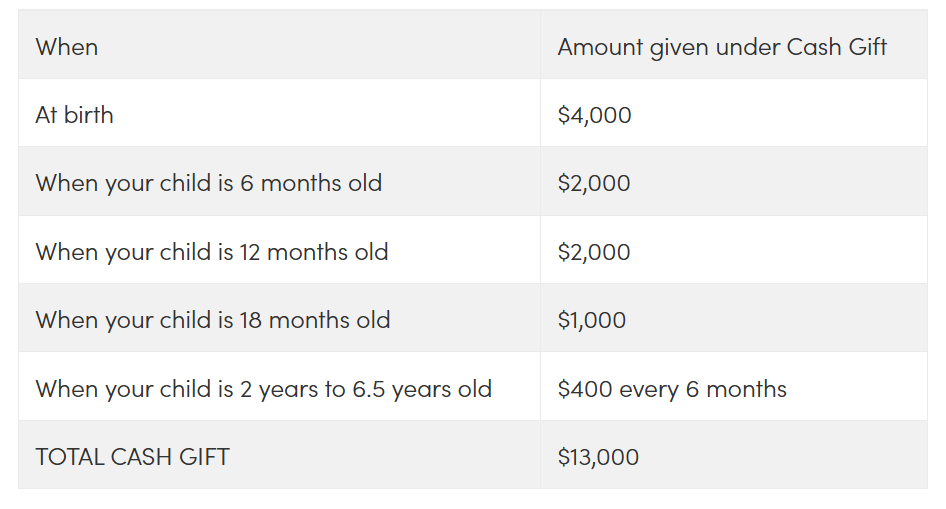
For the 5th child onwards, the Cash Gift component of the Baby Bonus is staggered according to the following schedule:

Do you get the Baby Bonus payout if you’re a single parent?
Unfortunately, single parents are not eligible for some of the financial perks:
❌ Cash Gift
✅ CDA First Step Grant
✅ Dollar-for-Dollar Matching
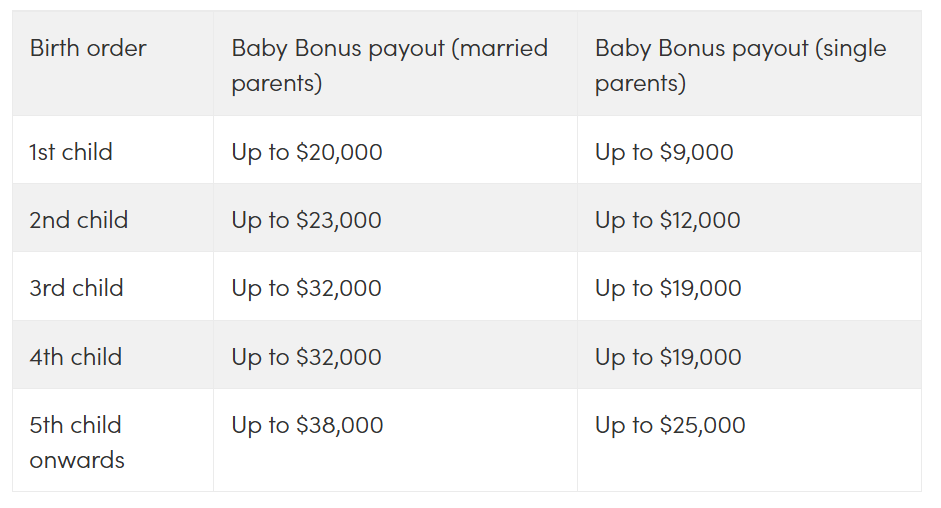
Single parents do not get the Cash Gift component of the Baby Bonus ($11,000 to $13,000), but their kids will still get their own CDA. They are also entitled to the $5,000 CDA First Step Grant as well as the usual dollar-for-dollar matching.
Here’s a comparison of how much less single parents get for the Baby Bonus payout as compared to their married peers:

How to apply for the Baby Bonus Scheme
The Baby Bonus Scheme is not an auto-enrolment, so you’ll need to register your child for the scheme before you can receive your cash gift. Kiasu parents can submit the online form, from as early as 2 months before their estimated delivery date.
During the application, you’ll have to choose which bank (POSB/DBS, OCBC or UOB) for the child’s Child Development Account (CDA). Then, the Child Savings Account (CSA) will be automatically opened when the CDA is opened. We’ll explain in more detail below.
Great timing because there’s a truckload of things to buy for your newborn and these expenses all add up.
Are adopted children eligible for benefits under the Baby Bonus Scheme?
Yes, adopted children are eligible if they meet the eligibility conditions. An adopted child who is born and adopted on or after 1 Jan 2010 shall be eligible for the Baby Bonus Scheme if:
- His/her adoptive parent is lawfully married at the time of his adoption
- He/she is a Singapore citizen at the time of his adoption or becomes a Singapore citizen before the age of 12 years
- He/she is below 12 years of age at the time he is adopted
But of course, there are some caveats, so it’s best to use the Baby Bonus Scheme Eligibility Check to determine if the child is eligible.
Baby Bonus Scheme 2026: Child Development Account (First Step Grant, Government Co-Matching Cap)
Now what is this CDA account for? Since we’re talking about the Baby Bonus Scheme, it’s to receive these 2 payouts:
- CDA First Step Grant
- Government co-matching cap
What is the CDA?
The CDA is basically a special co-savings account that you open for your child. You can open it at any major bank in Singapore, whether it’s DBS/POSB, OCBC or UOB. This account is where new parents will receive their child’s CDA First Step Grant (part of the Baby Bonus Scheme).
In addition, the government will match each dollar that you deposit into the CDA, up to the maximum co-matching cap. You can add money in your child’s CDA until Dec 31 of the year when they turn 12 years old.
These CDA funds can be used at Baby Bonus Approved Institutions. For example, to pay for your child’s fees at registered childcare centres, kindergartens, special education schools and early intervention programmes; your child’s medical expenses, insurance premiums (cash top-up portion to MediSave), assistive technology devices, eye-related products and services at optical shops (yup, given Singapore’s rate of myopia), and approved healthcare items at pharmacies.
Your child’s CDA will be opened within three to five working days of their birth registration, or after you’ve enrolled them into the Baby Bonus Scheme (whichever is later).
Here’s a quick summary of the enhanced CDA benefits:
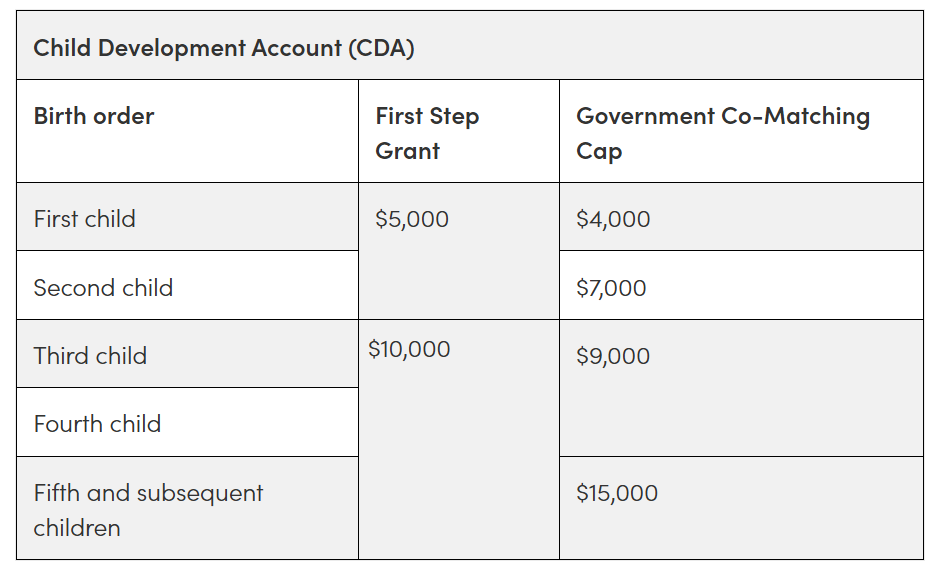

CDA First Step Grant & Government Co-Matching Contributions: Payout Timeline
Here’s a quick overview of when parents can expect to see the grant and co-matching payouts in their child’s CDA based on when they enrol their baby:
- CDA First step Grant: within two weeks of the account opening
- Government co-matching: co-matching amount will be credited into the account within two weeks of your deposit
So if you’ve any big purchases to make, you can expect to get extra money relatively quickly.
Other benefits for parents
MediSave Grant for Newborns
First newborns, there is an existing MediSave Grant of $5,000. Babies who are Singapore citizens will automatically get their own MediSave account when their birth is registered. A MediSave grant of $5,000 will be deposited into their account, and this amount can help parents pay for their little one’s healthcare expenses, which include MediShield Life premiums, recommended childhood vaccinations, hospitalisation, and approved outpatient treatments.
By the way, while being a mandatory basic health insurance for Singapore Citizens, MediShield Life can also help defray large hospital bills and certain costly outpatient treatments (i.e., dialysis, chemotherapy) in public hospitals. It covers all Singapore Citizens for life, including those with congenital and neonatal conditions.
Families who are of lower- to middle-income can also tap further government subsidies for the first 4 years of their child’s life. Needy citizens who are still unable to pay can also get Additional Premium Support.
Tax Reliefs for Parents
If your assessable income is above a certain amount, you will need to pay income tax. If eligible, parents who are Singapore tax residents enjoy further tax reliefs, which brings down their assessable income and reduces the tax they need to pay, up to the personal income tax relief cap of $80,000 per year of assessment.
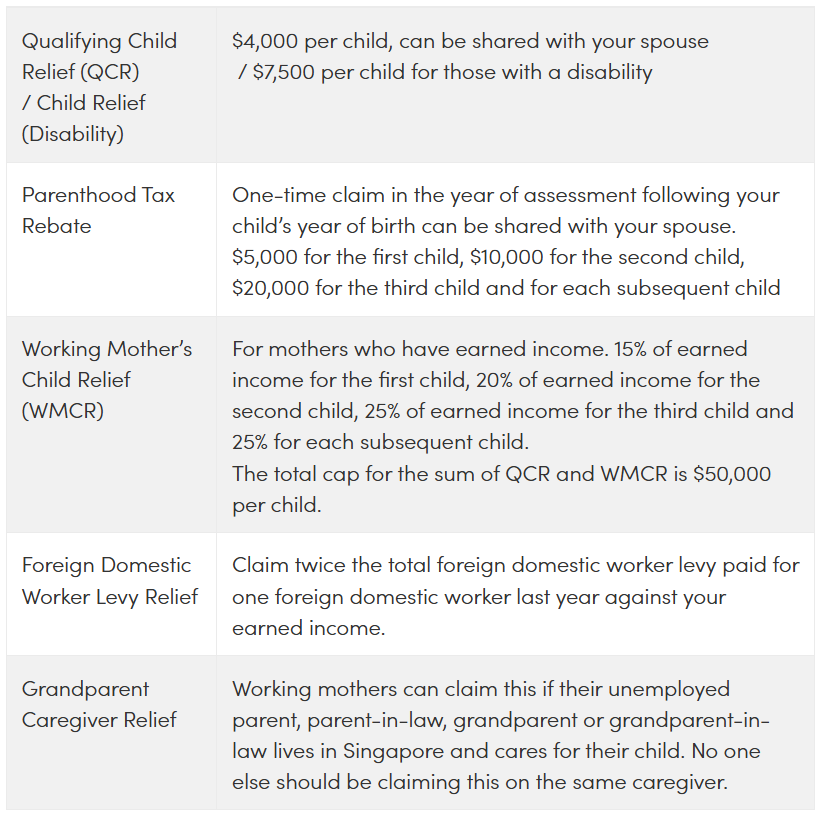

Mandated leave for parents
Speak to any parent, and they’ll tell you how tiring it is looking after a young child, especially one that is unwell. Now, with hybrid working, many parents may juggle both childcare duties and their job at home, which makes for an even busier day.
Singapore has finally increased paternity leave to four weeks for eligible working fathers of Singaporean children born from Jan 1, 2025.
By the way, self-employed dads who have been working in the same business or profession for at least 3 months before their children are born are also eligible!
Each parent also will get 12 days of unpaid infant care leave per year. This is double the 6 days they had per year previously. Parents are eligible for this benefit for the first two years of their Singaporean child’s life if they have worked with their current employer for a continuous period of at least 3 months.
Of course, it goes without saying that working mums are also entitled to up to 16 weeks of government-paid maternity leave. It was a lot of hard work carrying your child for those nine months, and after they are born, nurturing them into fine adults!
[[nid:739792]]
This article was first published in MoneySmart.
Read the full article here