
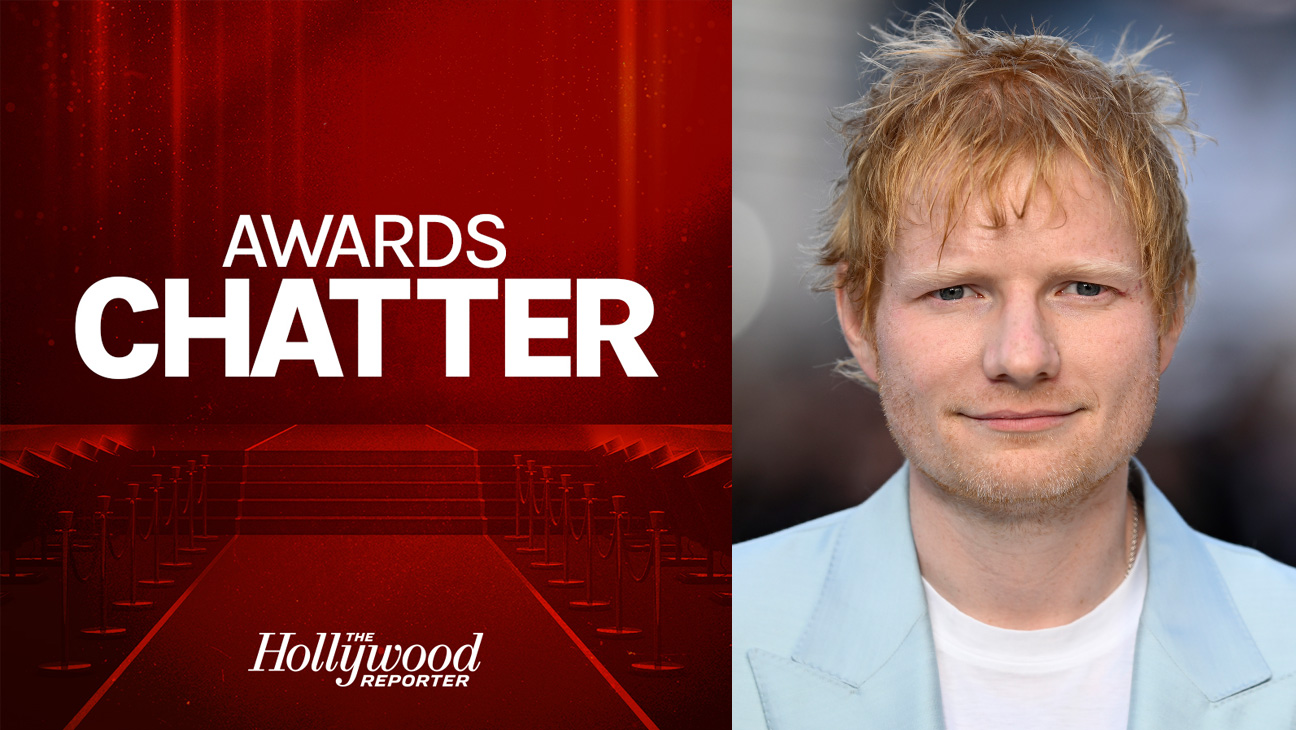

Ed Sheeran, the guest on this episode of The Hollywood Reporter’s Awards Chatter podcast, is an English singer/songwriter who has been described by Rolling Stone as “among the 21st century’s very biggest global pop superstars;” by the Los Angeles Times as “arguably the most successful male pop star in the world;” by The Guardian as “the most commercially successful British artist of his age” and “an era-defining musician [who] has earned his place alongside [David] Bowie, Elton [John], George Michael, Morrissey and Elvis Costello in the pantheon of great British male solo artists;” and by the New York Times as “this generation’s James Taylor,” “one of the few consistently bankable solo male global pop stars working” and “a defining pop artist of the modern era.”
At just 34, Sheeran is already a four-time Grammy winner who has had two songs top the Billboard Hot 100 — “Shape of You” and “Perfect” — and four albums top the Billboard 200. On the back of his megahit 2017 album Divide, he became that year’s bestselling musician in the world, and he ultimately became Spotify’s second-most-streamed artist of the 2010s, behind only Drake. And today, with more than 200 million records sold worldwide, he is one of the bestselling music artists of all time; the third most-followed person on Spotify, behind only the Indian singer Arijit Singh and Taylor Swift; and one of TIME’s 100 most influential people in the world for 2025.
Earlier this fall, he released his eighth studio album, Play; and he is currently in the running for best original song Oscar nominations for not one but two songs that he co-penned and performed for blockbuster 2025 films: “Drive” for F1: The Movie, which he wrote with John Mayer and Blake Slatkin, and which received a best song Critics Choice Award nomination last week; and “Zoo” for Zootopia 2, which he wrote with Shakira and Slatkin.
Over the course of a recent conversation at the London West Hollywood hotel, Sheeran reflected on his unlikely path from busking on the streets of London to superstardom; the origin stories of several of his biggest hits, including “The A Team,” “Sing,” “Thinking Out Loud” and “Bad Habits;” why he agreed to write songs for movies, and how doing so differs from the way he usually writes music; plus much more.
A few notable excerpts from the transcript of the conversation follow.
On Taylor Swift, who once described him as “the James Taylor to my Carole King”…
“I was opening up for Snow Patrol in Nashville, and Frank, who works with Taylor, would come down. And I just sort of mentioned, I just said, ‘If she ever wants to write a song, I’m around.’ I knew that she knew my music; she’d written the lyrics to “Lego House” on her hand when she was playing in, I want to say Brisbane, maybe it was Sydney, it was somewhere in Australia, but there was these photos going around of her with my lyrics on her hand. So I was like, ‘If she ever wants to write…’ And then we met. Obviously, we’re the opposite sex, and we’re from different countries and cultures, but I feel very intertwined creatively with her. And we had all this time on [the 2013-2014 Red] tour together where we sort of bonded as friends and collaborators and performers. And I do really agree with the James Taylor and Carole King thing. We have very transient lives. I’m very much settled kids in school. And then touring, I do see her from time to time. And when we see [each other], you just lock back in and reconnect, and it’s like no time has passed. It’s very similar to a sibling.”
On his song “Sing,” which Pharrell produced and backed you on, and which became his first No. 1 in the U.K. and went to No. 13 in America…
“I think that that is one of the most important songs in my discography because it took me out of the pigeonhole. I really think that that allowed me to be as experimental as I wanted without people raising eyebrows… I wouldn’t say it’s the biggest hit in my discography, but it opened up the door. And I don’t think songs like ‘Shape of You’ happen without that door being opened.”
On his album Divide, the first two singles of which, “Shape of You” and “Castle on the Hill,” both debuted in the top 10 of the Billboard Hot 100, something that no artist had achieved in the 58-year history of the charts up to that point; “Shape of You” was at No. 1 for 12 non-consecutive weeks, becoming the biggest song of 2017; other hits on the album included “Perfect” and “Happier”…
“I think everything was leading to that — all of the build from Plus, all of the build from Multiply, songs like ‘Sing’ opening me up to new audiences. I think that was the nucleus point where it all just sort of connected. You look at many artists’ careers and they have these moments that everything leads to, and then life goes on from there. I’ll be lucky if I have one more of those in my life. Sometimes people get two, sometimes people get three, but I’m lucky that I had one where it all just clicked.”
On his new series of albums about music playback commands, following the five about mathematical symbols…
“There will be five — technically six, because there’ll be one when I die called Ejects. I like the idea of creating whatever the posthumous album is before I go. Losing Jamal [Edwards, his close friend and early champion], and him dying without a will, was difficult for everyone, and it really made me think like, ‘If I do pass away, I want to make sure everything’s in order.’”
On becoming involved with F1: The Movie and writing the original song “Drive” for it…
I’d met Jerry [Bruckheimer, the producer] at the F1 2022 in Austin — maybe they were scouting for something, I don’t think they were shooting at this point, but him and Brad [Pitt] were there — and he was like, “You should do a song for the film when it’s finished.” I was just sort of like, “Yeah, cool. Fine.” And then they did get in touch. Because of the kind of artist that I am and the sort of songs that I’ve had that have been massive, people go, ‘We would love to have you for the love scene and we’ll do this—’ What I liked about it was Jerry was he was just sort of like, ‘You pick and you do what you want.’ I watched the first iteration of it, about 40 minutes on Zoom with Jerry, and then I got a screener and stuff like that, but it wasn’t like a finished movie. And I picked the end scene when he [Pitt’s character] is riding off in the dune buggy. I know what John [Mayer] can do — John is just a guitar wizard, and I knew that he would come up with the best riff — and we got in the studio, me, him, and Blake. He did the riff, did the melody. I took it away, added the lyrics, came back, tweaked it a little bit. And then Blake and John got Dave Grohl in and Pino Palladino.”
On whether or not, with “Drive,” he was trying to create a song that would also have an appeal independent of the movie…
“I wasn’t thinking of the independentness at all. No, I don’t think it necessarily does. It certainly doesn’t fit in my catalog — it’s like a big rock song. I actually said to the guy that runs F1, I was like, ‘Just have that song. I don’t want any money for it. Use it for whatever you want. Because if it doesn’t exist in that world, it’s kind of redundant.’ I just wanted it to be this fucking massive end credit song. Even me singing sounds like a car engine starting, but it’s just powerful and in your face. That whole movie is so adrenaline filled. You feel physically sick at points in that film as cars are speeding and whizzing by. So I wanted the song to have the same sort of power, energy, and adrenaline. And I think as I was making it, I sort of knew it didn’t exist outside the film. I was just like, this song is purpose built for this moment in the movie. And I think that’s what’s good about making songs specifically for movies — it’s tied to the film, and if the film’s great and the film lives on and the film has legacy, then the song has legacy. I think if you were to create a song thinking, ‘This has to exist outside the movie,’ then it won’t. I’ve met loads of people over the years that discovered me through The Desolation of Smaug — they watch that song, and “I See Fire” comes on at the end, and then they check my music out. And if this F1 film continues to be the sort of juggernaut that it is for the next 30 or 40 years of my life and career, people are always going to discover that song, which is exciting.”
Read the full article here