


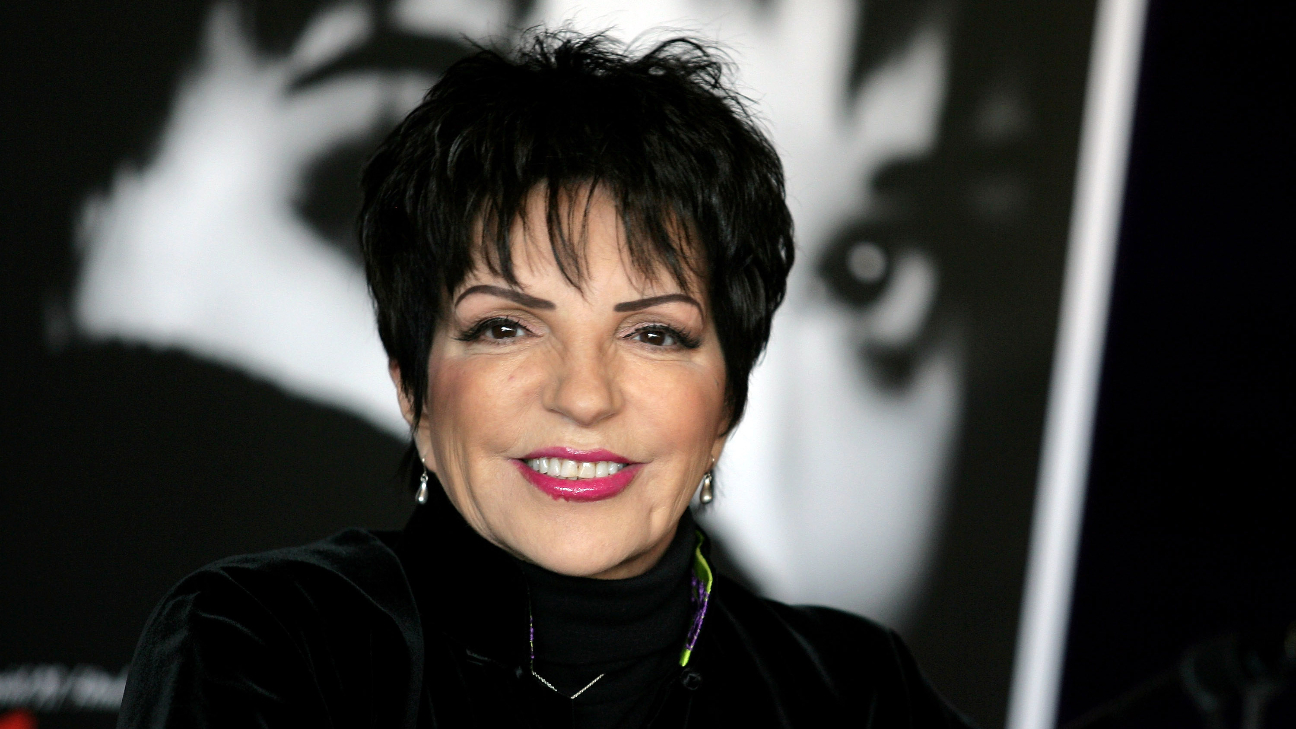


At a Los Angeles event celebrating the release of her memoir Kids, Wait Till You Hear This!, Liza Minnelli was introduced, repeatedly and reverently, as a living legend. Which she is. But what unfolded onstage was something far more complicated.
The evening began with a level of theatricality that felt almost defiant. It was set inside the Million Dollar Theater, an historic downtown venue where Minnelli’s mother, Judy Garland, once performed in a vaudeville review as part of The Gumm Sisters.
The 2,000-seat theater was at capacity; each $90 ticket included a copy of the memoir.
A full production number — male and female dancers moving through Fosse-esque choreography — gave way to a sequined majorette performing flaming baton tricks in front of a curtain. When it finally parted, Minnelli was revealed seated in a director’s chair, like an icon being unveiled. It was a striking image. It was also, almost immediately, at odds with what followed.
Minnelli, now 80, appeared physically fragile and struggled to communicate in a way that often left both her interviewer and the audience grasping for clarity. Answers came haltingly, sometimes in fragments or single words. “No,” she said when asked if she thinks about her legacy. Moments later, she added, “I listen to the words, the story,” a glimpse of the performer’s instinct still intact – but fleeting.
That interviewer was her confidante and sometime-accompanist Michael Feinstein, who guided the evening with a steady hand, asking most of the questions and, at times, gently reframing Minnelli’s responses to keep things moving.
The program included other voices. Vanessa Jade O’Neill, the granddaughter of Lorna Luft, Minnelli’s half-sister, appeared onstage to speak about family legacy. But the rhythm of the night belonged to Feinstein.
The structure of the event — part conversation, part audiovisual tribute — seemed calibrated to support what was happening in real time. Extended excerpts from the memoir’s audiobook filled in narrative gaps, offering a version of Minnelli that felt markedly different from the one onstage. In those recordings, her voice is steady, fluid, narratively precise: recounting her Tony win at 19, reflecting on her parents, Judy Garland and Vincente Minnelli, and articulating her life with clarity and control.
Interspersed throughout were clips of Minnelli in her prime — electrifying footage from Liza with a Z and Cabaret — where she moves with total command, every gesture precise, every lyric intentional. The juxtaposition was unmistakable: the fully realized performer on screen, and the far more fragile presence in the room.
The contrast extended to the voice itself. Whether the result of heavy editing, vocal processing, or something more technologically sophisticated, the audiobook version of Minnelli feels almost too seamless. Onstage, the gaps were visible.
At one point, attempting to explain her connection to performance, she circled the thought before landing simply on: “It’s… not good without it. ” Later, speaking about sobriety, she began, “Ask anybody out there…” before trailing off. Even her reflections on family came in fragments. “I thought my mother was perfect. Perfect,” Minnelli said, delivered with emotion, but without the narrative structure heard in the recordings.
The most striking moment came when music entered the picture. Minnelli, whose identity is inseparable from performance, was meant to sing. Feinstein played “Love is Here to Stay,” a standard by George and Ira Gershwin, at a grand piano. After a strong opening, the song went off track. Minnelli appeared unable to recall the lyrics, the moment dissolving into something closer to a gesture than a number.
Which brings Feinstein’s role into sharper focus. He is credited as a co-author of the memoir, appears in a black-and-white photograph with Minnelli on its back cover, and is frequently referenced throughout the book, in addition to writing its introduction.
Positioned as interviewer onstage, he functioned as something more expansive: a stabilizing presence, a narrative guide — perhaps even a kind of proxy for the version of Minnelli presented elsewhere.
That tension extends beyond the room. In the memoir, Minnelli recounts her appearance at the Academy Awards alongside Lady Gaga, framing the moment as one in which she felt exposed or humiliated. Seen in the context of this evening — where her ability to track conversation and performance cues appeared inconsistent — the question inevitably arises: how reliable are those recollections, and where does personal perception blur into something less stable?
And yet, the audience never turned. If anything, the room leaned in harder — not out of denial, but out of a kind of collective protectiveness.
There were flashes of the old instinct: a joke that landed, a burst of warmth, a gesture that hinted at the performer who once commanded every inch of the stage.
Over after just 48 minutes, what the night ultimately revealed is something Hollywood rarely knows how to process in real time: not just what it looks like when a legend keeps going — but how that legend is increasingly mediated, shaped and, perhaps, quietly reconstructed along the way.
Still, it offered a moment with a show business giant. For the Liza-ites in attendance, that was more than enough.
Read the full article here