






Like the entertainment industry everywhere, Ontario’s film and TV business has absorbed its share of external shocks — the L.A. strikes, the Peak TV hangover, a streaming boom going in reverse. But production beyond greater Toronto has emerged as a welcome buffer, with regional bonus incentives, cheaper labor and a diverse array of iconic locations helping the province weather Hollywood’s pullback.
Cities and towns across northern Ontario, having already pivoted from mining and manufacturing to hosting major film and TV shoots, are rising to the logistical challenges of turbulent times. And while talent, crews and infrastructure remain a draw, tax credits, currency savings and government rebates are the real superpower.
“Beautiful locations and strong infrastructure get you into the conversation, but incentives are what help close the deal,” says David Anselmo, CEO and president of Sudbury-based Banner Hideaway Pictures.
Provincial incentives can be stacked with the federal rebate to a bonus tax credit rate of 45 percent — a significant lever in an era when every greenlight is being scrutinized. “License fees are tighter, buyers are more selective,” Anselmo adds. “But I actually think that favors places like northern Ontario, because we’re no longer selling a theory. We’re offering a proven production ecosystem.”
That confidence echoes across the province, even as Ontario faces added competitive pressure from a foreign film tax credit hike in British Columbia. “If Kingston can stand in for Maine, we have better incentives that help you with your budget and your bottom line,” says Joanne Loton, Kingston’s film commissioner. The southwestern Ontario city recently hosted shoots for Peacock’s Devil in Disguise: John Wayne Gacy miniseries and Amazon’s scripted Muhammad Ali biopic The Greatest, both of which made use of the Kingston Penitentiary — a former maximum security prison turned museum.
The economic case for shooting outside Toronto is reinforced by the Northern Ontario Heritage Fund (NOHF), a tier-based grant that draws qualifying producers to the province’s northern reaches and can be layered on top of existing provincial and federal film tax credits. The fund has already contributed $2 million each to the Paramount medical drama SkyMed and the third season of Hallmark’s When Hope Calls to bring production north.
“We want Toronto to be busy. And we’re always going to go through those ebbs and flows,” says Patrick O’Hearn, executive director of Cultural Industries Ontario North (CION), which works to advance production across six major centers: Sudbury, North Bay, Timmins, Sault Ste. Marie, Thunder Bay and Parry Sound. “But we’ve really defined there’s no central hub that needs to be the be-all and end-all of production. We can use the full province and all of this great country to make amazing film and television.” Sudbury has been particularly active. Recent shoots include Jason Biggs’ directorial debut Getaway, gory fantasy action comedy Deathstalker, starring Patton Oswalt and executive produced by Slash of Guns N’ Roses, and body horror feature The Pond from director Jeff Renfroe.
The city’s natural landscape — lakes, wilderness, remote cottage country — has proven as much of a draw as its infrastructure. “People think of us as an industrial city, which we are, but we have beautiful lakes and wilderness here,” says Clayton Drake, Sudbury’s film officer. “Above-the-line talent often find gorgeous Airbnbs or cottages that give them the northern getaway experience while they’re filming.”
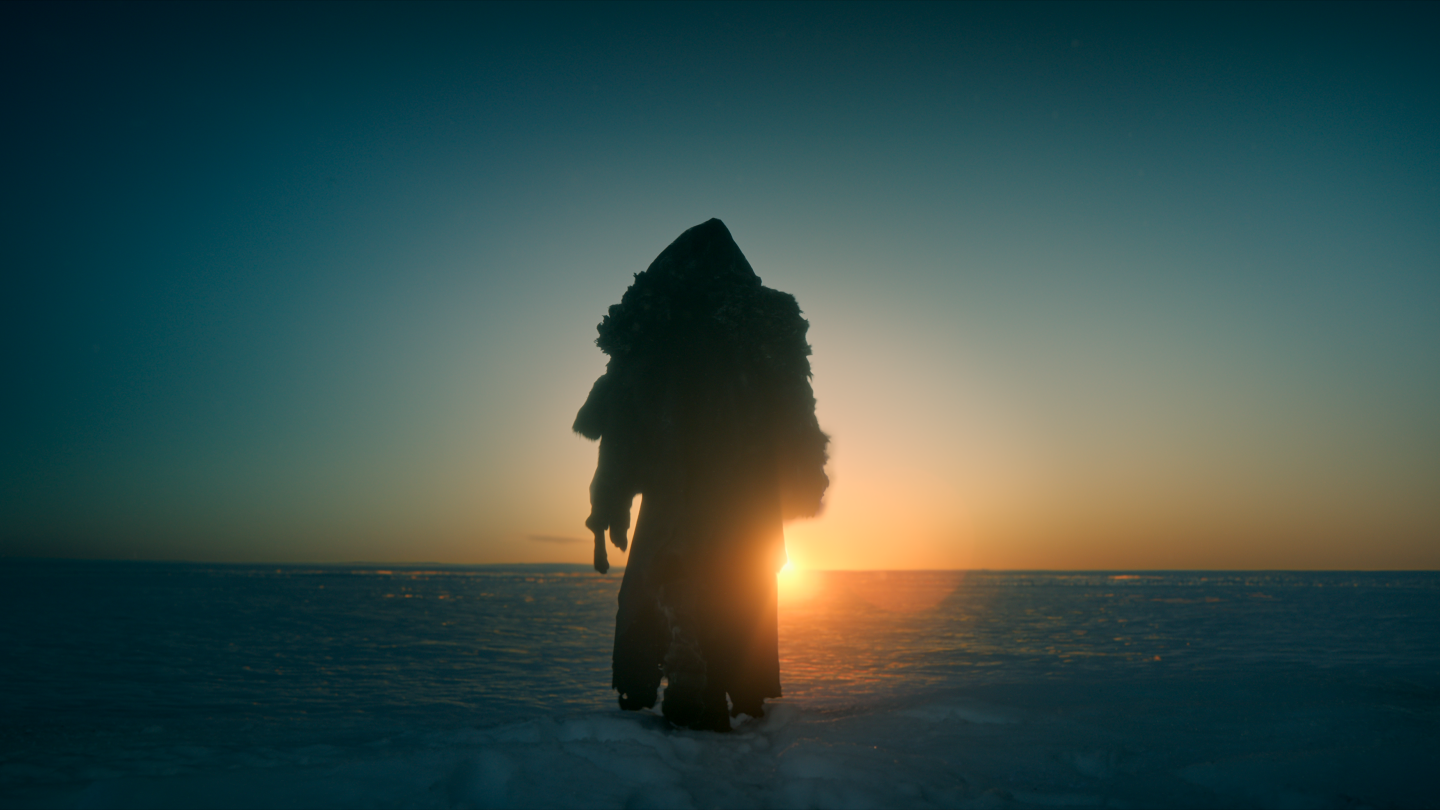
That promise of natural beauty was realized most dramatically by Guillermo del Toro’s Frankenstein, which used the icy surface of Lake Nipissing just outside North Bay to double as the Arctic’s frozen expanse, where Victor Frankenstein (Oscar Isaac) pursues the Creature (Jacob Elordi) by sled and dogs. “We knew we needed the Arctic, and at a certain time of the year. North Bay was perfect for that,” says producer J. Miles Dale. “Literally by just stepping off the land and going yards to the west, we had this beautiful, unobstructed view of the sunset.”
Tyler Levine, producer on Michael McGowan’s All My Puny Sorrows, also shot in North Bay and found the small-town rhythm suited the production perfectly. “Filming in North Bay is like having your own big studio where instead of taking a golf cart from one lot to another, you just have to drive your car a few minutes down the road to the next location,” he says. “The people are uniquely kind and accommodating. The city is beautiful and in no particular rush.” Most mornings, he and McGowan would run along Lake Nipissing, sometimes joined by crew. “It was like a moving production meeting but much more scenic and refreshing.”
Farther south, in Parry Sound, filmmaker Megan Park shot her second feature, My Old Ass — a fantasy drama starring Maisy Stella and Aubrey Plaza, produced by Margot Robbie’s LuckyChap Entertainment — among the forested landscapes and lakeside cottages of the Muskokas. The location was just a two-hour drive from Toronto. “Relatively speaking, it’s not that far,” notes Jeff Thom, an economic development officer in Parry Sound.
The threat of further disruption — whether from a repeat of the strikes or President Donald Trump’s proposed tariffs on foreign films — has regional jurisdictions actively exploring alternatives. “We’re all looking for ways we can collaborate in different ways,” says Kingston’s Loton. “Can we do more treaty co-productions with countries like Ireland, which is really upping the ante with their incentives and investments? Can we do more interprovincial filming?”
Ontario’s regions are also investing in homegrown storytellers. Director Lisa Jackson is at work on Medicine Fire, a documentary about an Anishinaabe couple restoring a traditional healing ceremony in their fly-in reserve of Kitchenuhmaykoosib Inninuwug in northwestern Ontario — a project that uses the region’s stunning natural landscape as a backdrop for a story about cultural survival and renewal. “It’s just a stunningly beautiful and peaceful area,” Jackson says. For this community, she adds, the ceremony she’s documenting is “within lived experience” — “a very valid way of looking at our place in this world.”
Fellow Canadian filmmaker Tricia Black is taking a different approach, anchoring her found footage horror comedy The B-Side: Dusk in the geological drama of the Canadian Shield — a vast exposed rock formation across the province estimated to be 4 billion years old. The film, now in development, follows two cousins trying to solve a cold case involving a rock duo who disappeared without a trace in 1999. “We know more about what’s in the skies, what’s above us and beyond our planet, and we don’t focus as much on the things that are below our feet,” Black says. In northern Ontario, the ground beneath the feet turns out to be worth paying attention to — in more ways than one.
Read the full article here