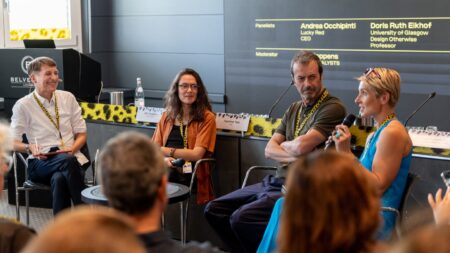






Film projects looking for funding or partners took the stage at day 2 of Locarno Pro, the industry strand of the Locarno Film Festival, whose 79th edition is running through Aug. 15, on Friday. The film showcase covered a wide range of topics and themes, including a feminist take on the Indian Kamasutra, a relationship story involving an android and the story of a man turning into a fish – yes, a fish!
In total, 11 projects selected for the annual Alliance 4 Development, the co-development platform for film projects from Austria, France, Germany, Italy, and Switzerland, were in the spotlight, with directors and producers presenting them.
Here is a look at takeaways from their pitches.
Cuoro Matte
directed by Tamer Ruggli, written by Ruggli and Joanne Giger
produced by Francine Lusser and G.rard Monier of Tipimages Production. Switzerland
Synopsis: “Bienne, 1969. Matteo, 17, dreams of becoming an actor and escaping his father and a grey industrial town. Sent to Ticino for the harvest, he discovers a vibrant, sensual world with Lucio and Alba, awakening desire and identity. At home, his mother Giusi, trapped in an oppressive marriage, begins her own quiet emancipation. Carried by Italian songs, their parallel journeys intertwine in a queer and feminist coming-of-age musical about freedom, love and reinvention.”
The Pitch: “Inspired by my father’s Ticino roots, Cuore Matto explores a son and his mother’s parallel emancipation in late-1960s Switzerland, shaped by social tensions and migration,” Ruggli says. “Between the industrial city of Bienne and the sensual South, the film draws on personal memory and historical reinterpretation. It blends melodrama and musical; songs give voice to what cannot be said, bridging past and present and revealing the characters’ inner desires.”
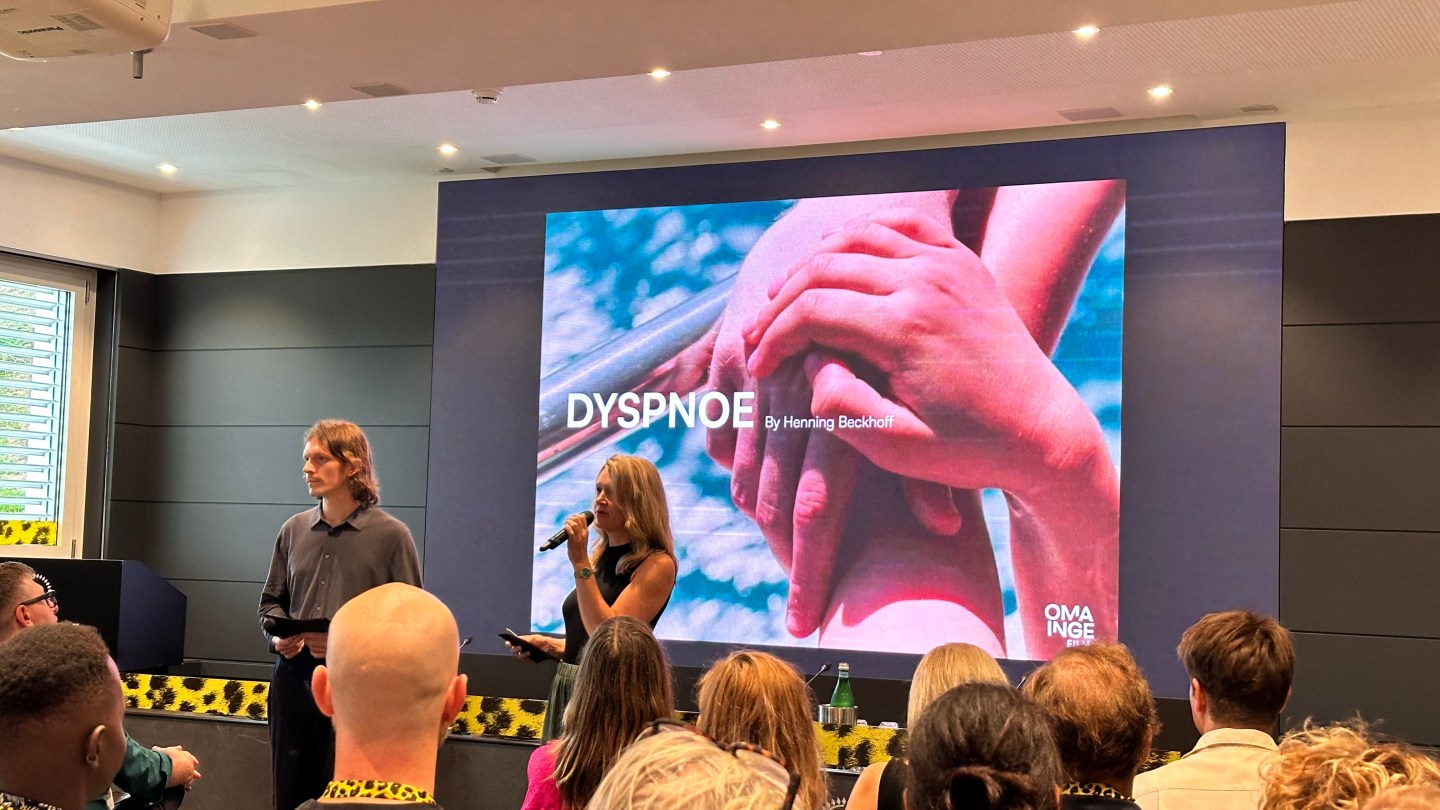
Dyspnoe
directed and written by Henning Beckhoff
produced by Frauke Kolbmüller of Oma Inge Film, Germany
Synopsis: “Burnt out and adrift, marine biologist Ludwig (46) takes his daughter Carlotta (11) to a parent-child clinic on an island. Between therapies, shifting loyalties and the unspoken truth of an impending separation, father and daughter are forced into a new closeness. As Ludwig’s body begins to change in unsettling ways, the cure becomes a journey through fear, loss and transformation.”
The Pitch: “I am drawn to moments when the body speaks before the mind,” notes Beckhoff. “Dyspnoe follows a man who tries to function while everything within him begins to collapse. His body resists, changes, escapes. The film stays close to a fragile father daughter relationship and observes how denial shapes intimacy. I aim for a physical, restrained cinema in which transformation emerges from reality, not as fantasy but as a necessity.
Humanoid
directed and written by Claudia Rorarius
produced by Claudia Rorarius of soQuiet Films, Germany
Synopsis: “After the death of her partner Adam (43), artist Elsa (48) deals with her grief by creating an android in his image. What begins as an art project turns into a journey of self-empowerment. More determined than ever, Elsa challenges patriarchal structures and creates space for her autonomous motherhood. Amidst technological futures, emotional conflicts, and old traumas, she finds a new beginning.”
The Pitch: “Humanoid is a deeply personal story about loss, love, and self-determined motherhood. Through Elsa’s journey, I want to explore intimacy and intensity, blending human emotions. My goal is to create a cinematic language that makes her grief, courage, and desire tangible, telling a universal story through a contemporary feminist lens rooted in both authenticity and imagination.”
Magnetic Storms (Les Orages Magnétiques)
directed and written by Wendy Pillonel
produced by Flavia Zanon of Close Up Films, Switzerland
Synopsis: “As she prepares to compete in crucial selections, Jo, a brash young rugby talent, finds herself without a phone, stranded with her mother in an Italian village where the ground is shaking. Angry and obsessed with returning to Switzerland, she secretly contacts her father, convinced he’ll help her. But his arrival upsets the fragile balance she believed she could control. Jo realizes she can no longer protect the silence surrounding her father’s behavior. As the ground and her world gradually crumble around her, she chooses to break free, not only from fear, but above all from complicity.?
The Pitch: “The film is inspired by the summers of my childhood in Friuli. Violence was part of it, though we didn’t have the words to name it — just a clinging sense of anxiety. And my anger. I didn’t want to become a woman; I wanted to be a boy, strong, fearless. Through Jo, a 13-yearold tomboy, the film explores the complexity of becoming a woman in a misogynistic environment: the contradictions, the silence, the feeling of a race toward the inevitable.”
Shooting Watermelons (Sparare alle Angurie)
directed by Antonio Donato, written by Donato and Paolo Carbone
produced by Santiago Fondevila Sancet of Cinedora, Italy
Synopsis: “During a difficult separation, an authoritarian father takes his two grown sons on a summer vacation without their mother for the first time. As they try to survive without her, the gap between them widens, especially when a wealthy foreign family arrives, stirring envy and rivalry. When a strong storm forces them to stay indoors, old wounds and hidden fears surface, revealing their struggle to connect and their quiet wish to stay together as a family.”
The Pitch: “The film sets out to peel back the layers of power that men are expected to display each day. I return to the summer world of my youth, a place fueled by rivalry, constant comparison, and the relentless pursuit of image. My own experiences become a mirror for a larger social pattern. This film is both a journey through my memory and an act of transformation, turning private scars into a universal narrative that questions, with irony and heart, old ideas of masculinity and patriarchy.”
Reign of Silures (Le Règne des Silures)
directed by Jessica Puppo, written by Puppo and Marine Flores-Ruimi
produced by Alexis Perrin of Rumble Fish Productions, France
Synopsis: “Maïa is a devoted concierge at a luxury thermal palace on the shores of Lake Geneva, where giant catfish – silures – are burned as scapegoats for a plague that cracks human skin like parched earth. When her teenage sister Léonie is placed in her care, the hotel seals itself off as a gilded fortress from the dying world beyond. As fissures begin to spread across her own body, Maïa must choose between the palace that gave her a place in the world and the sister who reminds her what it cost.”
The Pitch: “Maïa believes work will save her, even as illness cracks open her skin. She serves the wealthy while her own body dries out, trapped inside a hotel that promises dignity and escape. I want to film that body: the sweat, the cracks, the moment when holding on becomes more destructive than letting go. This is a film about a generation taught that work would protect them, while the world beneath them collapses.”
Stone Over Stone
directed and written by Hilal Baydarov
produced by Georg Tiller of Subobscura Films, Austria
Synopsis: “Arriving from their village, Shams and her husband settle into an unfinished construction site where he works to repay gambling debts – but as he is lured back into his addiction, pregnant Shams is left behind, drifting among the site’s outcasts: disillusioned students, a traumatized soldier, a woman trapped in abuse. As the fragile world around her collapses, she is forced into an unthinkable decision about the life she carries.”
The Pitch: “Stone Over Stone explores lives suspended between labour, debt and the lingering trauma of war. The unfinished tower becomes a space where economic violence and psychological scars take form. I am interested in bodies shaped by systems they cannot escape, and in moments where inner worlds begin to fracture. Shams – pregnant, isolated, yet unbroken – carries the weight of all this, and the fragile possibility of something new. The film seeks a language of stillness, tension and quiet eruption.”
Third Take
directed by Bruce LaBruce and written by Jérôme D’Estais, Pauline Baduel and LaBruce
produced by Olivier Zobrist (Langfilm, Switzerland)
Synopsis: “Set in a not-so-distant future, two iconic actresses, once madly in love, reunite in a drought-stricken villa, isolated from the world for a chaotic film shoot destined to become the epiphany of their decayed romance.”
The Pitch: “Third Take is a hyper-referential ‘meta-film’ exploring the essence of being an actress. It uses a dizzying ‘mise en abyme’ where television archives meet fiction. Set in a Mediterranean villa, this female melodrama blends classical glamour with raw realism. The idea is to synthesize cinematic obsessions and diverse visual formats to create an explosive work about human resilience and the profound strength of women.”
Wrecking Ball
directed and written by Clara Stern
produced by Michael Kitzberger of NGF Geyrhalterfilm, Austria
Synopsis: “What if hammering is the soundtrack of your life, and the water damage on the bedroom ceiling reminds you of your marriage? Breathlessly Eva, 41, runs up and down the dusty stairs in a bright yellow raincoat, exposing the real estate investor’s schemes, rallying her neighbors, fighting with her husband, wondering what went wrong. Eva is fueled by frantic hope, love and humor. And a deeply buried anger. A wrecking ball, spinning out of control, at risk of hurting who she wants to protect: her son.”
The Pitch: “A movie like a pressure cooker, combining two topics that make me angry: the real estate’s gambling with people’s homes paired with inequality in relationships. Eva’s struggle is that of women worn out between mental load, society’s expectations and their own dreams. But don’t expect a dark movie; I strive to find humor and absurdity in desperate situations. When dust drains colors out of Eva’s world, she brings in bright balloons and sings her son a lullaby to the rhythm of deafening drilling.”
Yazz
directed and written by Florian Hoffmann
produced by Katrin Renz of tellfilm, Switzerland
Synopsis: “As a teenager Yasmine –Yazz – grows up on a UN compound in the Central African Republic, caught between barbed wire, privilege and danger. A secret escape to see her local boyfriend Joseph ends in an accident that tears her family apart. Ten years later, her mother reappears in Switzerland – with Joseph by her side. Forced to face her first love and her own guilt, Yazz must ask whether old wounds can truly heal, or only scar.”
The Pitch: “I grew up between two worlds. As the child of documentary filmmakers, my youth unfolded inside UN compounds across several African countries. I was not alone: I met other children equally stranded in these strange non-places. Yazz draws directly from those lived experiences. The image of UN peacekeepers is familiar around the world, but what happens behind the fences is not. Growing up inside such injustice leaves you with a choice: fury or numbness. This film turns that fury into a force.”
Yumi
directed and written by Silvia Luzi, Luca Bellino
produced by Donatella Palermo, Italy
Synopsis: “Yumi is 13. She practices archery, steals wine and cosmetics from her parents, and searches for her place in the world. To protect her, her father monitors her through a parental control app, until that ordinary device turns into a private cinema: vertical, unsettling. When Yumi begins to feel watched, she reacts: she defies the lens and turns being thirteen into a ruthless performance, until an invisible threshold is crossed.”
The Pitch: “We wanted to tell of a time when looking has replaced seeing. We scroll through images, wars, bodies, lives, and believe exposure alone is enough to make them understandable. Gianni looks in the same way: his daughter’s life passes before him as something to be consumed, and for that reason it escapes him. The verticality comes from here. It is not only the phone’s format, but a form of gaze: narrow, partial, rapid, hypnotic. A contemporary keyhole. The deception lies in believing it is enough.”
Read the full article here