








With more Gen Zs entering the workforce in recent years, some might think they march to the beat of their own drum because they are young.
However, their tendencies might be the result of factors other than age.
Almost half (49 per cent) of Singaporean Gen Z workers are emotionally detached from work, according to a survey conducted by Kahoot! and Milleu in January.
It polled 265 Gen Z office workers in Singapore, aged 18 to 28, who graduated from university and have been in a corporate environment between 12 and 36 months, to understand their workplace experiences.
20 per cent of survey respondents reported feeling disengaged at work, while 29 per cent said they were neither engaged nor disengaged.
These results show that Singapore’s young professionals have an inconsistent and vulnerable emotional commitment to their workplaces, said Kahoot! in a media release on Monday (March 23).
The online quiz platform’s survey also found that employees who feel supported in their development and valued for their work feel a stronger sense of belonging in the workplace.
A significant proportion of respondents said they seek supportive team relationships (56 per cent), learning and growth opportunities (48 per cent) as well as recognition for contributions (45 per cent) in the workplace to better integrate into the new environment.
Leadership behaviour also plays a significant role in helping Gen Z employees feel like they belong in the workplace.
Respondents felt that transparent communication from leadership (41 per cent) and being included in decision making (35 per cent) are important aspects.
This suggests that belonging extends beyond team-level dynamics and takes into account organisational trust and having one’s voice heard, Kahoot! noted.
Meanwhile, social activities or events (32 per cent) and opportunities to share perspectives (28 per cent) were also selected by a notable proportion of respondents.
This points to the value of inclusive participation in the workplace.
When it comes to job satisfaction amongst survey respondents, salary and benefits were the top contributors (43 per cent).
However, these young professionals considered a healthy work-life balance to be nearly just as important (41 per cent).
Kahoot! said this shows how highly Gen Z values positive and sustainable working conditions in addition to financial compensation for their work.
Training methods have to adapt
When it comes to training, respondents strongly wish for more structured and in-depth onboarding (45 per cent), clearer expectations and assessment criteria (44 per cent) as well as greater access to mentors, coaches, or peer trainers (40 per cent).
The Gen Z employees polled by Kahoot! said they face a “boredom barrier” during training, which is often considered passive, boring, or time-consuming.
They highlighted the need for more engaging and motivating content (37 per cent), greater real-life application and interactivity (31 per cent), as well as more time to complete training effectively (29 per cent).
Respondents also felt that their workplaces could improve in terms of clearer learning pathways (27 per cent) and role-specific relevance (27 per cent).

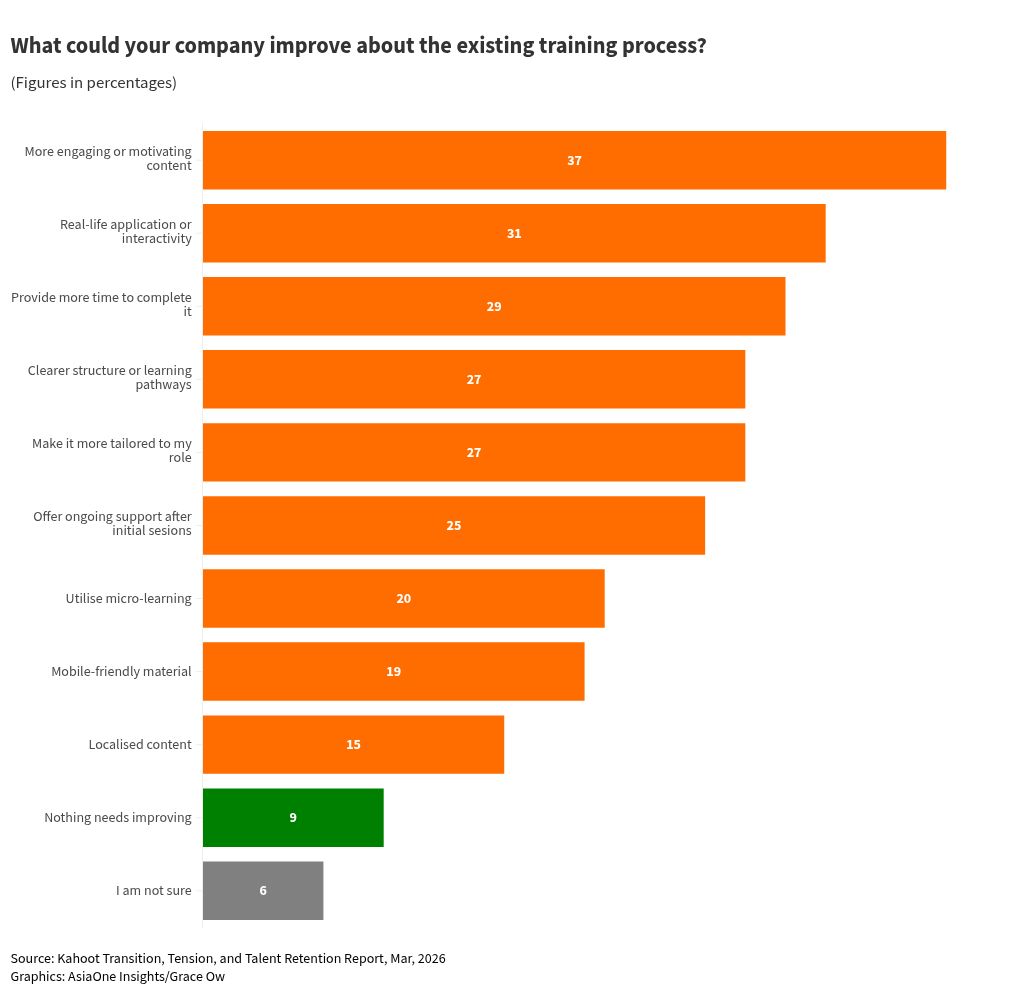
Moreover, the survey shows that Gen Z workers do not necessarily reject gamification in training sessions, but turn off when it is poorly executed.
47 per cent of respondents expressed that they would engage with learning content presented as a game, challenge, or friendly competition.
But enthusiasm drops sharply when gamification feels forced, childish, or disconnected from real work.
Addressing the survey findings, growth director for Kahoot! in Asia, the Middle East and North Africa Ahteram Uddin said that organisations which redesign workplace learning with intention will earn long-term commitment from the next generation of talent.
“Gen Z employees are asking for what they know works: clearer expectations, structured onboarding, ongoing coaching, and learning experiences that are engaging, interactive, and connected to real work,” he said.
“As Singapore stands as a major global hub for various industries, equipping Gen Z for workplace success is critical to maintain this position for both local and global organisations.”
[[nid:729398]]
bhavya.rawat@asiaone.com
Read the full article here